
A routine payment question should not take three follow-ups, a handoff, and another delay to resolve. Yet that is exactly where many finance teams still lose time. That is why the finance AI chatbot is moving from experiment to real buying priority. In April 2026, the Federal Reserve reported that about 18% of U.S. firms had adopted AI by the end of 2025, with financial sectors standing out in adoption.
This guide shows where these tools actually work, where they fall short, and how to tell the difference between a chatbot that sounds smart and one that can handle real finance workflows.
Executive Summary 2026: Finance AI chatbots work best when they handle structured, high-volume tasks such as account servicing, onboarding follow-ups, collections, and internal request handling. The real difference lies in workflow depth, escalation design, integration readiness, and whether the platform can move work forward safely instead of simply answering questions.
Key Takeaways
- A finance AI chatbot delivers value when it drives defined service and operations workflows rather than isolated Q&A.
- Strong deployments rely on NLU to detect intent and advance workflows like onboarding, collections, or claims.
- ASR ensures voice interactions are accurately transcribed for reliable routing and task progression.
- Orchestration coordinated action across systems and workflow steps, setting agents apart from simple chatbots.
- The right platform demonstrates workflow fit, escalation control, channel continuity, and integration readiness under real operating pressure.
What Is a Finance AI Chatbot?
A finance AI chatbot is a conversational system that uses machine learning, natural language processing, and artificial intelligence to answer financial questions, complete defined workflow steps, and support decisions across digital channels. In 2026, stronger systems combine conversational understanding with financial context, structured automation, and governed escalation for sensitive tasks.
Adoption is rising because finance chatbots now match how Americans use artificial intelligence in daily life, at work, and in financial operations.
- Mainstream Consumer Adoption: Nearly 40% of working-age Americans were already using generative artificial intelligence by late 2024, making chatbot-led financial interactions feel familiar.
- Workplace Usage Growth: About 41% of the workforce reported work-related generative artificial intelligence use by November 2025, raising expectations for similar assistance in finance workflows.
- Financial Sector Momentum: Federal Reserve analysis says financial sectors stand out in business adoption, showing that finance firms are moving from experimentation to operational deployment.
- Fraud Detection Value: The U.S. Treasury said artificial-intelligence-enhanced fraud detection helped prevent and recover more than $4 billion in fiscal year 2024.
- Routine Workload Relief: Finance chatbots are gaining traction because they absorb routine service volume, letting human teams focus on exceptions, approvals, and higher-risk customer cases.
Finance AI chatbots are gaining traction because they now combine mainstream artificial intelligence behavior, finance-sector adoption, and measurable operational value in one deployable system.
If you want more concrete banking-side workflow examples after this section, read Top 8 Use Cases of AI in Retail Banking That Drive Real Impact
Finance AI Chatbot Use Cases for Teams and Financial Services
Finance AI chatbots create the most value when they are deployed inside workflows that are repetitive, time-sensitive, and easy to govern. In practice, that includes customer servicing, finance operations, risk-sensitive checks, and structured case handling where speed matters but human oversight still needs to stay intact.
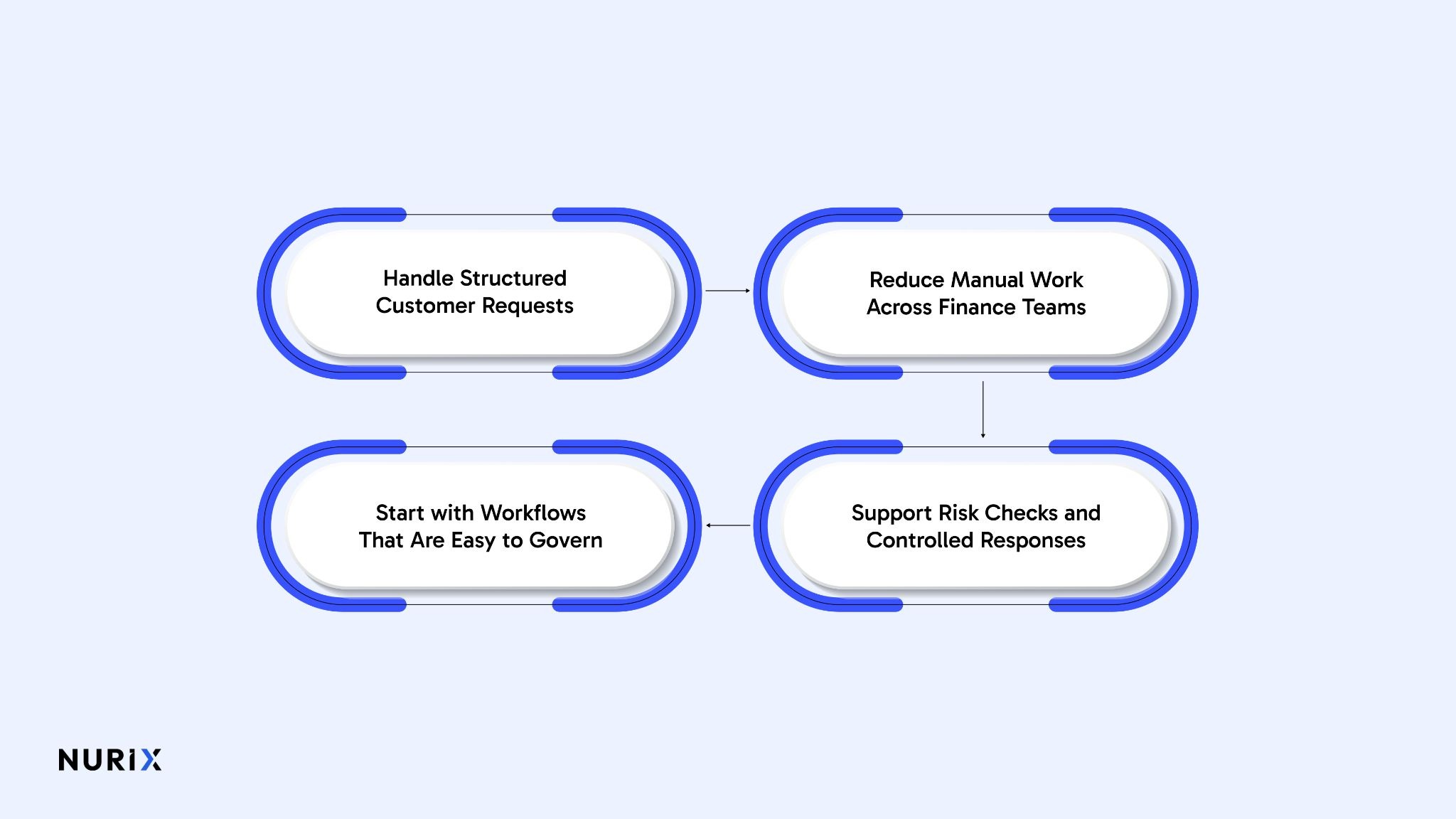
The strongest deployments usually fall into customer servicing, internal execution, risk-sensitive controls, and rollout priorities.
1. Handle Structured Customer Requests
This bucket works best for high-volume interactions where the request type is clear, the workflow is repeatable, and the response can be validated before completion.
- Resolve Account-Service Requests: Handle balance checks, payment confirmations, and card-blocking flows, such as when a customer reports a lost card after business hours.
- Move Loan Applications Forward: Collect documents, verify missing fields, and trigger next steps, such as flagging an expired ID before underwriting review.
- Support Claims Intake: Capture structured claim details and validate required inputs, such as identifying a missing incident date, before human review.
2. Reduce Manual Work Across Finance Teams
These use cases help teams spend less time on repetitive processing and more time on exceptions, approvals, and judgment-heavy work.
- Deflect Routine Support Tickets: Close repetitive account and transaction queries automatically, such as answering a payment-posting question without analyst involvement.
- Shorten Document Review Cycles: Pull key data from long records and summarize it, such as extracting fee terms from a lending document for faster review.
- Surface the Next Best Step: Recommend the next workflow action in real time, such as prompting a collections agent to offer a payment-plan option.
3. Support Risk Checks and Controlled Responses
This is where chatbots help teams move faster without removing the controls needed in regulated financial environments.
- Detect Suspicious Interaction Patterns: Monitor device and behavior signals, such as unusual typing speed during a password-reset attempt.
- Validate Numeric Responses: Check figures against source documents before sending them, such as confirming a payoff amount against current account data.
- Preserve Reviewable Evidence: Record how the system reached an output, such as storing the source fields used in a fraud-alert response.
4. Start with Workflows That Are Easy to Govern
The fastest path to value usually comes from narrow workflows with clear rules, high volume, and visible operational friction.
- Prioritize Repetitive Requests: Start with structured tasks, such as fraud alerts, payment-status checks, or account-update requests.
- Map Escalation Paths Early: Define where human review takes over, such as routing a disputed charge with incomplete evidence to a live specialist.
- Expand After Workflow Proof: Broaden deployment only after early tasks show stable accuracy, such as moving from card-support flows into lending support.
Finance AI chatbots work best when they are placed inside narrow, high-friction workflows first, then expanded as teams build trust, control, and measurable results.
If you are comparing vendors, look at how quickly the system handles live call flows, connects to your stack, and produces usable outputs without extra manual cleanup. NuPlay by Nurix AI supports enterprise voice and chat workflows with low-latency performance and broad integration coverage. Schedule a demo.
Risks, Limits, and When Human Escalation Is Needed
Finance AI chatbots work well in structured, low-risk workflows, but they still break under ambiguous inputs, adversarial prompts, deepfake fraud, and high-stakes decision contexts. In financial services, those failures are not minor product issues. They can trigger compliance breaches, customer harm, audit gaps, and escalation failures.
The clearest way to govern deployment is to define where automation stops and human accountability starts.
Strong finance deployments treat AI as an execution layer for bounded tasks, while humans retain authority over judgment, exceptions, verification, and risk-threshold decisions.
If you want a clearer view of where automation should stop, and human judgment should take over, watch The Complete Guide to Human-in-the-Loop for Enterprise AI
How to Evaluate a Finance AI Chatbot
The right platform should be judged by how well it performs inside live finance workflows, not by how polished it looks in a demo. It should reduce operational friction, support task completion, fit your existing setup, and stay dependable when conversations become sensitive, regulated, or more complex than a standard support exchange.
A stronger evaluation checks whether the platform can perform, adapt, and scale inside day-to-day finance operations.
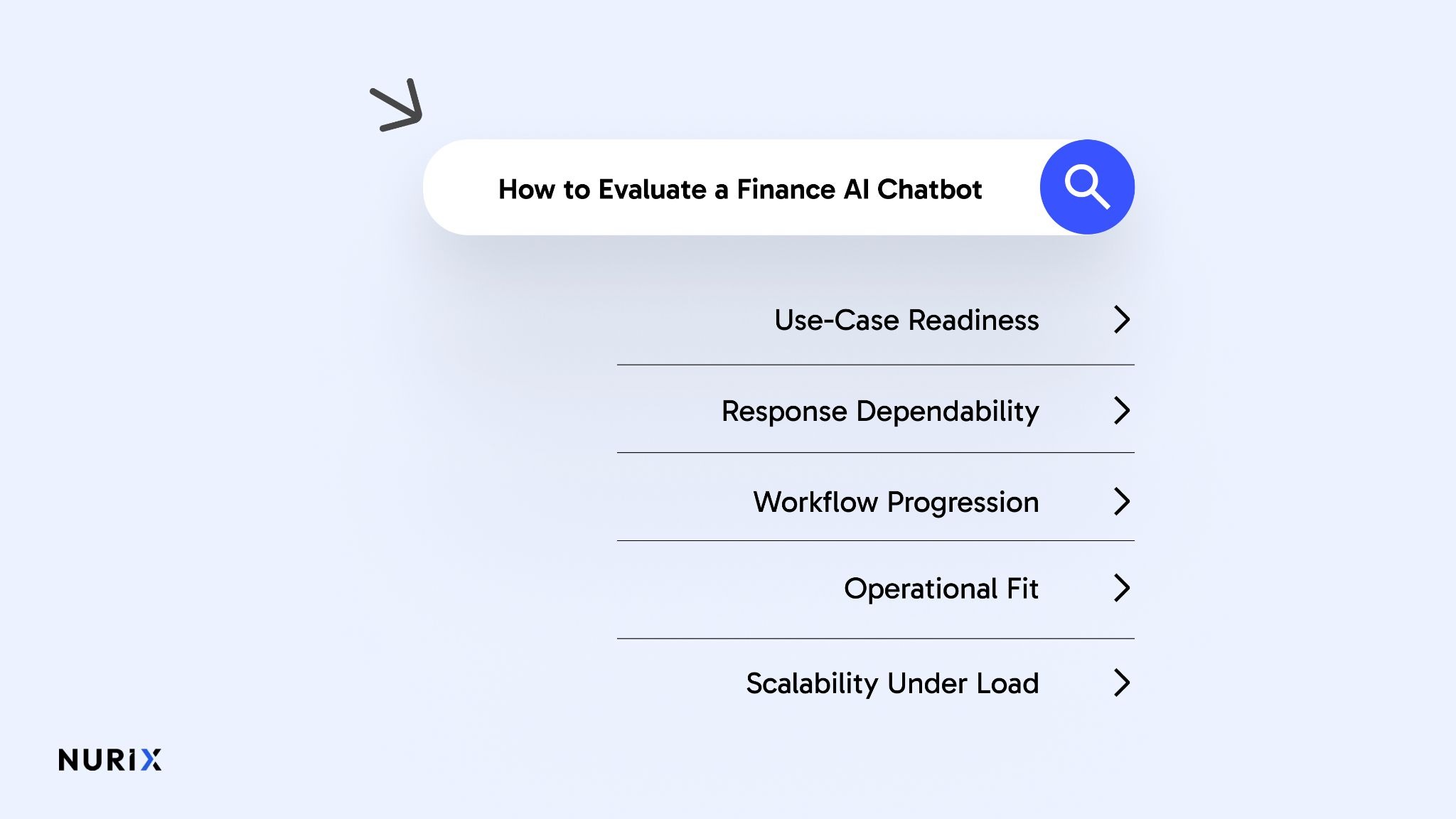
- Use-Case Readiness: Check whether it can handle target workflows like servicing, onboarding, collections, or internal request handling without heavy manual cleanup.
- Response Dependability: Review whether answers stay specific, complete, and usable across real finance scenarios, not just simple prompts during a guided demo.
- Workflow Progression: Assess whether it can move tasks forward by collecting inputs, triggering next steps, and reducing stalled conversations.
- Operational Fit: Confirm that it works within your existing channels, teams, and process flow instead of creating a separate layer staff must manage.
- Scalability Under Load: Test whether performance stays stable when interaction volume rises, especially in high-traffic or time-sensitive environments.
The strongest option is one that improves workflow movement, lowers operational drag, and continues performing reliably as usage grows.
If you are assessing implementation readiness, validate the platform on real calls, workflow fit, transcript accuracy, and response speed. NuPlay by Nurix AI is an enterprise AI voice and chat platform with low latency and 400+ integrations. Get in touch with us!
AI Chatbots vs AI Agents in Finance
AI chatbots are built for narrow finance interactions such as answering questions, collecting basic inputs, or routing requests. AI agents are better suited to workflows that require multi-step execution, context retention, and action across systems, such as moving a loan, claim, or dispute case from one stage to the next.
The distinction is easiest to see when both are compared against live finance workflow requirements.
The choice depends on whether you need faster answers for simple requests or controlled execution across longer, more operationally complex finance workflows.
If the difference still feels more operational than technical, this will sharpen the picture through Your AI Agent Isn’t Broken—Your Workflow Is
Top Finance AI Chatbot Platforms to Explore in 2026
The strongest finance platforms in 2026 stand out in measurable automation, deployment speed, integration depth, and compliance readiness. The most useful shortlist should reflect production signals from service pages, especially when comparing support, lending, collections, or finance operations use cases across regulated and workflow-heavy environments.
The comparison below focuses on product fit, quantifiable signals, integrations, and governance strength.
- NuPlay: An enterprise-grade voice and chat AI platform for support, sales, and workflow automation with orchestration, observability, audit logs, personally identifiable information redaction, 400+ integrations, 80% automation coverage, and 65% cost savings.
- Boost AI: Banking-focused platform with 90%+ inquiry resolution, 50%+ automation across channels, 80+ live AI agents, and seamless human handoff.
- Kore AI: A finance workflow platform that shortens monthly close by 3 to 5 days and supports SAP Ariba, Coupa, and NetSuite-linked processes.
- Rezo AI: Banking platform with omnichannel support, intelligent routing, automated user verification, and compliance-oriented identity workflows.
- Ema: FinOps platform with enterprise resource planning, customer relationship management, billing, procurement, and ticketing integrations, System and Organization Controls 2 compliance, and first active workflows launched in weeks.
The best fit depends on whether you need stronger banking containment, finance-operations acceleration, or voice-led workflow execution with deeper integration and governance controls.
If you want a narrower shortlist focused on agent-led finance workflows, read Top 5 AI Agents for Finance You Shouldn’t Ignore
How NuPlay By Nurix AI Helps Finance Teams Automate High-Volume Conversations
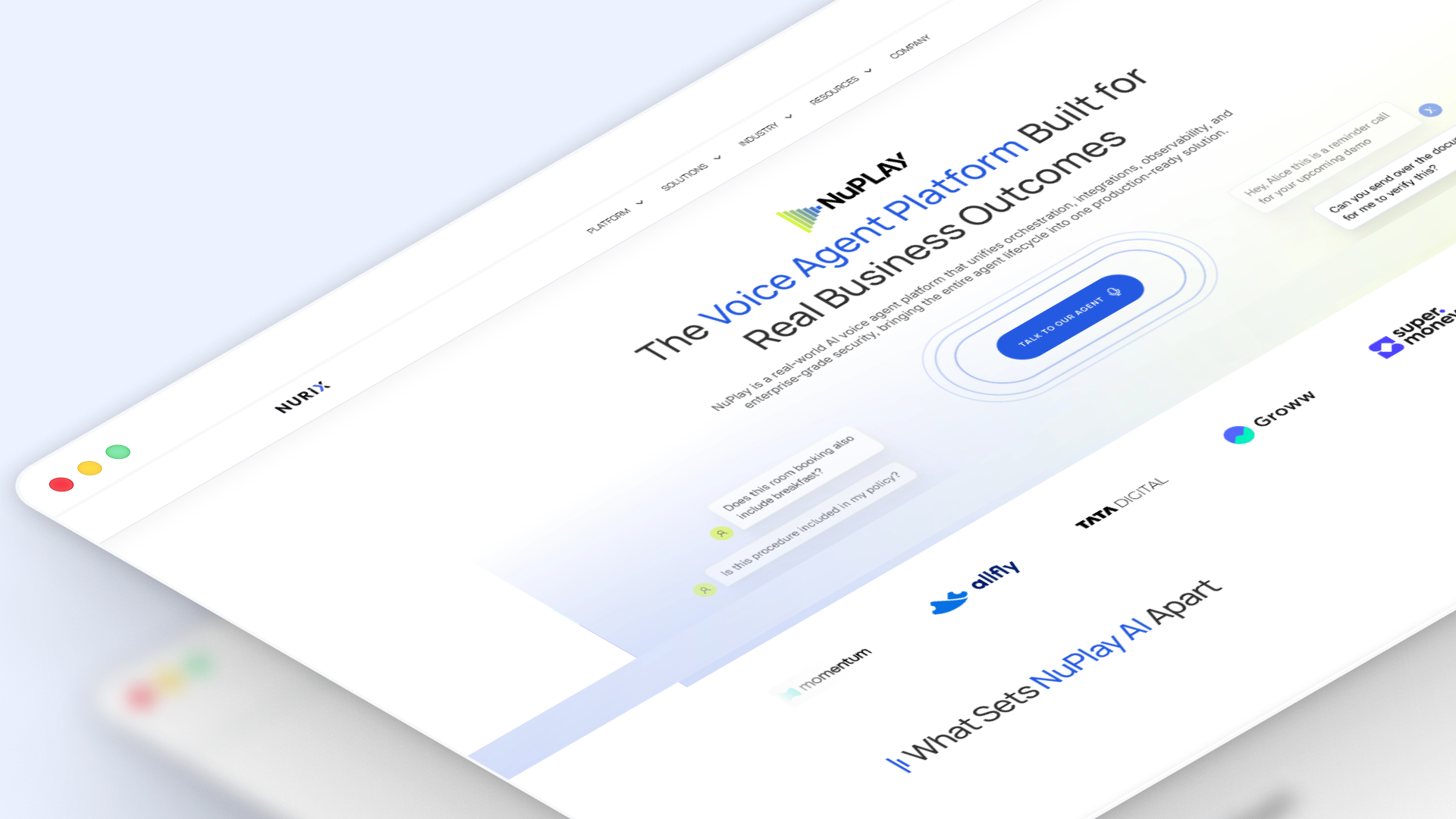
NuPlay by Nurix AI helps finance teams automate high-volume conversations by combining voice and chat agents with orchestration, integrations, monitoring, and compliance controls in one platform. Instead of adding a front-end bot to existing queues, it is built to move lending, servicing, collections, and support workflows forward with measurable automation and governed handoffs.
The product fit becomes clearer when you look at how each layer supports finance operations at scale.
- Workflow Execution: NuPlay supports lead qualification, payment recovery, support resolution, and upsell flows across financial services journeys.
- Production-Scale Outcomes: The platform cites about 800,000 conversations per month, 80% automation coverage, 65% cost savings, and a 50% efficiency boost.
- System Integration: NuPlay by Nurix AI integrates with customer relationship management systems, loan-origination platforms, core banking tools, Twilio, Salesforce, Zoho, FIS, Fiserv, Temenos, and custom application programming interfaces.
- Monitoring and Insight: NuPulse tracks response time, containment, resolution rate, intent accuracy, escalation frequency, transcripts, and conversation-level analytics.
- Governance and Security: NuPlay includes personally identifiable information redaction, role-based access control, single sign-on, audit logs, retention policies, and regional data residency options.
NuPlay by Nurix AI stands out when finance teams need one governed system that can execute conversations, connect to core tools, surface performance signals, and escalate safely.
Wrapping Up!
The real decision is not whether finance conversations can be automated. It is whether the platform can handle volume, connect with the systems your team already uses, and move requests forward without adding more manual review.
The right finance AI chatbot should help your team resolve routine service faster, support lending and collections workflows more smoothly, and keep escalation clear when a person needs to step in. NuPlay by Nurix AI fits that need well for teams managing high-volume finance interactions across channels.
If you are comparing platforms, schedule a demo and test it on a live workflow. Schedule a demo!
Author: Sakshi Batavia, Marketing Manager
Sakshi Batavia is a marketing manager focused on AI and automation. She writes about conversational AI, voice agents, and enterprise technologies that help businesses improve customer engagement and operational efficiency.