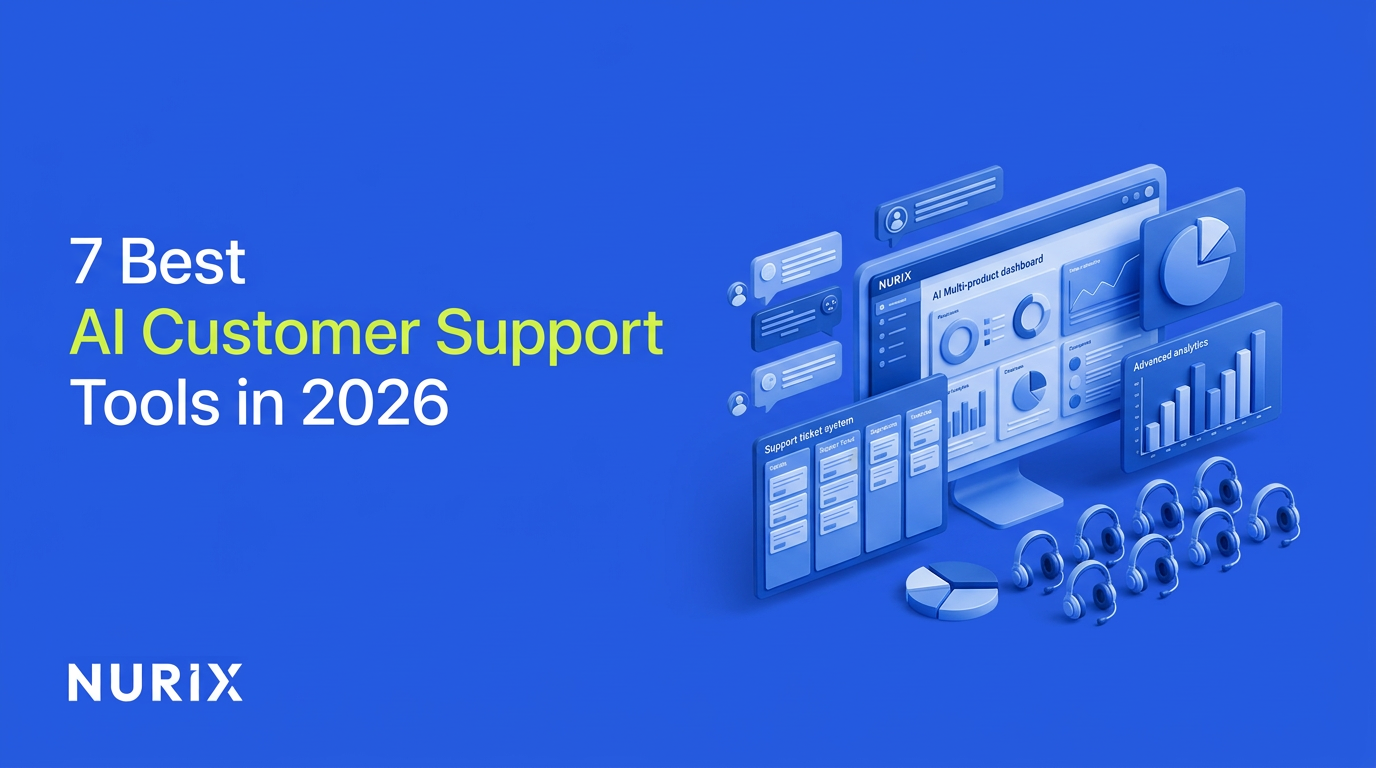

Customer support teams are facing a paradox: customer expectations have never been higher, but the economics of scaling human teams have never been harder. The solution isn't hiring more agents—it's deploying AI that handles the volume while your team focuses on the conversations that actually need a human touch.
The AI customer support market in 2026 is mature enough to deliver real results. Companies are seeing 50-90% cost reductions, 80%+ automation rates, and measurable improvements in customer satisfaction. But the market is also crowded—dozens of tools claim to be "the best," making it hard to match your specific needs to the right platform.
We evaluated 25+ tools and narrowed it down to 7 that serve distinct use cases. This list includes enterprise helpdesk platforms (Zendesk, Freshdesk), specialized AI agents (Intercom, Ada), voice-first AI (Nurix), ecommerce support (Gorgias), and SMB-friendly options (Tidio). Whether you're a 5-person startup or a 5,000-seat enterprise, one of these fits your situation.
What Are AI Customer Support Tools?
AI customer support tools are software platforms that use artificial intelligence to handle customer inquiries automatically across chat, email, voice, and social channels. They go far beyond the basic chatbots of a few years ago—modern AI agents understand context, remember previous conversations, detect sentiment, and take actions in connected systems.
Here's how the 2026 landscape breaks down:
Enterprise helpdesk platforms with AI: Tools like Zendesk and Freshdesk provide the full support infrastructure—ticketing, routing, knowledge base, workforce management—with AI capabilities layered on top. Best for organizations that need a complete support system, not just an AI add-on.
Specialized AI agents: Tools like Intercom Fin and Ada focus specifically on deploying autonomous AI that resolves customer issues end-to-end. They integrate with your existing helpdesk rather than replacing it. Best for organizations that want to add conversational AI to an already-working support stack.
Voice-first AI: Tools like Nurix specialize in phone-based support automation with ultra-low latency voice agents that sound human. Best for contact centers and businesses where most customer interactions happen over the phone.
Ecommerce-specific support: Tools like Gorgias and Tidio are built for online stores with native integrations into Shopify, WooCommerce, and other ecommerce platforms. They combine support automation with sales features like product recommendations and dynamic discounts.
The technology has matured significantly. Natural language processing handles complex multi-turn conversations. Integration with CRM, ERP, and order management systems means AI agents can actually resolve issues—processing returns, updating accounts, scheduling callbacks—not just answer FAQs.
For businesses, the key question is matching platform type to primary use case. Phone-heavy operations need different tools than chat-first SaaS companies or Shopify stores.
Research & Evidence
The data behind AI customer support is strong, with documented results across industries and use cases.
Zendesk's 2026 research shows AI agents now automate over 80% of customer interactions, with companies achieving 20% productivity gains for human agents who focus on complex cases. A Forrester Total Economic Impact study found organizations using AI-powered support platforms achieved 301% ROI over three years.
On the voice AI side, Cult.fit achieved a 90% reduction in turnaround time and 80% reduction in frontline support load after deploying voice AI agents, while maintaining 95% issue resolution rate. Aditya Birla Capital reported a 10% increase in conversion rates using AI agents that engage prospects 24/7 with sub-800ms response times.
Intercom's benchmark data reveals their Fin AI Agent resolves up to 65% of complex queries end-to-end—significantly outperforming competitors in head-to-head comparisons. Lightspeed uses Fin for 99% of conversations with 65% end-to-end resolution of complex fintech queries.
For ecommerce, Gorgias reports their AI Agent automates 60% of repetitive inquiries while driving 2.5x conversion increases through personalized product recommendations. Tidio case studies show 67-89% AI resolution rates, with Tailfin achieving 71% resolution and saving 400 hours in 30 days.
These aren't pilot programs—they're production deployments with quantified ROI across enterprise, mid-market, and SMB segments.
1. Zendesk: Best for Omnichannel Automation at Scale
Zendesk's 2026 platform combines agentic AI agents with Agent Copilot to automate over 80% of interactions while boosting human agent productivity by 20%. The Resolution Learning Loop continuously improves AI performance with every resolved conversation—no manual retraining required.
What sets Zendesk apart is the agentic approach. These aren't simple chatbots following scripts. The AI agents adapt to complex scenarios, learn from every resolution, and improve continuously. When customers reach out via email, chat, voice, or social media, the same AI context follows them across channels.
The numbers back it up. Companies report 92% decrease in email handling time and 66% one-touch resolution rates. With 100,000+ businesses using the platform and a Forrester-validated 301% ROI, Zendesk proves enterprise-grade reliability. Pricing starts at $55/agent/month for Suite Team, $89/agent/month for Suite Growth, and $115/agent/month for Suite Professional, with the Copilot add-on at $50/agent/month.
Pros: - Automates 80%+ of interactions with continuously learning agentic AI - Agent Copilot provides contextual insights for 20% agent productivity boost - Omnichannel support across email, chat, voice, and social - Thousands of prebuilt integrations via Zendesk Marketplace - Proven 301% ROI with 92% reduction in email handling time
Cons: - Pricing adds up quickly for larger teams ($115+ per agent/month with Copilot) - Feature complexity requires training for full utilization - Advanced AI features locked to higher tiers
Best For: Mid-sized to enterprise businesses with 50+ agents managing high-volume, multichannel support in retail, finance, IT, and SaaS industries.
2. Intercom: Best for Complex Query Resolution
Intercom's Fin AI Agent outperforms every competitor in resolving complex customer service queries, powered by a patented AI Engine that refines questions, retrieves precise information, reranks results, generates responses, and validates accuracy. Built for fintech and SaaS companies handling intricate support scenarios—not just simple FAQs.
What makes Fin different is the Fin Flywheel—a continuous improvement loop that trains on your procedures, tests simulations, deploys across channels, and analyzes insights for optimization. Companies like Lightspeed see Fin involved in 99% of conversations, resolving up to 65% end-to-end. CleanCloud maintains 92.3% CX scores on nearly 10,000 inquiries.
The pricing model aligns with business outcomes: $0.99 per resolution—you only pay when Fin successfully resolves an issue. Intercom backs this with a Million Dollar Guarantee. Setup takes under an hour with seamless integration into Zendesk, Salesforce, HubSpot, Jira, and 450+ apps. The Copilot feature helps human agents close 31% more conversations daily.
Pros: - 65% end-to-end resolution rate for complex queries (industry-leading) - Patented AI Engine outperforms competitors in benchmarks - Resolution-based pricing ($0.99/resolution) aligns costs with outcomes - Setup in under an hour with 450+ app integrations - Continuous improvement via Fin Flywheel learning system
Cons: - Per-resolution pricing can add up for very high volumes - Voice pricing requires custom quote—core strength is chat and email - Requires quality knowledge base for optimal performance
Best For: Mid-sized SaaS and fintech companies with 50-500 daily support tickets involving complex, multi-step resolutions across global teams.
3. Freshdesk: Best for Growing Support Teams
Freshdesk offers one of the most accessible entry points for AI-powered customer support, with a free tier for up to 2 agents and paid plans starting at just $15/agent/month. The Freddy AI suite—spanning self-service agents, agent copilot, and analytics insights—brings enterprise-grade AI to teams that don't have enterprise budgets.
What makes Freshdesk compelling for growing teams is the balance of capability and simplicity. Freddy AI Agent handles customer-facing automation—processing refunds, updating orders, verifying details—while Freddy Copilot assists human agents with suggested replies, conversation summaries, real-time translation, and sentiment analysis. The platform deploys quickly with minimal configuration, making it practical for teams scaling from 5 to 500 agents.
Over 60,000 companies use Freshdesk, including iPostal1 (which cut customer interaction time by 99%) and Gail's Bakery (where Freddy AI Agent handles \~1,000 inquiries per month). The Freshworks marketplace offers 1,000+ integrations covering Salesforce, HubSpot, Shopify, Slack, Jira, and more. G2 rating: 4.4/5.
Pros: - Most affordable AI support platform: free tier + $15/agent/month Growth plan - Freddy AI Copilot provides real-time suggestions, summaries, and sentiment analysis - 1,000+ marketplace integrations including major CRMs and ecommerce platforms - Quick setup with minimal learning curve - 60,000+ companies including mid-market and enterprise
Cons: - Freddy AI Agent sessions are usage-based ($100/1,000 sessions)---can be unpredictable - Advanced AI features locked to Pro ($49) and Enterprise ($79) tiers - Omnichannel experience still feels fragmented across Freshworks products
Best For: Growing support teams (5-200 agents) in SaaS, IT services, and professional services needing reliable helpdesk automation without enterprise pricing.
4. Ada: Best for Resolution-Based Pricing
Ada stands out with resolution-based pricing and omnichannel AI agents that autonomously resolve up to 83% of support queries across chat, voice, email, SMS, and social. Built for enterprises managing 5,000+ monthly interactions—designed to scale personalized support without exponentially increasing costs.
The pricing advantage is clear: instead of paying per conversation or per seat, you pay for actual resolutions. This aligns costs with value and makes high-volume support more affordable. The platform's generative AI personalizes responses based on customer context, while the no-code builder lets you customize workflows without developer resources.
With 350+ businesses using Ada and recognition as a G2 Grid Leader for AI customer service, the platform proves reliability at scale. Integration with Salesforce, Zendesk, Shopify, Intercom, and Slack means it fits into existing tech stacks. The platform supports omnichannel deployment across all major customer channels with consistent quality.
Pros: - Resolution-based pricing aligns costs with actual value delivered - 83% autonomous resolution rate across all channels - Omnichannel support: chat, voice, email, SMS, and social - No-code builder for custom workflows without engineering - G2 Grid Leader with 350+ enterprise customers
Cons: - Pricing details require sales contact—no public price list - Resolution-based model requires volume to show ROI - Best suited for high-volume operations (5,000+ monthly interactions)
Best For: Large SaaS companies, ecommerce platforms, and enterprises with 100K+ annual support tickets needing cost-efficient omnichannel automation with outcome-aligned pricing.
5. Nurix: Best for High-Volume Voice Support
Nurix solves the high-volume call problem with enterprise-grade voice AI that delivers sub-800ms response times—the lowest latency in the market. When phone conversations flow without perceptible delay, the AI experience becomes indistinguishable from speaking with a human agent.
Unlike text-first tools that bolt on voice as an afterthought, Nurix is built from the ground up for natural phone conversations with interruption tolerance and brand-aligned personality. NuPlay (formerly Nurix AI) is an enterprise AI platform for deploying conversational voice and chat agents at scale. The NuPlay platform creates custom voice agents that match your brand identity, while NuPulse analytics tracks 100% of conversations with real-time insights.
Documented enterprise results back this up. Cult.fit reduced frontline support load by 80% and turnaround time by 90% while maintaining 95% issue resolution. Aditya Birla Capital increased conversions by 10% without adding headcount. The platform connects to 300+ enterprise systems (CRM, ERP, contact centers), so it doesn't just answer questions—it takes actions like processing returns, updating accounts, or scheduling callbacks.
Pros: - Sub-800ms response time for natural-sounding voice conversations - 300+ integrations including CRM, ERP, and contact center platforms - NuPulse analytics provides real-time visibility into every interaction - SOC 2 and GDPR compliant with enterprise security - Documented results: 90% TAT reduction, 80% support load reduction
Cons: - Enterprise-focused pricing (custom quotes required) - Best suited for high-volume operations (1,000+ daily calls) - Requires integration planning for complex deployments
Best For: Mid-to-large enterprises in retail, insurance, financial services, and health & fitness handling 1,000+ daily customer calls needing 24/7 multilingual voice support.
6. Gorgias: Best for Shopify Ecommerce Support
Gorgias dominates ecommerce support with native Shopify integration, AI Agent automation of 60% of inquiries, and unique sales features like product recommendations and dynamic discounts during support conversations. Built specifically for DTC brands—designed to blend support efficiency with revenue generation.
What makes Gorgias different is the ecommerce focus. The AI doesn't just answer questions about orders—it can edit Shopify orders directly, recommend complementary products, and offer personalized discounts to convert browsers into buyers. This dual support-and-sales approach drives 2.5x conversion increases while reducing bounce rates by 37%.
Trusted by 15,000+ brands with 4.6/5 on G2, Gorgias proves ecommerce expertise. Pricing starts at $10/month (50 tickets) for Starter, $50/month (300 tickets) for Basic, $300/month (2,000 tickets) for Pro, and $750/month (5,000 tickets) for Advanced. AI Agent costs $0.90-1.00 per automated resolution. Integrates with Klaviyo, Recharge, Loop Returns, and 100+ ecommerce tools.
Pros: - Native Shopify order editing and real-time data access - AI-powered sales upsells drive 2.5x conversion increases - Omnichannel: email, chat, Facebook, Instagram, WhatsApp, SMS, voice - 100+ ecommerce integrations (Klaviyo, Recharge, Loop Returns) - 15,000+ brands with 4.6/5 G2 rating
Cons: - Primarily Shopify-focused—less ideal for non-Shopify platforms - Per-resolution AI costs add to monthly subscription - Ticket overages charged at $0.36-0.40 each
Best For: Shopify-based DTC ecommerce brands managing 300-5,000 monthly support tickets with high volumes of repetitive inquiries and cross-sell opportunities.
7. Tidio: Best for SMBs and Startups
Tidio brings AI customer support to small and growing businesses with its Lyro AI agent—powered by Claude (Anthropic)---that averages 67% automation rate at a fraction of enterprise pricing. With 300,000+ active users and same-day deployment, it's the fastest path from zero to AI-powered support.
What makes Tidio unique for smaller teams is the conversation-based pricing model. Instead of per-agent fees, you pay for AI conversations—starting at $39/month for 100 Lyro conversations. This means a 3-person support team pays the same as a 10-person team, making it dramatically more affordable than per-seat models for small businesses.
Case studies show strong results even for small operations. Tailfin achieved 71% resolution rate and saved 400 hours in 30 days. Your KAYA automates 75% of inquiries. ADT Security boosted conversions from 44% to 61%. The platform integrates natively with Shopify, WooCommerce, WordPress, BigCommerce, and connects to HubSpot, Salesforce, and Mailchimp. G2 rating: 4.7/5 from 1,400+ reviews.
Pros: - Conversation-based pricing is dramatically cheaper for small teams - 67-89% AI resolution rates documented across case studies - Same-day deployment with minimal configuration - Native integrations with Shopify, WooCommerce, WordPress, BigCommerce - 4.7/5 G2 rating from 1,400+ reviews
Cons: - Usage-based costs can spike during high-traffic periods - Limited advanced customization compared to enterprise platforms - Many integrations require Zapier (adds cost and complexity)
Best For: Small to medium ecommerce businesses and startups with limited budgets needing fast, effective AI support automation—especially those on Shopify or WordPress.
Comparison Table: AI Customer Support Tools at a Glance
| Tool | Best For | Type | Starting Price | Key Strength | Resolution Rate |
|---|---|---|---|---|---|
| Zendesk | Omnichannel automation at scale | Enterprise Helpdesk | $55/agent/month | Agentic AI with continuous learning, 301% ROI | 80%+ automated |
| Intercom | Complex query resolution | AI Agent | $0.99/resolution | Patented AI Engine, Million $ Guarantee | 65% end-to-end |
| Freshdesk | Growing support teams | Helpdesk | Free / $15/agent/month | Freddy AI suite at affordable pricing | Varies by tier |
| Ada | Resolution-based pricing | AI Agent | Custom (resolution-based) | 83% resolution across all channels | 83% autonomous |
| Nurix | High-volume voice support | Voice AI | Custom enterprise | Sub-800ms latency, 300+ integrations | 90%+ resolution |
| Gorgias | Shopify ecommerce | Ecommerce Support | $10/month (50 tickets) | Native Shopify integration + sales upsells | 60% automated |
| Tidio | SMBs and startups | SMB Support | $39/month (100 AI convos) | 67% AI resolution, same-day deployment | 67-89% |
How to Choose the Right AI Customer Support Tool
Start with your primary channel. If most customer interactions happen over the phone, Nurix's sub-800ms voice AI is built for that. If you're handling chat, email, and social media, omnichannel platforms like Zendesk or Ada cover all bases. Ecommerce-first? Gorgias or Tidio with their native Shopify integrations.
Consider your team size and budget. Startups and small teams should look at Tidio (conversation-based pricing from $39/month) or Freshdesk (free tier available). Mid-market teams benefit from Intercom's resolution-based pricing or Zendesk's comprehensive platform. Enterprise operations with thousands of daily interactions need Nurix, Ada, or Zendesk at scale.
Match to query complexity. Simple FAQs about shipping or hours? Most platforms handle these easily. Complex troubleshooting with multi-step resolutions? Intercom Fin's 65% end-to-end resolution rate on complex queries leads the market. High-volume phone support? Nurix's voice AI handles natural conversations with the lowest latency available.
Evaluate pricing models carefully. Subscription-based (Zendesk, Freshdesk, Gorgias) offers predictable costs. Resolution-based (Intercom, Ada) aligns costs with value but requires volume to justify. Conversation-based (Tidio) works well for smaller teams. Pay-per-use voice (Nurix custom) scales with call volume. Calculate expected monthly interactions and compare total costs—not just base prices.
Check integration requirements. Verify the platform connects to your CRM, helpdesk, and ecommerce platform. Intercom's 450+ apps and Freshdesk's 1,000+ marketplace integrations provide the widest coverage. Gorgias and Tidio lead for Shopify and ecommerce integrations. Nurix's 300+ enterprise integrations cover CRM, ERP, and contact center systems.
Test with real scenarios. Most platforms offer demos or trials. Don't just test simple questions—throw complex, multi-part queries at the AI. Check how it handles interruptions, context switching, and edge cases. The difference between 60% and 90% resolution rates is massive at scale. Measure AI support metrics rigorously during evaluation.
For enterprises evaluating broader AI solutions beyond support—including call center automation and conversational AI across all channels—our guides to the best AI call center solutions, best conversational AI platforms, and best voice AI platforms cover the full landscape.
Getting Started with AI Customer Support
Step 1: Audit your current operation. Pull 90 days of data: ticket volume by channel, average handle time, top inquiry types, resolution rates, and cost per interaction. Identify the 20% of queries consuming 80% of agent time—these are your automation targets.
Step 2: Start with a pilot use case. Pick one high-volume, low-complexity interaction—password resets, order status checks, or basic FAQs. This lets you test the technology without betting the farm. Most companies see 70-80% automation rates on these simple queries, building confidence for expansion.
Step 3: Prepare your knowledge base. AI agents are only as good as the information they access. Audit your help center, FAQs, and documentation. Fill gaps, update outdated content, and organize information logically. If your human agents give inconsistent answers, your AI will too—clean up inconsistencies first.
Step 4: Define success metrics. Set specific targets before launch: "Resolve 60% of order status queries autonomously" or "Reduce average handle time by 25% within 90 days." Vague goals like "improve customer experience" make it impossible to evaluate objectively.
Step 5: Deploy and monitor closely. Start with 10-20% of traffic. Monitor every conversation initially. Track resolution rates, escalation patterns, and customer feedback. Be ready to adjust if issues arise. Use analytics from platforms like NuPulse or Zendesk's Admin Copilot to identify patterns.
Step 6: Optimize and expand. Review analytics weekly. Identify patterns in failed conversations. Update knowledge base based on new questions. Once your pilot hits target metrics (70%+ resolution rate with 80%+ CSAT), expand to additional use cases and channels.
Most companies see positive ROI within 90 days when following this approach. The key is starting focused, measuring rigorously, and expanding based on data.
Conclusion: Match the Tool to Your Situation
The AI customer support market in 2026 has matured into distinct categories, and the best choice depends on your starting point.
For comprehensive omnichannel support, Zendesk's agentic AI handles 80%+ of interactions across every channel with enterprise-grade reliability and 301% documented ROI. Growing teams on a budget should look at Freshdesk—the free tier and $15/agent/month entry point make it the most accessible path to AI-powered support.
For complex query resolution where accuracy matters most, Intercom Fin's 65% end-to-end resolution rate and outcome-based pricing set the standard. Ada's resolution-based model offers a similar pay-for-results approach with 83% autonomous resolution across all channels.
For phone-heavy operations, Nurix's sub-800ms voice AI and 300+ integrations deliver enterprise-grade automation with documented results including 90% TAT reduction and 10% conversion increases.
For ecommerce, Gorgias dominates Shopify support with native order management and 2.5x conversion increases from AI-powered upsells. Tidio brings similar ecommerce AI to SMBs and startups at a fraction of the price, with 67-89% resolution rates and same-day deployment.
Ready to implement enterprise-grade AI customer support? Start with a pilot program focused on one high-volume use case and measure resolution rate, CSAT, and cost per interaction within the first 90 days. The companies seeing transformative results all started with disciplined pilots and expanded systematically.