
The field of artificial intelligence is advancing at an unprecedented rate, with major technology firms regularly unveiling more powerful and capable models. A 2025 EY study found that 47 percent of enterprises now run multiple Generative AI workflows in production rather than in pilot testing
Google has long been a key player in this space, and its latest family of models, known as Gemini, represents a significant step forward in its AI development. This article provides a clear, educational overview of the newest iteration, Gemini 3, for business professionals and technology leaders. We will explore what makes it different from its predecessors, its core capabilities, and its potential implications for the industry.
Understanding the Gemini Model Family
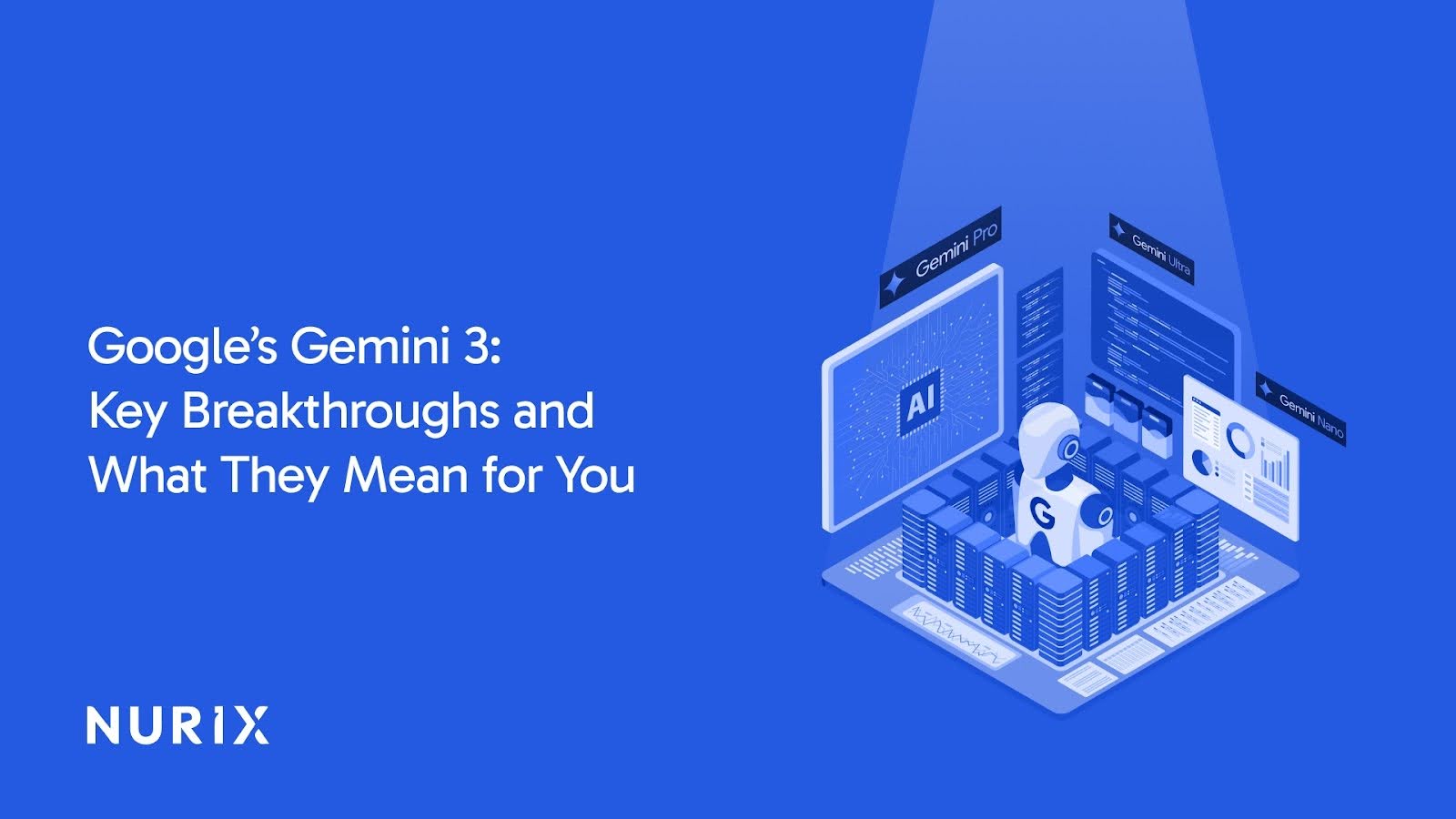
Gemini is not a single model but a full family of AI models built for different levels of complexity and deployment needs. Each version is designed to handle varied workloads, from lightweight tasks on devices to demanding enterprise-scale operations.
Here is how the family is structured:
- Gemini Ultra: The most capable version, designed for complex reasoning, analysis, and advanced multimodal tasks.
- Gemini Pro: The balanced, general purpose model used for a wide range of business and developer applications.
- Gemini Nano: A compact version built to run efficiently on mobile devices and edge environments.
The latest updates, often referred to as Gemini 3 or the next generation of Gemini models including Gemini 1.5 Pro, continue this multimodal and scalable design. These models can work across text, images, audio, and video in a unified way. This multimodality is built into the architecture itself rather than added later, which allows Gemini models to process and reason over diverse data inputs from the ground up.
What Makes Gemini 3 A Meaningful Upgrade
Each new version of Gemini aims to push the boundaries of performance, efficiency, and capability. Compared to earlier versions, the latest Gemini models introduce several key enhancements that are critical for business and development applications.
How Gemini 3 Handles Entire Data Sets At Once
One of the most significant advancements is the drastically expanded context window. This refers to the amount of information the model can process at one time. For example, Gemini 1.5 Pro was introduced with a standard 128,000 token context window, with an experimental version capable of handling up to 1 million tokens. To put that in perspective, a 1 million token context window can process:
- an hour of video
- 11 hours of audio
- a codebase with over 30,000 lines of code in a single prompt
This massive context window, combined with its native multimodal abilities, unlocks new possibilities. For example:
- A developer could feed the model an entire API documentation and ask it to generate code that uses it.
- A media analyst could upload hours of earnings calls and ask for a summary of key themes and a sentiment analysis of the CEO's tone.
This ability to reason over vast and varied datasets is a game-changer for complex problem-solving.
Advanced Reasoning and "Deep Think" Capabilities
Beyond just processing more data, the latest Gemini models demonstrate improved reasoning capabilities. Google has discussed implementing techniques that allow the model to perform more deliberate and complex analysis, sometimes referred to as a "Deep Think" or advanced reasoning mode. This is analogous to a human taking more time to think through a difficult problem rather than giving an immediate, instinctive answer.
This approach combines multiple reasoning techniques, like search and planning, to break down complex queries into smaller steps. For businesses, this could translate into more nuanced and reliable answers for strategic planning, financial forecasting, or complex data analysis, where a superficial response is insufficient.
What Google Changed About Safety In This Release
As AI models become more powerful, ensuring their safe and ethical deployment is paramount. With Gemini 3, Google has emphasized its commitment to building safety directly into the model's core. This includes:
- pre training the model to follow safety policies
- using filtering techniques to block harmful, biased, or inappropriate outputs
- embedding stronger controls during training rather than relying only on post processing safeguards
Google's approach also includes red teaming, which is the practice of:
- intentionally trying to break the model's safety protections
- identifying weaknesses that could cause incorrect or unsafe behavior
- patching vulnerabilities before the model is deployed at scale
For enterprises looking to adopt AI, these built in safety features are important for reducing risk and protecting brand reputation.
How Google’s TPU Chips Boost Gemini 3’s Performance
Gemini 3’s performance gains are strongly linked to Google’s custom Tensor Processing Units (TPUs). These chips are designed specifically for large scale machine learning workloads, giving Google tighter control over model performance and efficiency.
Key advantages of TPUs for Gemini 3:
- built for large matrix computations needed for trillion parameter models
- optimized to handle million token context windows
- lower latency and higher throughput compared to general GPUs
- better energy control for long running training cycles
- hardware and software tuned together for stable performance
This tight vertical integration allows Google to train and deploy Gemini models faster and more cost effectively than competitors that rely on third party GPUs.
How Gemini 3 Compares With Other Leading Models
Where Gemini 3 Stands in the Current AI Competition
Gemini 3 enters a competitive field with powerful alternatives from OpenAI, Anthropic, and Meta. The difference now is how quickly models can process long inputs, handle multimodal tasks, and work across existing business tools.
Google’s strengths in this race include:
- end to end control of both hardware and software
- access to large data repositories through its platforms
- strong integration across Google Cloud and Workspace
- a fast growing developer base exploring Gemini via API and AI Studio
This combination puts Google in a strong position as companies look for reliable, scalable AI options.
Where Gemini 3 Can Make An Impact Today
The advanced capabilities of Gemini 3 open up a range of practical applications for businesses and developers.
- Code Generation and Debugging: Developers can use the large context window to upload entire codebases to find bugs, suggest optimizations, or generate new functions that are consistent with the existing code style.
- Advanced Data Analysis: A business can upload entire quarterly financial reports, sales data, and market research to ask complex questions like, "What were the main drivers of revenue growth last quarter, and what risks are highlighted in our competitor's public filings?"
- Hyper-Personalized Customer Support: Chatbots powered by Gemini could access a customer's entire interaction history-including past calls (as transcripts), emails, and chat logs-to provide highly contextual and effective support without needing the customer to repeat information.
- Media and Content Creation: A video editor could upload hours of raw footage and ask the model to identify the best takes, create a highlight reel, or even generate a script for a promotional clip based on the video's content.
- Research and Development: Scientists and researchers can process vast archives of academic papers, experimental data, and clinical trial results to identify patterns and accelerate discoveries.
Limitations and Open Questions
Despite its impressive capabilities, Gemini 3 is not without limitations.
- Cost and Accessibility: Running models with million-token context windows is computationally expensive. The cost-effectiveness of using such large models for everyday business tasks remains an open question.
- Factuality and Hallucinations: Like all large language models, Gemini can still "hallucinate" or generate factually incorrect information. Rigorous fact-checking and human oversight are still necessary, especially for critical applications.
- Real-World Performance: The performance demonstrated in controlled research environments may not always translate perfectly to messy, real-world scenarios. The robustness and reliability of these models in production will need to be continually assessed.
What Gemini 3 Suggests About The Future Of AI In Business
The release of Google's Gemini 3 models marks another important milestone in the evolution of artificial intelligence. Its advancements in multimodal reasoning, a vastly expanded context window, and improved safety features offer a glimpse into the future of enterprise AI. For business leaders and technology decision-makers, understanding these developments is no longer optional.
The key is to move beyond the hype and focus on practical, value-driven applications. While challenges around cost, reliability, and ethical implementation remain, the potential for AI to enhance efficiency, unlock new insights, and create a competitive advantage is undeniable. The journey of integrating these powerful tools is just beginning, and staying informed is the first step toward harnessing their transformative potential.