Enterprise teams rarely set out to replace core platforms, yet Palantir alternatives keep surfacing as workflows grow harder to manage across fragmented tools. Leaders are balancing tighter SLAs, higher case volumes, and pressure to move work forward without adding headcount. The Workflow Automation market is booming, projected to reach $46.86 billion by 2033 with a CAGR of 9.52%, which reflects how strongly teams are leaning toward execution driven AI. Many organizations evaluating Palantir alternatives aim to reduce operational friction rather than invest in another analytics layer.
What makes the decision complex is that most organizations already operate inside dense tech ecosystems where every new platform introduces risk. Enterprise buyers want automation that fits into existing workflows, supports real operational coordination, and holds up in production. The focus has moved away from static dashboards toward systems that act inside live processes.
In this guide, you will see how different platform categories compare, where agentic execution fits, and how enterprises are approaching the transition.
Key Takeaways
- Execution Is The Priority: Enterprises evaluating Palantir alternatives focus on platforms that complete workflows across operational systems, not only generate insights or analytics.
- Different Platforms Solve Different Layers: Databricks, Snowflake, Fabric, Informatica, Denodo, and Dataiku strengthen data and AI foundations but often lack deep workflow execution capabilities.
- Agentic Systems Add Action Layers: Platforms like Nupilot coordinate multi-step workflows, approvals, and system updates, shifting automation toward real operational execution.
- Architecture Matters In Evaluation: Teams compare orchestration depth, exception handling, observability, and integrations to determine whether automation will scale reliably.
- Enterprise AI Is Moving Toward Execution: Modern stacks combine governed data platforms with agentic layers that turn intelligence into coordinated operational outcomes.
What Palantir Gets Right and Where Enterprise Teams Hit Friction
Palantir provides strong ontology modeling, governance, and operational data alignment. However, teams often struggle to turn structured insights into scalable, real-time workflows.
Enterprise operators evaluating platform performance typically highlight both architectural strengths and execution level constraints shaping day-to-day adoption:
- Ontology Driven Modeling: Standardized entities and relationships allow consistent data context across domains, allowing business teams to query operational objects without writing schema-level logic or SQL transformations.
- Embedded Operational Applications: Foundry applications connect analytics with frontline tools, supporting planning simulations, investigative workflows, and production monitoring through governed digital twin environments tied to enterprise datasets.
- Deployment Velocity Constraints: Building production apps requires heavy configuration cycles, ontology mapping, and dependency alignment before workflows reach live environments or generate measurable operational output.
- Limited Action Layer Depth: Insights often surface through dashboards or applications, while downstream actions such as CRM updates, document handling, or approvals still rely on manual orchestration outside the platform.
- Customization and Maintenance Overhead: Specialized engineers maintain semantic logic, pipelines, and application layers, creating bottlenecks when business teams request quick workflow changes or operational experimentation.
Palantir excels at structuring complex enterprise data and governance, yet many teams look for complementary execution layers that convert structured insight into coordinated action across operational systems consistently.
If you are evaluating how agentic execution fits into real operational workflows, explore our guide on Agents vs Workflows: The Hybrid Future of Enterprise AI
Top 8 Palantir Alternatives Available in 2026
Enterprises comparing Palantir alternatives in 2026 face a fragmented market spanning data platforms, AI development suites, and execution focused systems designed to operationalize enterprise workflows.
At a Glance
These platforms reflect how enterprise AI has split across data, development, and execution layers. Each option supports a different stage of turning an AI strategy into a real operational output.
1. Nupilot
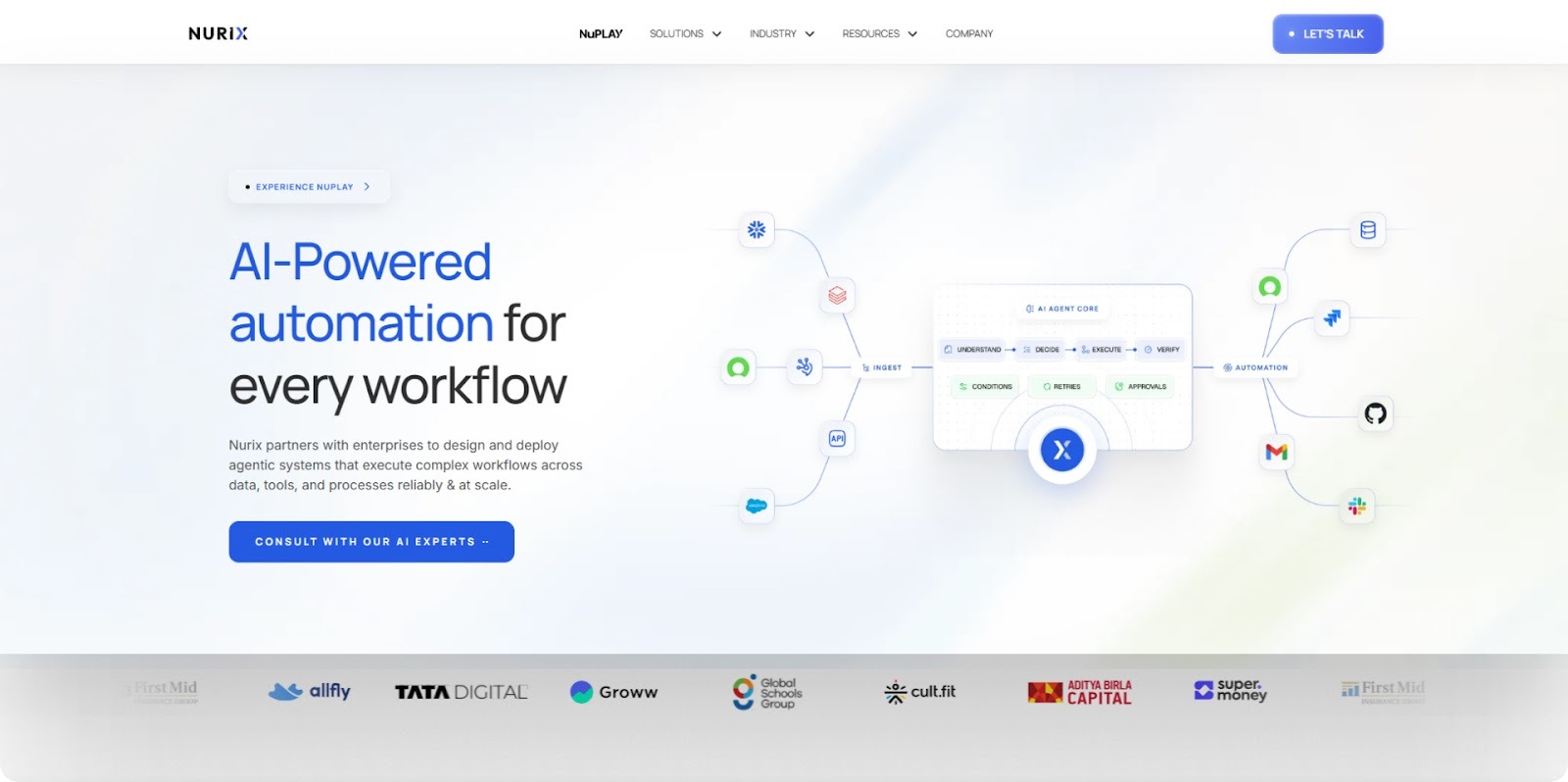
Nupilot is Nurix’s agentic AI workflow automation platform built for enterprises that need complex work executed across systems, teams, and processes without adding operational overhead. Instead of focusing only on data modeling or task triggers, Nupilot deploys AI agents that coordinate multi-stage workflows, manage dependencies, and drive consistent execution across CRM, ERP, underwriting, and internal tools.
The platform is designed for recurring and structured operations where reliability, governance, and scale matter, helping enterprises reduce manual coordination while maintaining visibility into every step of execution.
- Agentic Workflow Orchestration: AI agents coordinate multi-stage tasks, approvals, and system actions, allowing end-to-end execution rather than isolated automation triggers or scripted handoffs.
- End-to-End Process Execution: Automates recurring structured workflows from intake to completion, handling dependencies, routing logic, and outcome tracking across operational environments.
- Deep Enterprise Integrations: Connects directly with core business systems, allowing agents to move data, trigger actions, and update records without heavy middleware layers or manual intervention.
- Context Aware Decision Logic: Agents interpret workflow context in real time, adjusting routing, validations, or actions based on growing inputs and operational states.
- Governance and Observability: Built-in monitoring tracks agent activity, workflow performance, and edge cases, giving operations teams visibility into execution without losing control.
- Scalable Execution Infrastructure: Designed for high-throughput operations where consistent execution, repeatability, and predictable performance are required across large enterprise workloads.
Best For: Enterprise operations teams in banking, insurance, retail, and B2B SaaS that need AI agents to execute structured workflows across multiple systems while maintaining governance, reliability, and measurable operational outcomes.
Case Study: First Mid Insurance replaced a complex 200-page training manual with a Nurix AI assistant that delivers real-time workflow guidance, compliance support, and knowledge retrieval. The solution unified onboarding across acquired agencies, automated workflows, and reduced manual errors. Teams achieved 95% guidance accuracy, faster onboarding, and a 25% productivity increase. The deployment delivered a measurable impact, reaching 237% ROI within 90 days.
Talk to Nurix AI to see how Nupilot can operationalize agentic workflows across your enterprise systems.
2. Databricks
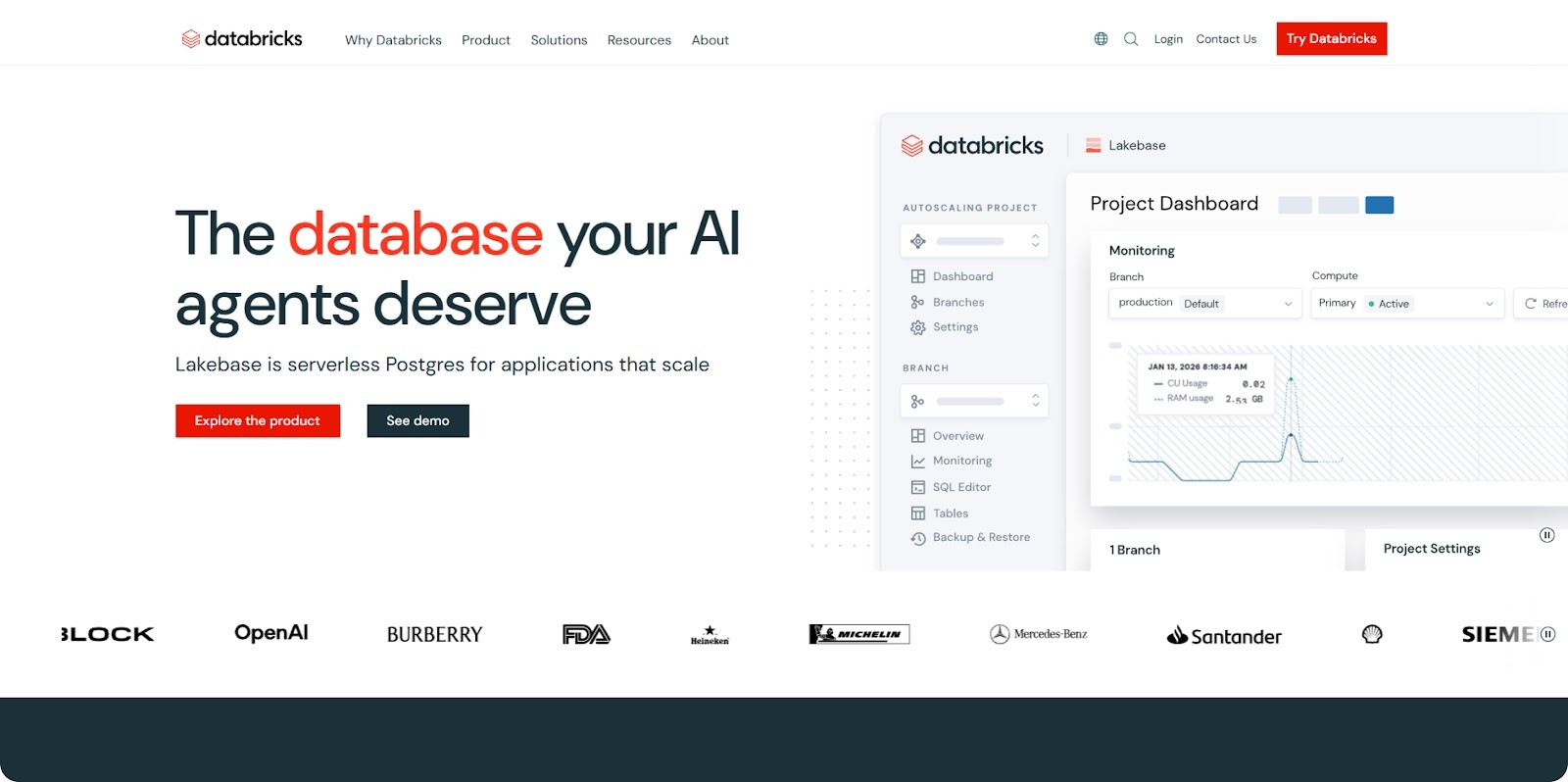
Databricks is a data and AI platform built on a lakehouse architecture that combines data engineering, warehousing, and machine learning to support AI development on governed enterprise data. It maintains lineage, privacy controls, and governance across the AI lifecycle, helping organizations unify fragmented data environments, experiment with generative AI, and deploy models at scale with operational control.
- Lakehouse Architecture: Combines data lakes and warehouses into a unified platform, allowing analytics, engineering, and AI development within a single governed environment.
- Generative AI Development: Supports creating, tuning, and deploying custom generative AI applications directly on enterprise data while maintaining privacy and control standards.
- End-to-End Governance: Maintains lineage, quality controls, and experiment tracking across AI workflows, helping teams manage risk and compliance across large data environments.
- Scalable Model Deployment: Allows monitoring and serving of models at enterprise scale, supporting high request volumes and production-level AI applications.
Best For: Engineering-led organizations building large-scale machine learning pipelines, generative AI applications, and unified data platforms where governance, experimentation, and model deployment require centralized infrastructure.
3. Snowflake
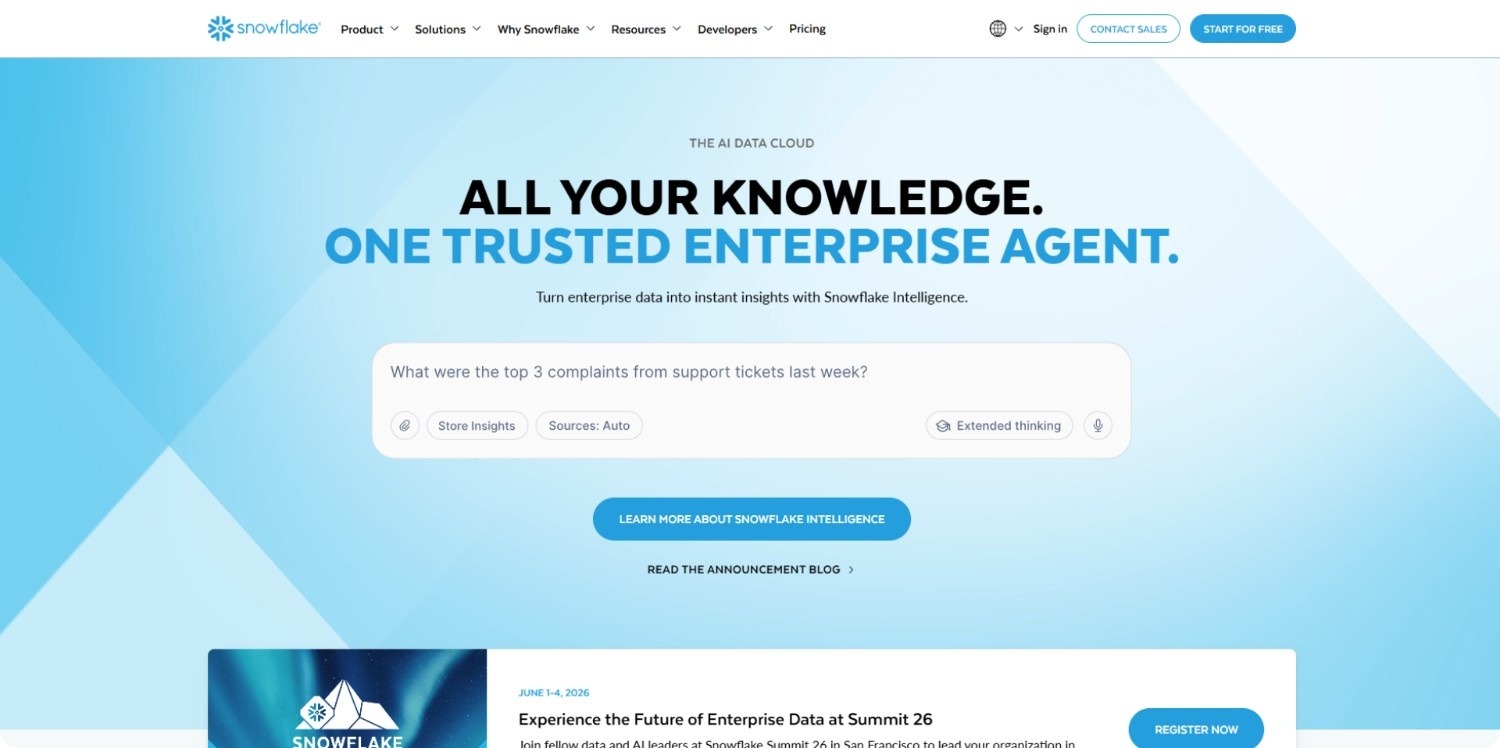
Snowflake is a cloud data and AI platform that unifies structured and unstructured enterprise data, supporting analytics, machine learning workflows, and data-driven applications at scale. Its AI Data Cloud lets teams build data agents and AI models directly where data lives, helping centralize analytics while maintaining governance, access control, and observability.
- Unified AI Data Cloud: Combines data storage, analytics, and AI services in one governed platform, allowing teams to analyze data and develop AI applications without moving datasets across systems.
- Data Agents And Conversational Apps: Supports building AI-powered agents and interfaces grounded in enterprise data, allowing contextual querying, semantic search, and natural language interaction.
- Unstructured Data Processing: Allows large-scale analysis of documents, text, and multimodal media within Snowflake’s secure perimeter using integrated AI and LLM capabilities.
- End-to-End ML Workflows: Provides tools to develop, deploy, and monitor machine learning models with unified governance, model registry, and scalable compute infrastructure.
Best For: Organizations prioritizing centralized analytics, AI-driven insights, and governed data access across large enterprise datasets where structured and unstructured data need to power reporting, ML, and data applications.
4. Microsoft Fabric
Microsoft Fabric is an end-to-end data and analytics platform that combines data engineering, real-time intelligence, business intelligence, and AI in a unified environment. Built around OneLake and the Microsoft ecosystem, it helps organizations unify data estates, build pipelines, analyze streaming data, and generate AI-driven insights while maintaining governance and security.
- Unified Data Platform: Combines data engineering, warehousing, business intelligence, and AI workloads into one environment, reducing data movement and simplifying collaboration across teams.
- AI-Powered Copilot and Fabric IQ: Supports natural language interactions and AI-assisted workflows that help teams build reports, pipelines, and data models faster.
- Real Time Intelligence: Allows near real-time data analysis and streaming insights, helping teams monitor operations and respond to events with low-latency analytics.
- Integrated Security and Governance: Built-in tools such as OneLake security and Microsoft Purview provide access control, cataloging, and enterprise-wide governance across enterprise data.
Best For: Microsoft-centric organizations seeking a unified analytics platform that connects Power BI, Azure, and Microsoft 365 workloads while allowing real-time insights, AI-powered analytics, and centralized governance.
5. Informatica (IDMC)
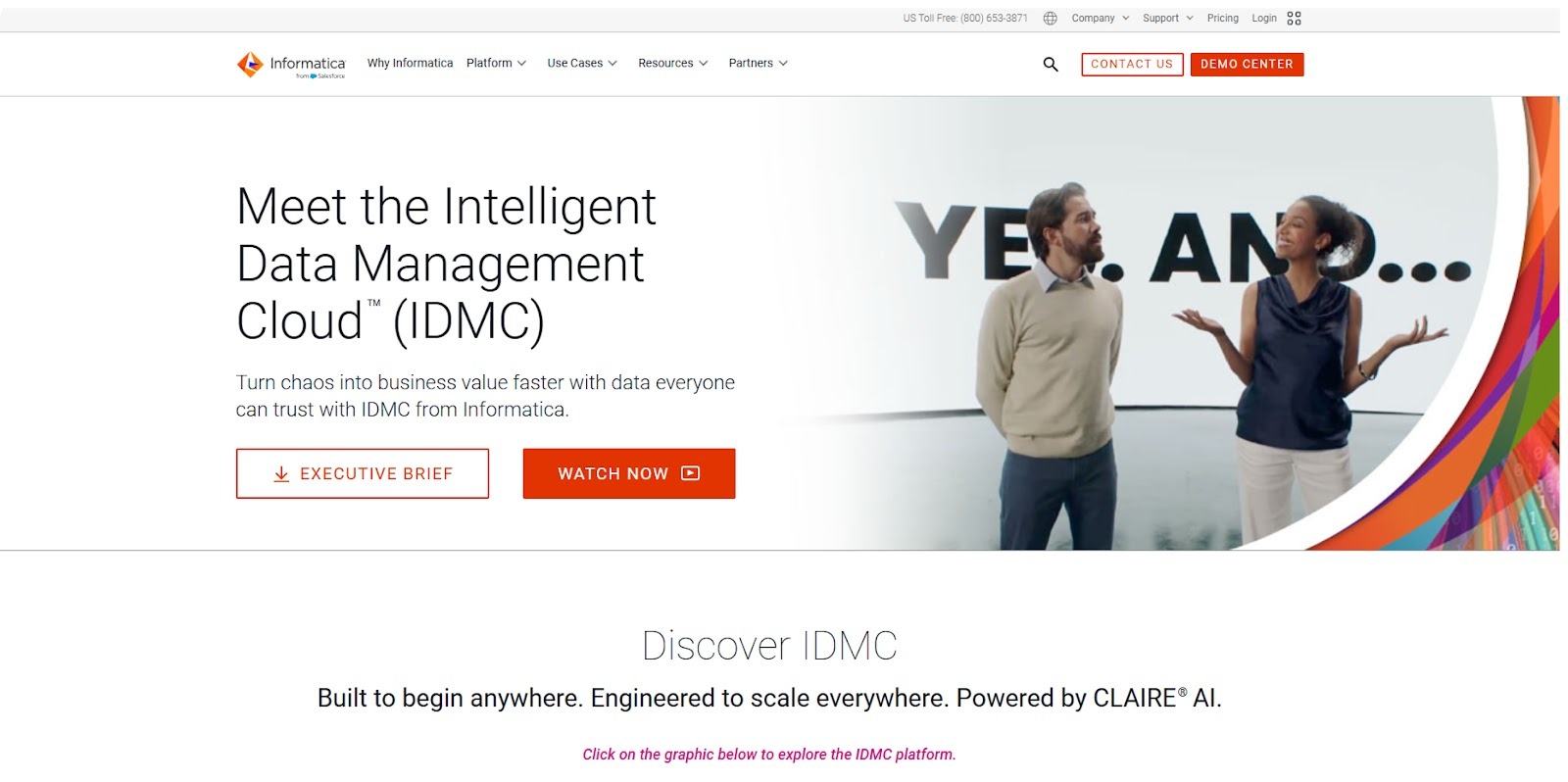
Informatica Intelligent Data Management Cloud (IDMC) is a cloud-native platform for data integration, governance, quality, and master data management across hybrid and multi-cloud environments. Powered by CLAIRE AI and metadata-driven architecture, it helps enterprises unify fragmented data, enforce governance policies, and deliver trusted datasets for analytics, compliance, and AI initiatives.
- Metadata Driven Intelligence: Uses a centralized metadata system to provide context, lineage, and governance across thousands of connected data sources and applications.
- AI-Powered Data Management: CLAIRE AI automates data discovery, quality checks, and integration workflows, helping teams manage large-scale enterprise data environments efficiently.
- Multi Cloud Integration: Supports hybrid and multi-cloud connectivity with extensive prebuilt connections, allowing smooth data movement across distributed enterprise ecosystems.
- Governance and Compliance Controls: Provides policy enforcement, access management, and privacy controls to help organizations maintain secure and compliant data operations.
Best For: Enterprises prioritizing centralized data governance, master data management, and large-scale integration across hybrid environments where trusted, well-governed data is required before analytics or AI deployment.
6. Denodo
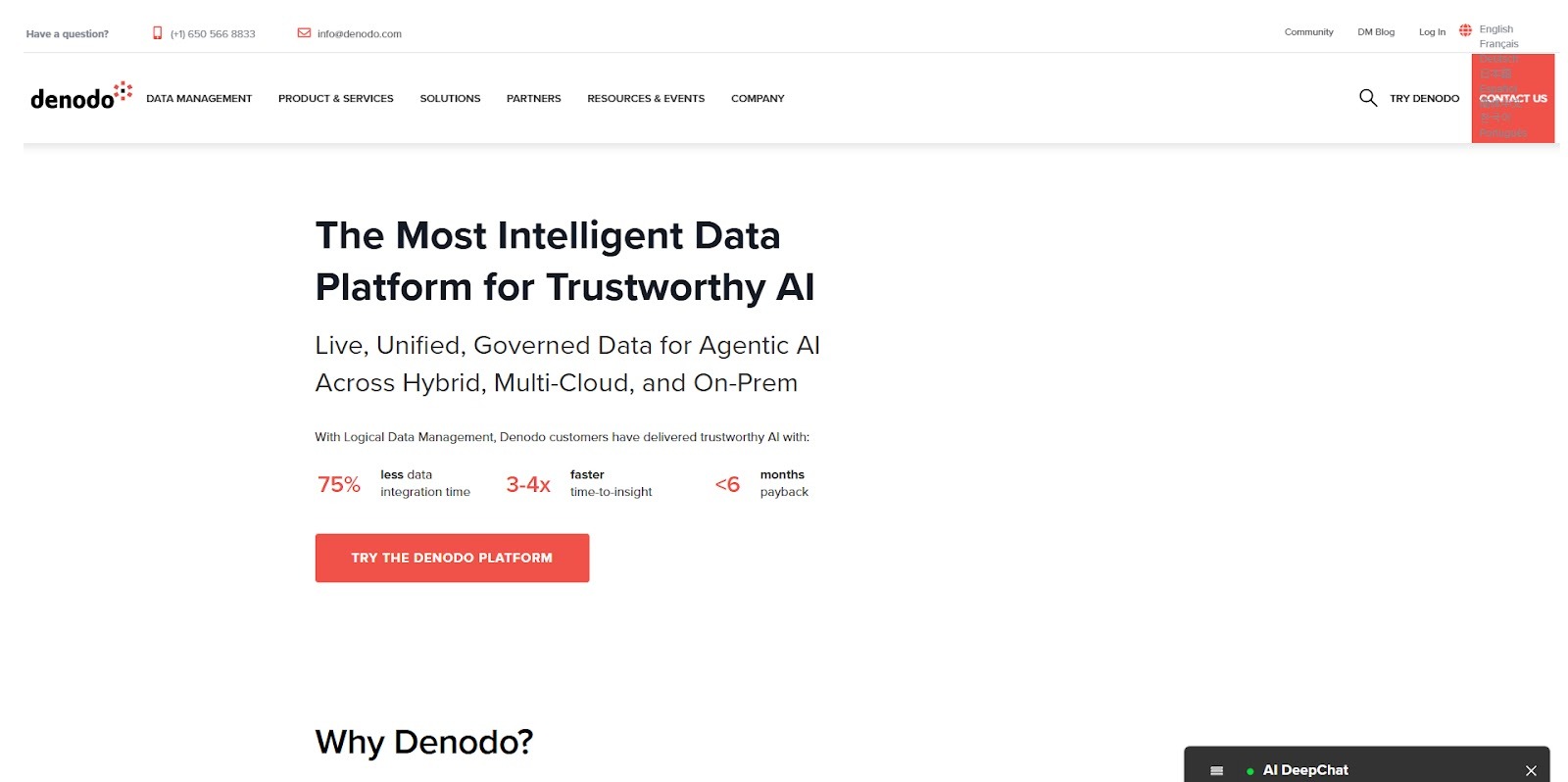
Denodo is a logical data management and virtualization platform that provides unified, real-time access to distributed enterprise data without replication. It creates a semantic access layer that allows analytics, AI agents, and applications to query live data across hybrid, multi-cloud, and on-premises environments while enforcing federated governance and reducing data integration complexity.
- Logical Data Virtualization: Provides unified access to distributed data sources without moving or duplicating datasets, allowing faster analytics and AI workflows across hybrid environments.
- Federated Governance Controls: Enforces centralized policies and compliance across multiple systems while maintaining data in its original location.
- Real Time Data Delivery: Optimizes queries to deliver live data for analytics and AI applications, guaranteeing that the decisions rely on current business context rather than replicated snapshots.
- Self-Service Data Marketplace: Allows business users to discover, access, and prepare governed data independently using personalized views and semantic context.
Best For: Organizations needing real-time data access across hybrid systems without heavy ingestion pipelines, especially where governance, semantic consistency, and live operational data are critical for analytics or AI.
7. Dataiku
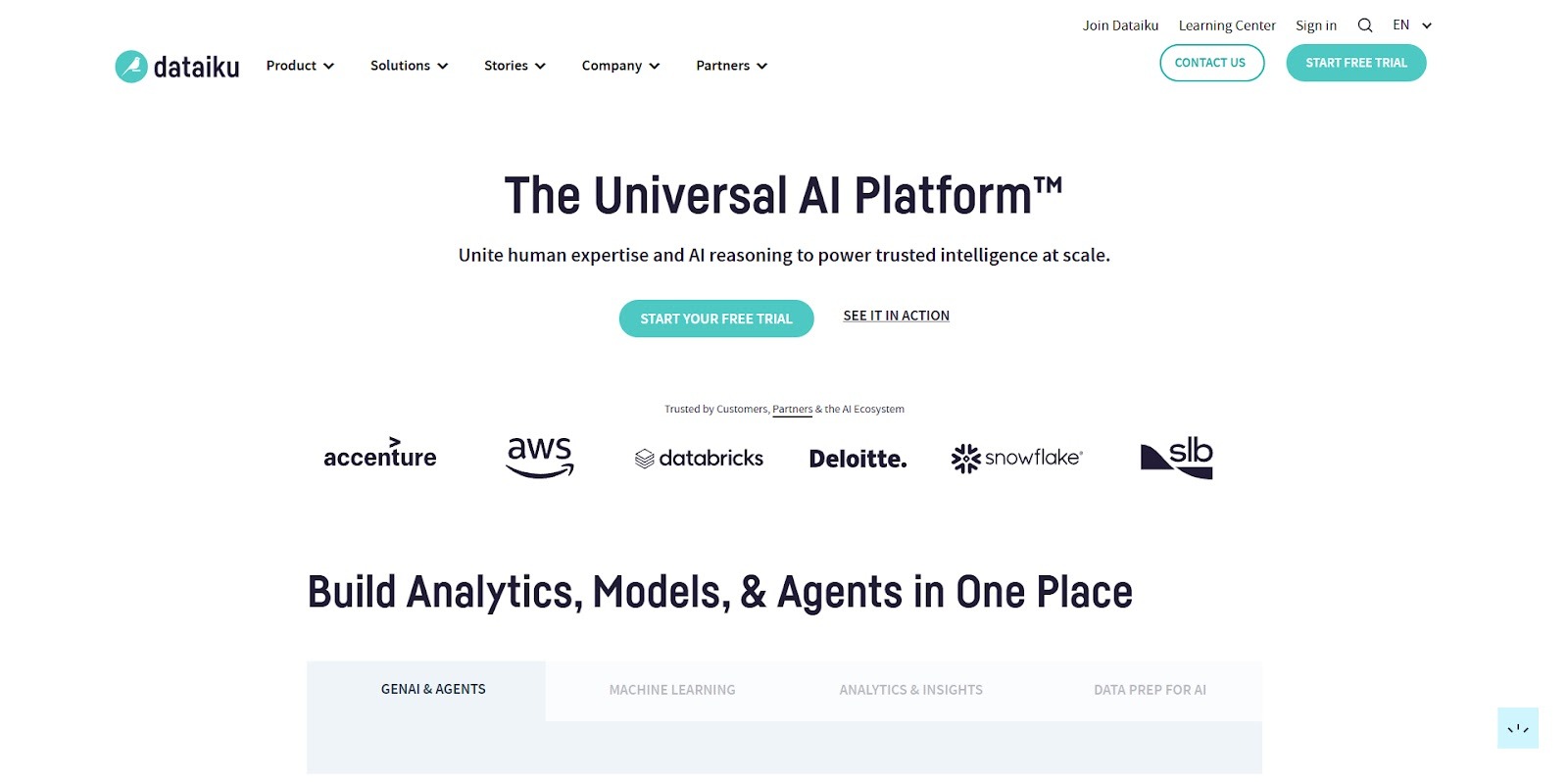
Dataiku is a collaborative AI and machine learning platform that allows teams to build analytics, models, and AI agents within a governed environment. It combines data preparation, experimentation, deployment, and governance, helping organizations move from experimentation to production using AutoML, full-code development, and integrated workflows for analytics and generative AI.
- Unified AI Development Environment: Combines data preparation, analytics, model development, and deployment into one platform, allowing teams to build AI projects without switching tools.
- GenAI and Agent Development: Provides secure LLM gateways, evaluation tools, and governance controls to develop and scale enterprise AI agents and generative AI applications.
- Collaborative Machine Learning: Supports both visual workflows and full code development, allowing analysts, data scientists, and engineers to collaborate on model building and experimentation.
- AI Governance And Operations: Centralizes monitoring, explainability, and lifecycle management for analytics, models, and agents across enterprise AI portfolios.
Best For: Organizations focused on collaborative data science, AI experimentation, and governed machine learning workflows where cross-functional teams need a unified platform to build and operationalize AI initiatives.
8. Turing
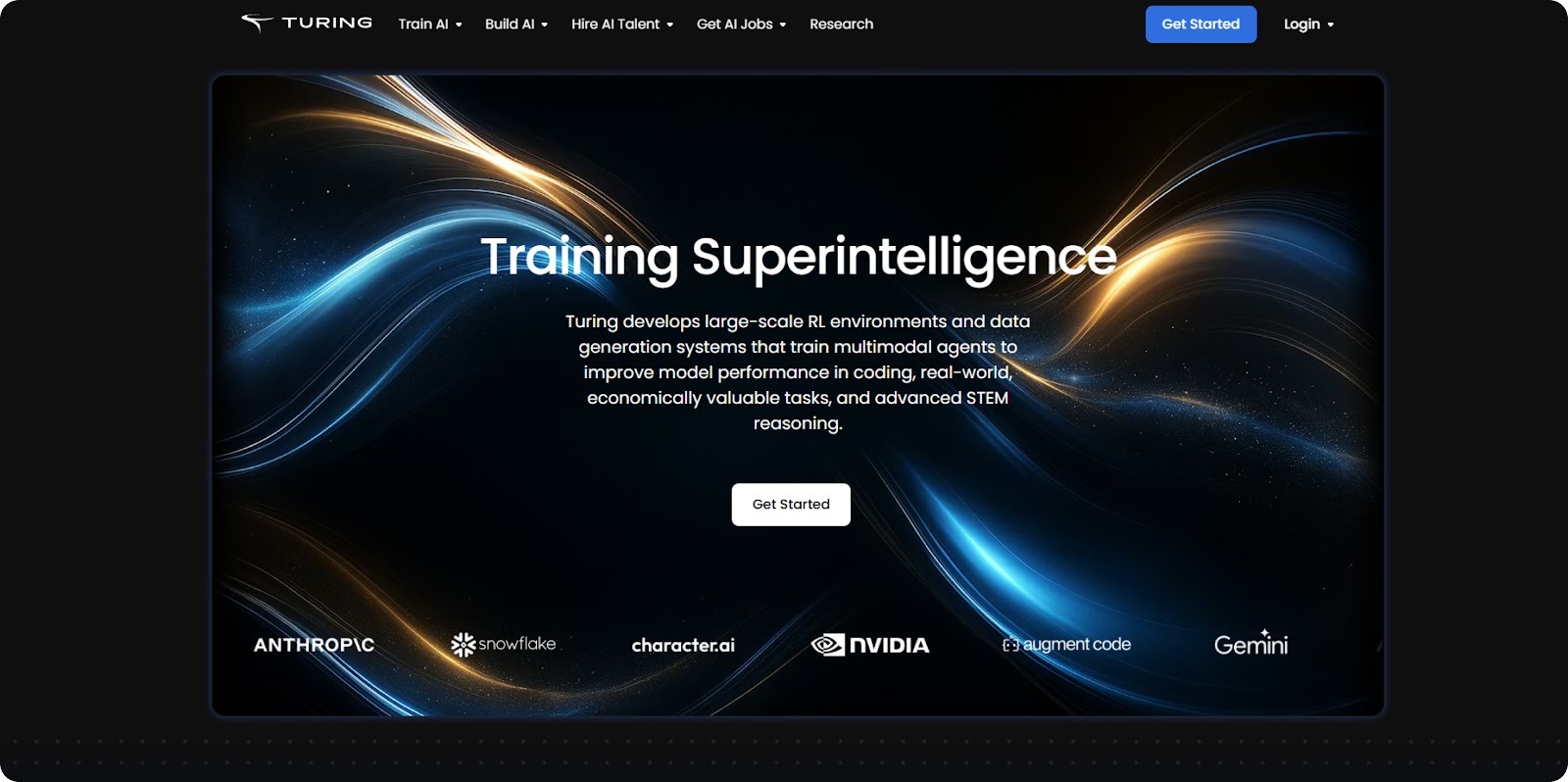
Turing is an enterprise AI build and delivery platform that helps organizations design, prototype, and deploy real-world AI systems alongside their internal teams. Rather than providing only strategy or tooling, Turing works through embedded engineering pods that co-create agentic workflows, fine-tuned models, and AI-enabled products built around measurable business KPIs.
Enterprises use Turing to move from stalled pilots to production-ready systems while maintaining ownership of code, infrastructure, and long-term direction.
- Co-created AI System Development: Embedded experts collaborate directly with enterprise teams to design and build AI systems aligned with operational goals and real workflow requirements.
- Quick Prototype To Production: Focuses on early feasibility testing and fast iteration cycles, helping organizations validate ROI before scaling into full production deployments.
- Ownership and No Lock In: Enterprises retain control over IP, codebase, and architecture, guaranteeing flexibility to develop without dependency on proprietary frameworks.
- Production Ready Engineering: Builds resilient AI systems with attention to reliability, model integration, and infrastructure readiness rather than short-term proof of concept experimentation.
Best For: Enterprises that need hands-on execution support to design and build custom AI systems or agentic workflows, especially when internal teams require acceleration from prototype stages to production deployment.
Each alternative reflects a different philosophy, yet the decision depends on whether your priority is data management, model development, or autonomous workflow execution at scale.
How to Evaluate Palantir Alternatives for Workflow Automation
Evaluating Palantir alternatives for workflow automation requires analyzing execution architecture, orchestration depth, governance models, and operational scalability rather than relying on feature comparisons or analytics capabilities alone.
Enterprise teams assessing workflow automation platforms typically apply the following technical evaluation criteria when comparing execution focused alternatives:
- Execution Graph Architecture: Assess whether workflows are modeled as stateful execution graphs with retries, branching logic, and dependency tracking rather than static pipelines or analytics-driven triggers.
- Agent Coordination and Task Handoffs: Evaluate how platforms manage multi-system actions such as approvals, escalations, and routing across CRM, underwriting, and case management environments.
- Operational Observability Depth: Look for replayable logs, execution states, SLA monitoring, and edge case visibility instead of high-level lineage views focused only on datasets.
- Exception Handling And Recovery Models: Validate how automation handles partial failures, manual interventions, and conditional rerouting without breaking workflow continuity or losing context.
- Integration Surface Area: Measure native connectivity with enterprise tools and APIs, including the ability to trigger downstream actions instead of only querying or analyzing data.
Strong evaluations prioritize execution reliability, orchestration depth, and governance across live workflows, helping enterprises select platforms that turn structured intelligence into consistent operational outcomes at scale.
See how agentic systems are changing execution inside real enterprise operations by reading Generative Agents: Rethinking Workflows in Complex Business Environments
Where Traditional Alternatives Focus and Where Agentic Systems Differ
Traditional Palantir alternatives concentrate on data engineering, analytics, or governance layers, while agentic systems introduce execution frameworks designed to complete operational workflows autonomously across enterprise environments.
Enterprise teams comparing platform approaches typically see clear architectural differences across how traditional stacks and agentic systems handle data, actions, and operational responsibility:
- Analytics Centric Outcomes: Traditional platforms prioritize dashboards, warehousing, or reporting layers where humans interpret results before triggering operational changes inside CRM, underwriting, or case systems.
- Pipeline Driven Architecture: Many alternatives emphasize ETL pipelines, semantic modeling, or data virtualization, optimizing ingestion and access rather than coordinating downstream workflow execution across applications.
- Human Led Action Loops: Insights often require manual follow-ups, such as updating records, approving cases, or initiating escalations, creating delays between analysis and operational response.
- Agentic Execution Models: Agentic systems orchestrate tasks across tools, coordinating validations, approvals, and handoffs without relying on external orchestration scripts or manual interventions.
- Embedded Operational Intelligence: Instead of separate analytics environments, agentic platforms operate inside enterprise workflows, adapting decisions dynamically based on live context and system feedback.
The core difference lies in purpose: traditional alternatives organize and analyze enterprise data, while agentic systems execute structured work, closing the gap between insight generation and operational outcomes.
Curious how enterprises are applying agentic AI across real operational workflows? Dive into Top 15 AI Agents Use Cases Transforming Business Operations
The Future of Enterprise AI: From Insight Platforms to Autonomous Execution
Enterprise AI is shifting from insight-driven platforms toward execution driven systems where AI agents actively complete operational workflows, reducing manual coordination and accelerating measurable business outcomes.
Enterprise leaders moving toward autonomous execution typically see five technical shifts reshaping how AI platforms operate across production environments:
- Operational AI Embedded In Workflows: AI capabilities move inside intake systems, servicing tools, and case management environments, allowing agents to trigger actions rather than generate standalone analytics outputs.
- Real Time Execution Loops: Agents ingest streaming signals such as transaction events or support tickets, triggering validations, updates, and downstream actions without waiting for batch analytics refresh cycles.
- Human And Agent Collaboration Models: Autonomous workflows introduce structured approval checkpoints where AI executes tasks while humans intervene only for policy-sensitive or high-risk decisions.
- Continuous Context Learning: Execution platforms capture workflow outcomes, edge cases, and user overrides, feeding structured feedback into agent behavior to improve future operational performance.
- Composable AI Architectures: Enterprises build modular stacks where analytics platforms provide context while agentic layers coordinate execution across legacy systems, APIs, and enterprise applications.
The future of enterprise AI centers on autonomous execution, where agents convert governed intelligence into coordinated operational actions, helping enterprises achieve scale, speed, and measurable workflow outcomes.
Final Thoughts!
Choosing among Palantir alternatives often becomes less about replacing one platform with another and more about deciding how work actually moves inside your organization. Teams that step back and look at execution realities tend to find that architecture decisions shape everyday operations far more than feature lists ever will.
The real shift happening across enterprises is a move toward systems that quietly remove friction while keeping people in control of critical outcomes. As AI matures, the platforms that last will be the ones that fit naturally into how teams already operate.
If your organization is exploring what that next step looks like, NuPilot focuses on turning complex workflows into coordinated execution without forcing a rebuild of your existing stack. NuPilot brings agentic systems into real operational environments, helping teams move faster while staying accountable to governance and performance goals. Whether you are evaluating options or preparing for your next rollout, talking through real workflows often makes the path forward clearer.
Connect with us to see how agentic execution can fit into the way your teams already work.