
Enterprise AI leaders know the moment when another outsourced dev team joins the stack, yet operational workflows still feel stuck between systems. Conversations around turing alternatives often begin when execution slows, handoffs multiply, and internal teams carry delivery pressure across tools that never truly connect.
At the same time, the Workflow Automation Market size valuation is expected to reach USD 45.57 billion in 2034, expanding at a CAGR of 10.5%, signaling how quickly enterprises are moving toward agentic execution models. The shift is less about replacing talent and more about turning scattered automation efforts into coordinated workflow outcomes that actually run in production.
As organizations evaluate turing alternatives, the real pressure shows up inside daily operations where approvals, compliance checks, and CRM updates still rely on manual orchestration. Leaders are looking for execution that connects AI models directly to outcomes across complex environments.
In this guide, we break down how enterprise teams compare alternatives, where outsourcing models fall short, and how agentic workflow platforms change enterprise delivery at scale.
Key Takeaways
- Execution Model Shift: Turing alternatives reflect a move from outsourced development toward agentic workflow platforms that drive governed execution across enterprise systems.
- Agentic Workflow Advantage: Autonomous orchestration, contextual decisioning, and persistent integrations reduce coordination overhead compared to traditional outsourcing models.
- Three Alternative Paths: Enterprise teams typically choose between agentic workflow platforms, fully managed delivery partners, or flexible global outsourcing networks.
- Outsourcing Scaling Limits: Talent platforms accelerate builds but often leave orchestration, governance, and production execution responsibility with internal teams.
- New Evaluation Lens: Leaders assess Turing alternatives based on execution ownership, governance depth, integration maturity, and long-term operational cost.
Where Turing Intelligence Excels and Where Teams Hit Limits
Turing Intelligence accelerates AI development through AI-driven vetting, global engineering scale, and secure build environments, yet enterprises often face friction when shifting from development speed to operational execution.
Enterprise evaluation of Turing Intelligence typically centers on engineering acceleration versus production workflow readiness, including delivery ownership, orchestration maturity, and domain-specific execution requirements.
- AI Talent Cloud Scale: Intelligent matching helps teams quickly find vetted engineers across different tech stacks, making it easier to start LLM projects, backend builds, and testing environments.
- Developer Productivity Telemetry: Built-in analytics track commits, task velocity, and engineering output, helping leads monitor developer performance without deploying additional observability tooling.
- Secure Development Workspaces: Isolated cloud environments with enforced access controls support model development involving sensitive datasets, minimizing code leakage risks during distributed engineering work.
- Contractor-Driven Execution Model: Enterprises remain responsible for sprint orchestration, architectural direction, and delivery governance, increasing internal coordination as projects expand across business functions.
- Workflow Orchestration Constraints: Strong during build phases, but complex multi-system automation, stateful process management, and operational agent coordination typically require external execution layers.
Turing Intelligence excels at speeding up AI system development. But enterprises scaling to governed, cross-system workflows often need orchestration platforms to run in production.
Still weighing where agents fit versus structured automation in your stack? Dive into Agents vs Workflows: The Hybrid Future of Enterprise AI
Top Turing Alternatives by Category for Enterprise AI Execution
Enterprises evaluating Turing alternatives compare platforms across agentic workflow execution, managed delivery, and global outsourcing models to determine how AI initiatives translate into scalable operational outcomes.
At a Glance
1. Nupilot
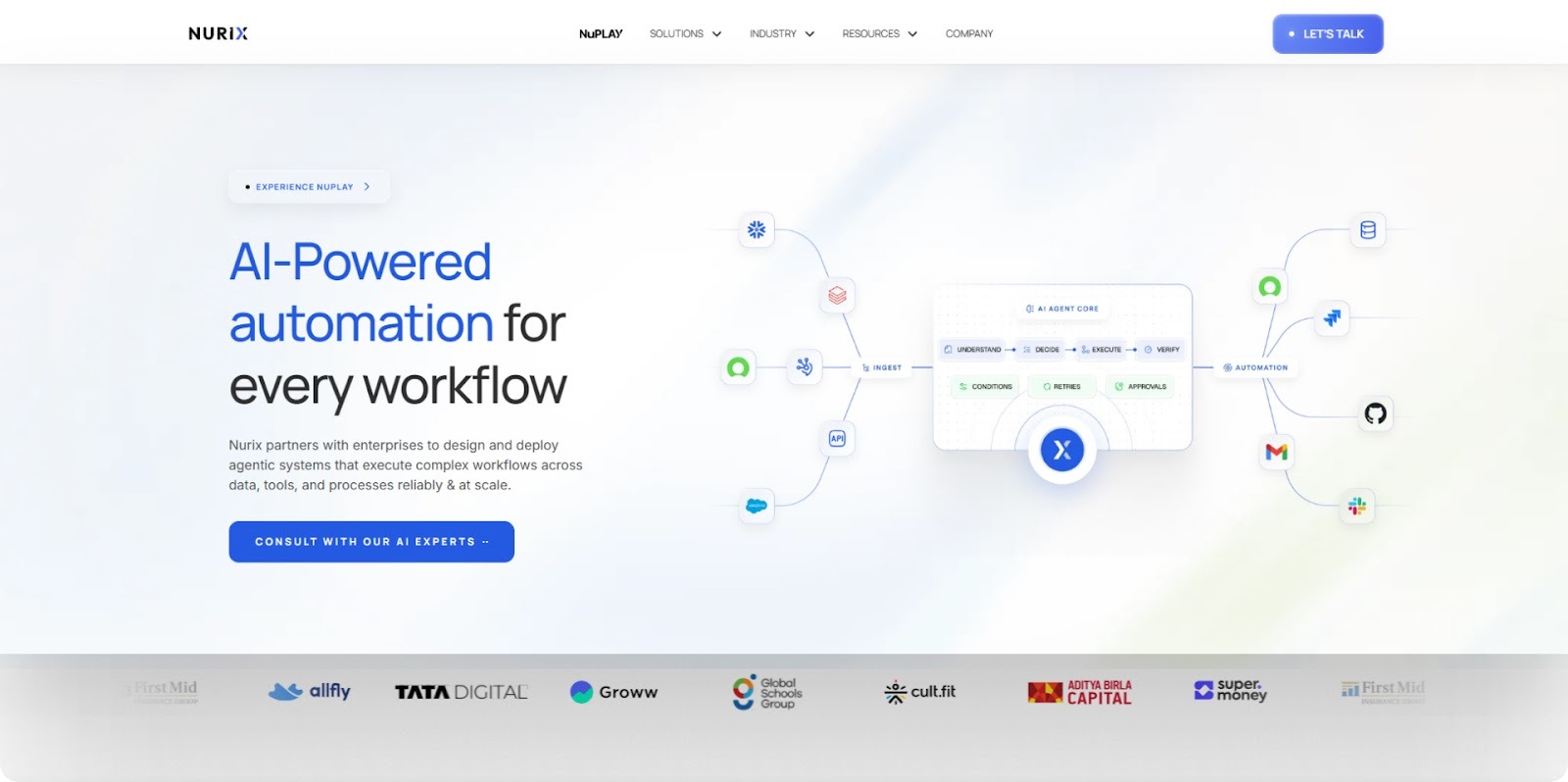
NuPilot is Nurix’s enterprise agentic workflow automation platform built to execute complex, multi-system operations at scale. Instead of isolated task automation, it orchestrates AI agents that manage dependencies, coordinate actions across tools, and deliver consistent outcomes across structured business workflows.
- Agentic Workflow Orchestration: Deploy adaptive AI agents that execute multi-stage processes across CRM, ERP, and internal systems while managing handoffs, dependencies, and workflow state automatically.
- End-To-End Automation Engine: Automates recurring operational flows from intake through completion, reducing manual coordination across teams while maintaining predictable execution across structured enterprise processes.
- Native Enterprise Integrations: Deep connectivity with core enterprise tools allows smooth data exchange and action execution without heavy middleware or fragmented automation layers.
- Context-Aware Decisioning: AI agents interpret workflow context and adjust execution paths dynamically, supporting conditional routing, exception handling, and real-time operational decisions.
- Governance and Observability: Built-in monitoring, auditability, and control layers provide visibility into agent behavior, supporting compliance-heavy environments requiring transparent automation oversight.
- Enterprise Scale And Throughput: Designed for high-volume execution, allowing organizations to increase operational capacity and reduce processing cycles without proportional increases in team size.
Best For: It helps teams orchestrate agents with strong governance and is ideal for complex, multi-system operational processes.
Case Study: Partnerplex deployed NuPilot to automate cloud funding workflows end-to-end. AI agents qualified deals, collected inputs, and submitted applications, reducing development time by 75% while allowing faster partner revenue execution.
Talk to Nurix AI experts to see how NuPilot can orchestrate your enterprise workflows from intake to outcome without adding operational complexity.
2. Palantir
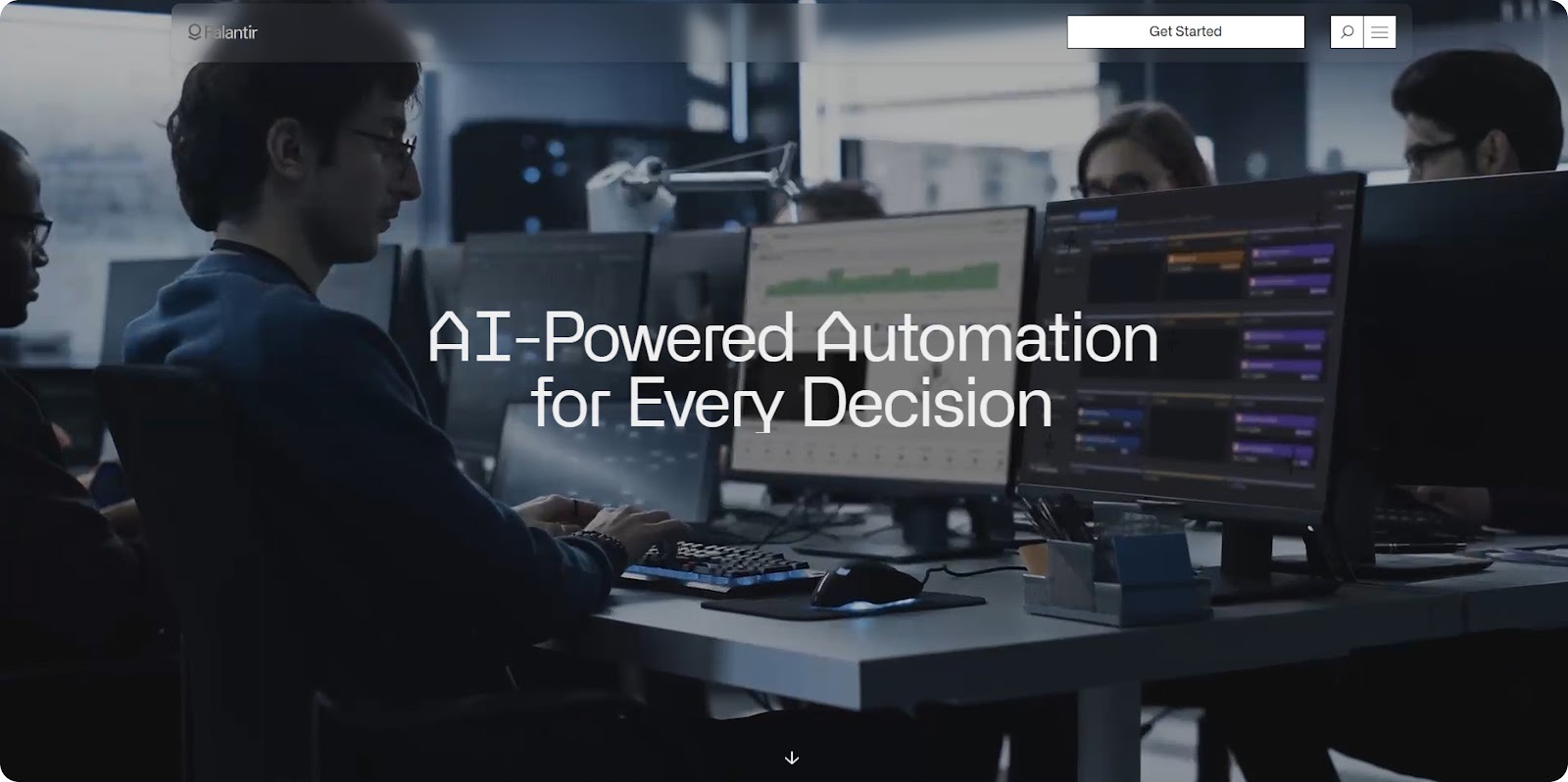
Palantir provides an enterprise AI operating layer designed to unify data, models, and decision workflows across large organizations. Platforms like AIP, Foundry, Gotham, and Apollo allow Human+AI teams to build ontology-driven applications, orchestrate real-time decisions, and deploy mission-critical systems across industries ranging from defense to financial services and healthcare.
- Ontology-Driven Data Modeling: Builds a shared operational model linking data, workflows, and business logic, allowing teams to create applications aligned with real-world entities and decision structures.
- AI Deployment With Artificial Intelligence Platform: Supports multimodal AI workflows across any model or compute environment, allowing enterprises to operationalize AI-driven decisions within existing infrastructure and governance frameworks.
- Foundry Decision Orchestration: Centralizes analytics, applications, and operational workflows, allowing organizations to coordinate complex decisions across distributed Human+AI teams.
- Apollo Continuous Delivery: Manages deployment, monitoring, and updates across hybrid environments, helping enterprises operate software reliably across cloud, edge, and on-premise systems.
Best For: Large enterprises or government organizations needing centralized data platforms, ontology-based AI applications, and end-to-end decision orchestration across complex operational environments and highly regulated infrastructures.
3. Gigster
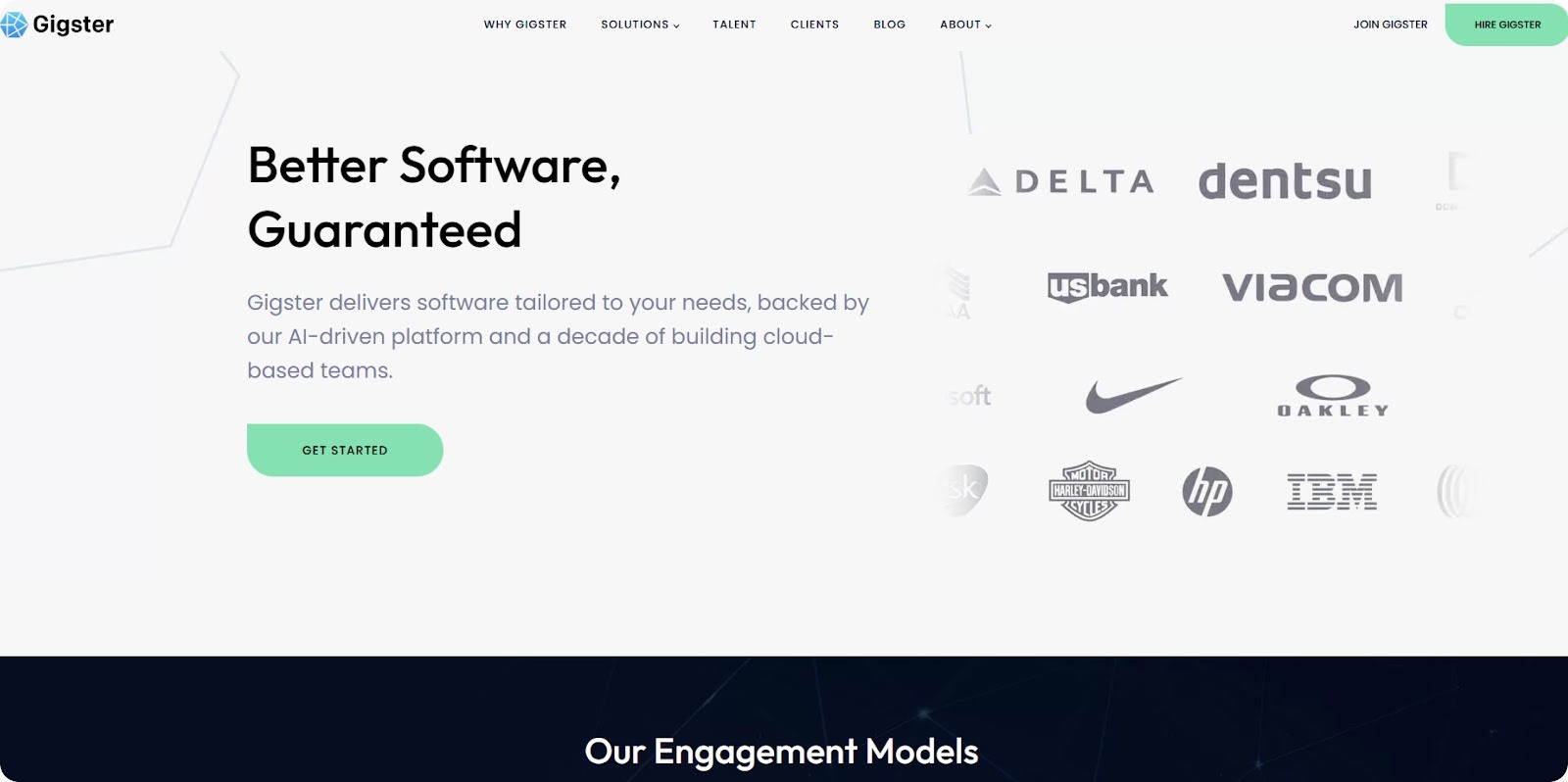
Gigster is an AI-driven software delivery platform that assembles managed development teams to build enterprise applications end-to-end. Instead of sourcing individual freelancers, Gigster combines elite global talent, AI-powered talent matching, and structured delivery frameworks to execute complex software and AI initiatives with predictable timelines and outcomes.
- Fully Managed Delivery Model: Gigster assumes ownership of project execution, managing scope, timelines, and delivery risk while enterprises focus on business outcomes rather than engineering coordination.
- AI-Powered Talent Matching: Uses historical success factors from thousands of engagements to assemble optimized teams of developers, designers, and product experts aligned with project complexity.
- Flexible Engagement Structures: Supports fully managed builds, dedicated teams, or on-demand talent augmentation, allowing organizations to scale resources without traditional hiring overhead.
- Enterprise AI Development Expertise: Builds custom applications, AI solutions, and platform modernization initiatives using structured frameworks designed for large-scale enterprise environments.
Best For: Enterprises needing managed software delivery or custom AI application development without managing distributed engineering teams, particularly for large transformation projects requiring structured execution and guaranteed outcomes.
4. Toptal
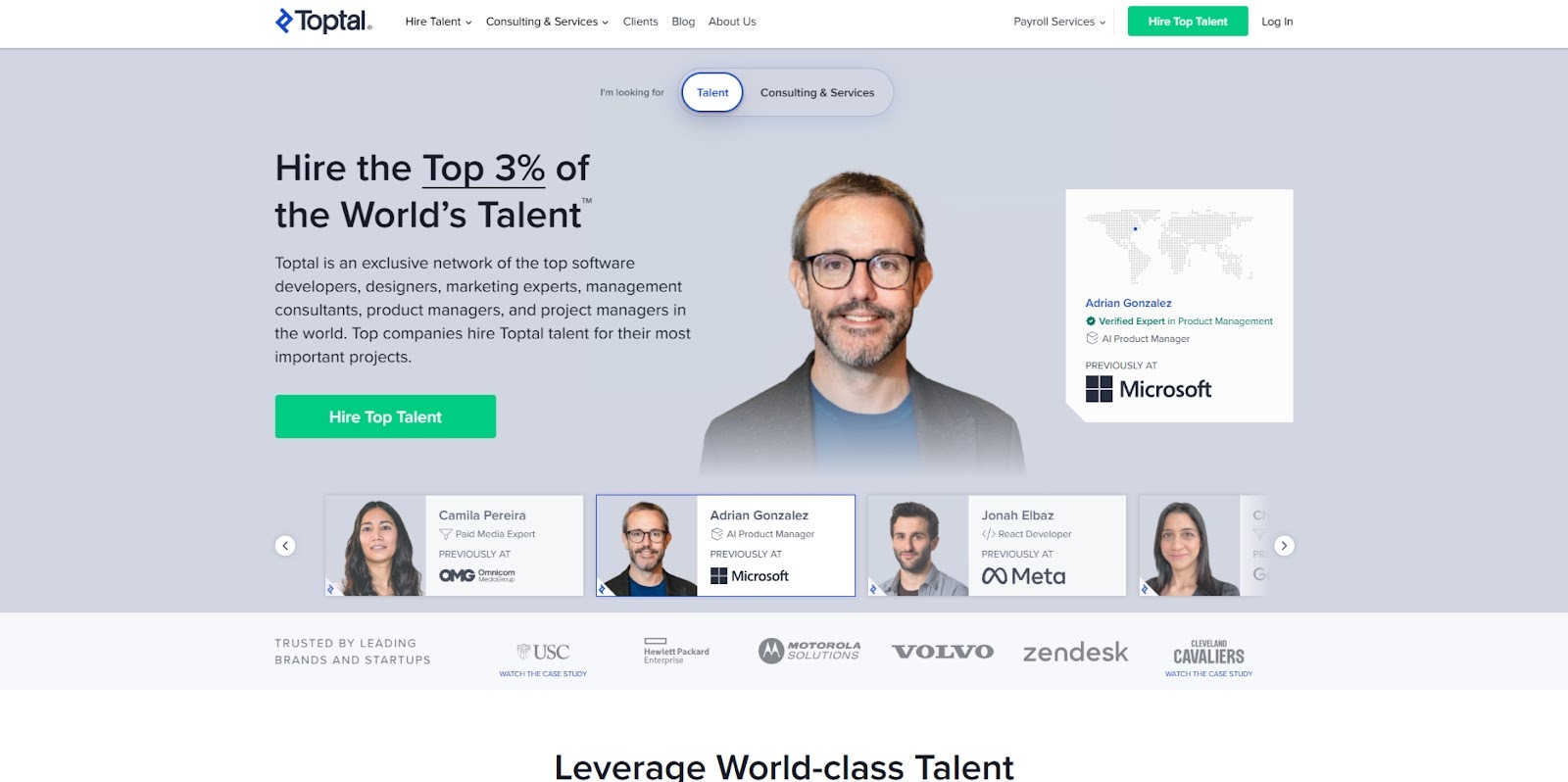
Toptal is a global talent network and managed delivery provider connecting enterprises with vetted engineers, consultants, and automation specialists to build custom workflows, integrations, and scalable software solutions. Rather than offering a fixed platform, Toptal delivers flexible project execution through on-demand experts and structured delivery models that support automation initiatives, system integrations, and enterprise transformation programs.
- Vetted Expert Network: Access senior developers, automation architects, and consultants drawn from a curated global talent pool with experience across cloud, AI, and enterprise systems.
- Custom Workflow Development: Designs customized automation solutions, including process automation, approval systems, and document workflows aligned to specific operational requirements.
- Flexible Delivery Models: Supports managed delivery, dedicated teams, or on-demand specialists, allowing enterprises to scale projects without long-term hiring commitments.
- Workflow Monitoring And Analytics: Provides real-time visibility into automation performance through monitoring tools, analytics dashboards, and optimization strategies to improve operational efficiency.
Best For: Organizations needing highly specialized freelance experts or managed teams to design custom automation solutions, integrate enterprise systems, and execute transformation initiatives without committing to a single software platform.
5. Arc.dev
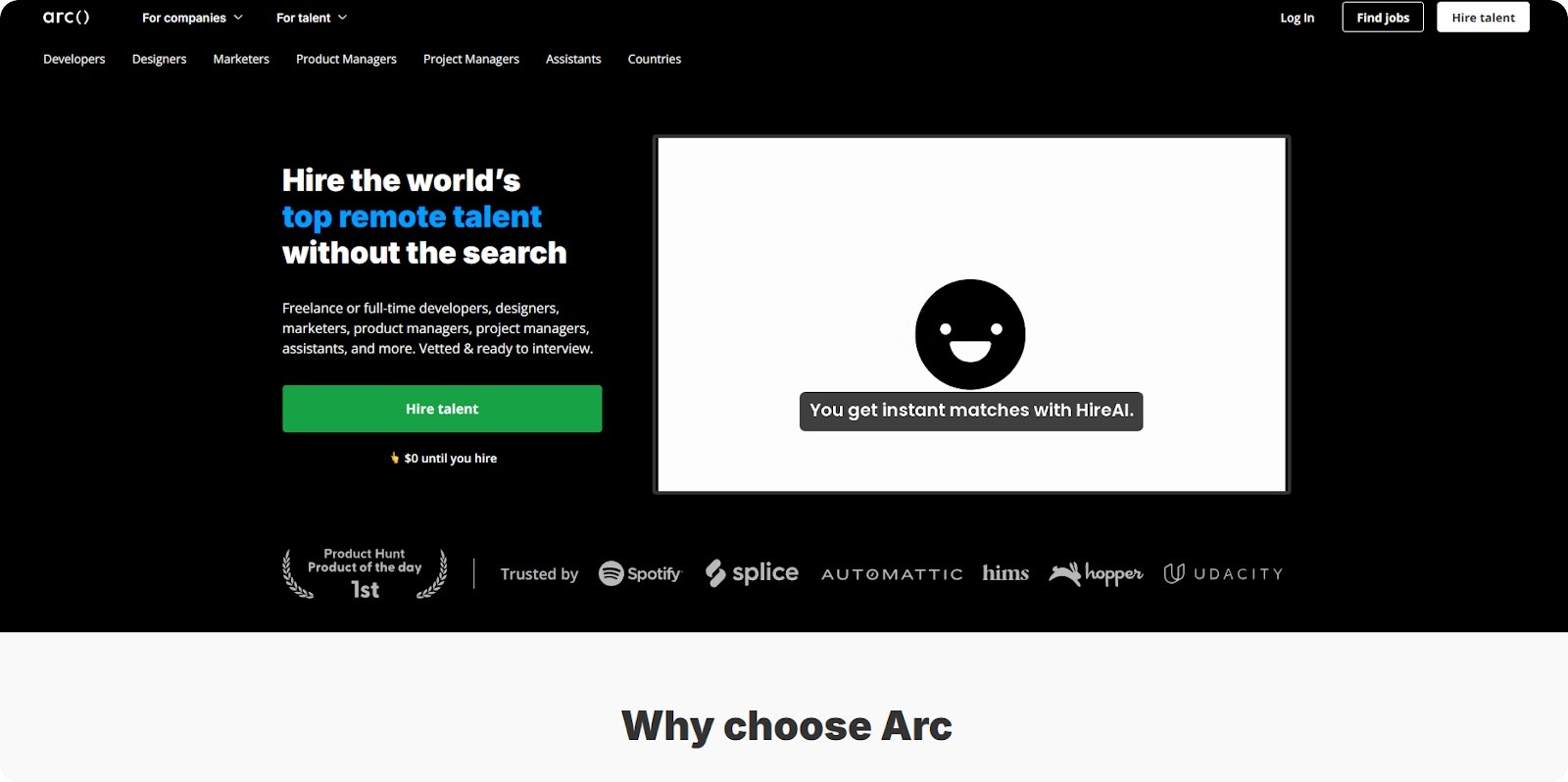
Arc.dev is a remote talent marketplace designed to help companies hire vetted global professionals quickly across engineering, design, product, and marketing roles. Instead of functioning as a software platform, Arc focuses on accelerating distributed hiring through AI-assisted matching, recruiter support, and pre-vetted candidate pools ready for freelance or full-time engagement.
- AI-Powered Candidate Matching: HireAI surfaces pre-qualified candidates instantly, reducing resume screening and allowing companies to review relevant talent profiles within seconds.
- Global Talent Network: Access over 450,000 vetted professionals across 190 countries, allowing organizations to build distributed teams while reducing hiring costs compared to local recruitment.
- Flexible Hiring Models: Supports freelance contracts, full-time remote hires, and global team scaling with dedicated recruiter assistance and compliant hiring workflows.
- Fast Hiring Pipeline: Companies can hire freelancers within 72 hours or fill full-time roles in roughly two weeks through structured vetting and recruiter-led candidate curation.
Best For: Startups and growing tech companies looking to scale distributed teams quickly through vetted remote talent rather than investing in internal recruiting pipelines or long-term staffing infrastructure.
6. CloudDevs
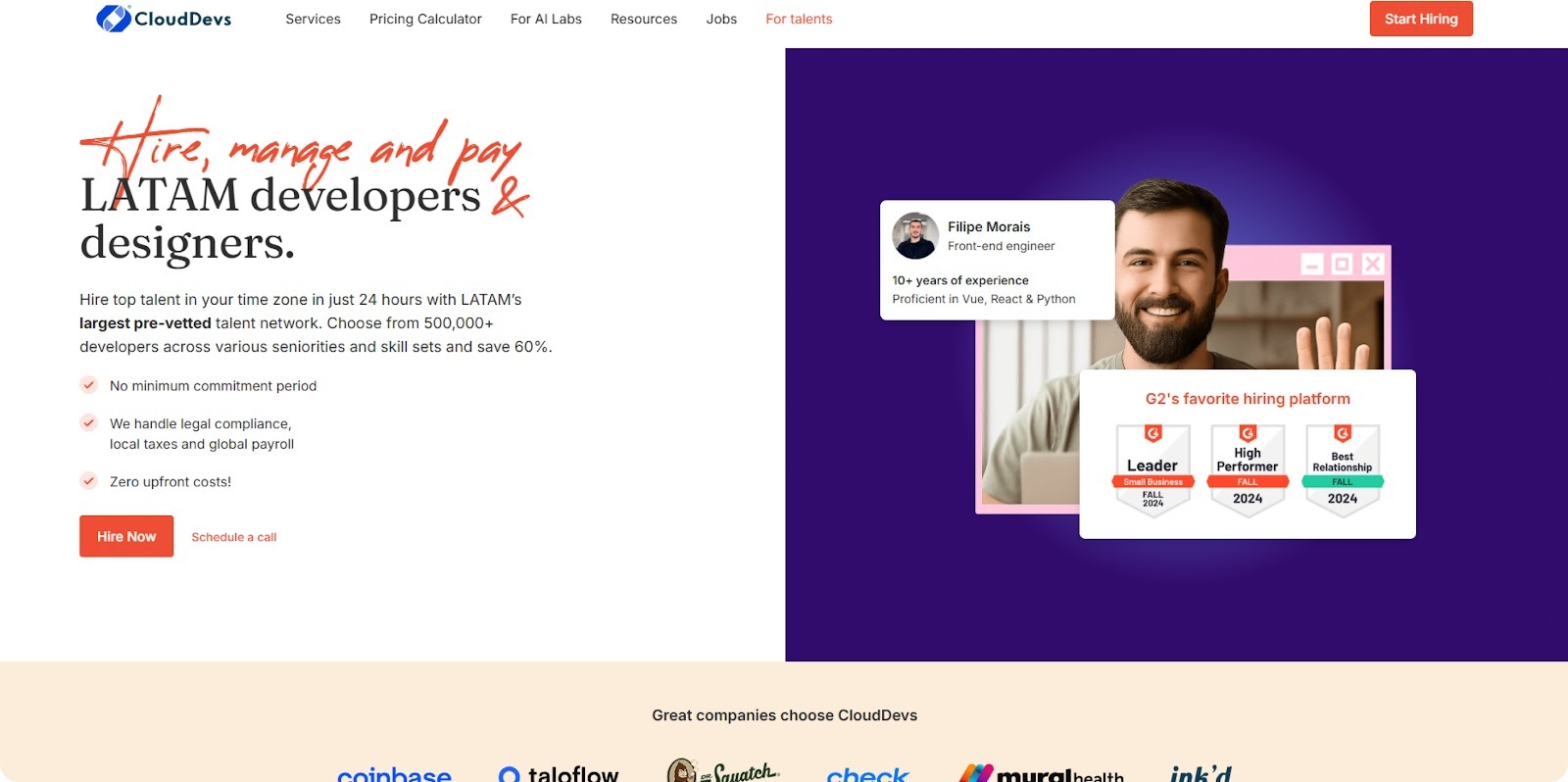
CloudDevs is a nearshore talent platform focused on helping companies hire pre-vetted Latin American developers and designers with strong time-zone alignment to US teams. Rather than providing a software platform or managed delivery model, CloudDevs specializes in fast remote hiring supported by compliance, payroll, and operational infrastructure, allowing companies to scale engineering capacity quickly without navigating international hiring complexity.
- LATAM Talent Specialization: Access a large pool of developers across Latin America with strong English proficiency and time-zone overlap for real-time collaboration with North American teams.
- Quick Hiring Pipeline: Companies can onboard developers within 24 hours through curated matching, technical vetting, and recruiter-assisted candidate selection processes.
- Compliance And Payroll Management: Handles international payroll, local tax compliance, HR support, and healthcare benefits, reducing operational overhead tied to global hiring.
- Flexible Engagement Options: Supports freelance hires, direct placements, and LLM training support, allowing teams to scale engineering resources without long-term contractual lock-ins.
Best For: US-based startups and mid-market companies seeking cost-efficient nearshore engineering talent with strong time-zone alignment rather than full-service software delivery or enterprise workflow automation platforms.
7. BairesDev
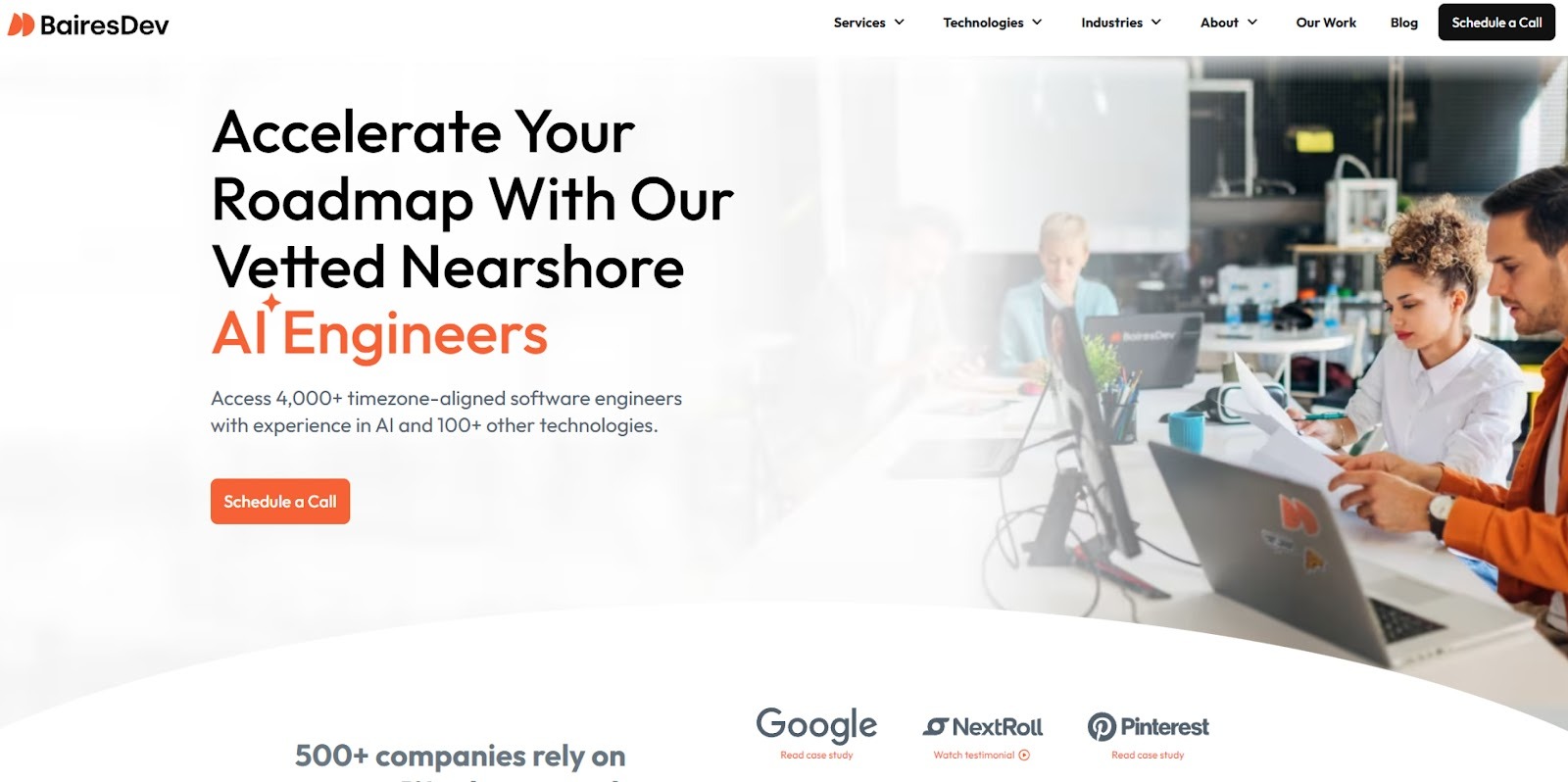
BairesDev is a nearshore software development partner that provides dedicated engineering teams and end-to-end technology services across AI, data science, custom software, and platform engineering. Rather than offering a standalone product, BairesDev focuses on assembling timezone-aligned teams that integrate directly with enterprise workflows to accelerate development roadmaps and deliver large-scale digital initiatives.
- Nearshore Engineering Teams: Access 4,000+ developers aligned with US time zones, allowing real-time collaboration and faster sprint execution within agile delivery environments.
- Full-Stack Development Services: Supports custom software, AI solutions, mobile applications, and infrastructure engineering across modern technology stacks and enterprise architectures.
- Flexible Engagement Models: Offers staff augmentation, dedicated teams, or outsourced delivery structures that adapt to evolving project scope and scaling requirements.
- Quality And Delivery Frameworks: Combines rigorous vetting, QA automation, and performance monitoring to maintain predictable execution across complex multi-team software initiatives.
Best For: Enterprises needing scalable nearshore engineering capacity or full-service development partnerships to accelerate product delivery, modernize platforms, or expand AI and data engineering initiatives.
Across these categories, the real difference comes down to execution models, not feature lists. Enterprise leaders evaluate whether they need agentic workflow orchestration, managed delivery ownership, or scalable outsourcing capacity, depending on how AI connects to real operations.
Hiring Developers vs Deploying Agentic Workflows
Enterprises evaluating Turing alternatives are shifting from scaling headcount to deploying agentic systems that execute workflows autonomously, reducing coordination overhead and accelerating production outcomes consistently.
Operational differences between hiring models and agentic workflow deployment become clear when you look at execution ownership, architecture, scalability mechanics, governance layers, and integration depth.
Teams moving beyond hiring models gain predictable execution by embedding AI into workflows themselves, turning engineering effort into orchestrated operational outcomes that scale across systems.
Still mapping how autonomous workflows fit into real enterprise execution? Start with Top Key Differences Between AI Agents and Agentic AI
Real Enterprise Use Cases Driving the Shift Away From Talent Platforms
Enterprises are replacing talent marketplaces with execution partners that deploy agentic workflows, automate regulated operations, and deliver measurable business outcomes instead of adding outsourced developer capacity.
Enterprise buyers evaluating alternatives increasingly focus on execution scenarios where outsourcing developers cannot deliver operational scale, governance, or continuous orchestration across enterprise systems.
- Regulated Workflow Automation: Healthcare SaMD pipelines and fintech KYC programs require embedded compliance logic, audit trails, and policy enforcement executed directly inside agentic workflows rather than outsourced code delivery.
- End-To-End Operations Orchestration: Lending intake, underwriting, and servicing flows demand coordinated actions across CRM, document systems, and decision engines without manual vendor coordination.
- AI Deployment Without Internal AI Teams: Enterprises building models still need orchestration layers to connect AI outputs with ERP workflows, approval chains, and operational triggers across departments.
- Revenue Operations Automation: Cloud partner funding workflows demonstrate how agents gather inputs, validate eligibility, and submit applications autonomously, replacing fragmented outsourced operational processes.
- High-Volume Lead Processing: Agentic qualification workflows monitor signals, enrich data, and route leads through CRM pipelines automatically, reducing reliance on outsourced SDR execution models.
Enterprises shifting away from talent platforms are prioritizing execution ownership, production governance, and persistent workflow orchestration, treating AI agents as operational infrastructure rather than external engineering services.
Want to see how agentic execution actually plays out across real business processes? Start with What are AI Agent Workflows? Top Use Cases With Examples
How to Evaluate Turing Alternatives as an Enterprise AI Leader
Enterprise AI leaders evaluating Turing alternatives focus on execution ownership, agentic workflow capability, governance depth, and operational scalability rather than outsourcing speed or developer volume alone.
Evaluation lenses enterprise AI leaders apply when comparing outsourcing vendors, managed delivery partners, and agentic workflow platforms include the following technical and operational criteria.
- Execution Ownership Model: Determine if vendors deliver scoped engineering services or own workflow outcomes, SLAs, and operational performance across multi-system enterprise environments.
- Agentic Workflow Capability: Assess support for multi-stage orchestration, contextual decisioning, and autonomous task chaining instead of isolated automation scripts or RPA-style triggers.
- Enterprise Governance Controls: Validate audit trails, execution monitoring, and role-based access enforcement required for regulated financial services, insurance, and enterprise operations workflows.
- Integration Depth Across Systems: Confirm native connections into CRM, ERP, and internal platforms without fragile middleware layers that slow deployment and increase maintenance overhead.
- Operational Cost Structure: Compare long-term outsourcing spend against lifecycle automation value, focusing on reduced manual coordination once agentic workflows operate continuously in production.
Enterprise AI leaders evaluating Turing alternatives succeed when platform decisions align with operational execution models, governance requirements, and long-term workflow scalability across distributed enterprise systems.
Final thoughts!
Enterprise teams are realizing that progress rarely comes from adding another outsourcing layer. What changes outcomes is how work flows once AI moves into daily execution. The strongest platforms connect strategy with real operational results, allowing workflows to adapt as business priorities shift.
That is where NuPilot enters the picture, helping teams translate complex operational goals into agentic workflows that execute with consistency across enterprise systems. NuPilot connects AI logic directly to the work your teams already manage, turning fragmented processes into coordinated execution without adding overhead. If you are rethinking how work actually moves through your organization, it might be time to see what agentic orchestration looks like in practice.
Talk to our team and explore how NuPilot can turn an AI strategy into workflows that deliver real outcomes.