
Most AI agent projects do not fail in the demo. They fail later, when the agent has to pull data from a customer relationship management system, follow approval rules, hand work to another team, and explain what happened when something goes wrong.
That is why choosing the best ai agent framework is a production decision, not just a build decision. For enterprise teams, the right framework has to support orchestration, integrations, monitoring, and control from the start.
Executive Summary: The best AI agent framework is the one that helps enterprise teams move from prototypes to controlled production workflows. This guide explains how to evaluate frameworks by orchestration, integration depth, observability, security, voice readiness, and cost. It also shows why enterprise AI agents need a foundation that can execute work, not just generate responses.
TL;DR
- AI agent framework selection is an operational risk decision: Enterprises should evaluate frameworks based on how safely they can run real workflows, not how advanced they sound.
- Start with the workflow before choosing the tool: The right framework depends on the use case, required autonomy, system access, human review needs, and business outcome.
- Governance is central to production readiness: Strong access controls, audit trails, escalation rules, and performance monitoring help prevent AI agents from creating unmanaged risk.
- Not every workflow needs an AI agent: Some use cases are better served by simple automation or AI assistants when full agentic decision-making is unnecessary.
- Enterprise value depends on measurable outcomes: A framework should prove impact through metrics such as resolution time, containment, lead qualification speed, workflow completion, and human touchpoint reduction.
- NuPlay supports governed customer-facing automation: NuPlay helps enterprises deploy AI voice and chat agents across sales, support, and service workflows with the integrations, analytics, and controls needed to scale responsibly.
What Is an AI Agent Framework?
An AI agent framework is the foundation a team uses to build, connect, and control AI agents. Instead of starting from scratch, the framework gives developers and enterprise teams the structure for how an agent understands a request, decides what to do next, uses tools, retrieves information, and completes a task.
That matters because enterprise AI agents are expected to do more than answer questions. A chatbot may respond to a customer, and a large language model may generate text. An AI agent framework helps turn that intelligence into a working system that can follow steps, call an application programming interface, check a database, update a customer relationship management system, or send work to a human team.
Most frameworks include a few core pieces. Orchestration decides which step, tool, or agent should act next. Memory helps the system keep useful context across a task or conversation. Tool calling lets the agent connect with external systems. Retrieval-augmented generation, or RAG, helps the agent pull answers from approved company knowledge instead of relying only on model memory. Monitoring shows what the agent did, where it failed, and how teams can improve it.
For example, a support agent may receive a delivery question from a customer. The framework can help the agent identify the intent, verify the customer, pull the order status, update the ticket, and escalate the issue if the case is too complex. Without a framework, each step has to be custom-built and managed separately.
This is also why the buyer is not only an engineering leader. Support, sales, operations, compliance, and revenue teams all feel the impact when an agent misses context, routes work incorrectly, or acts without enough visibility.
For enterprise teams, the best ai agent framework is the control layer that helps AI agents move from isolated responses to reliable, governed workflows.
Why the “Best” AI Agent Framework Depends on the Workflow
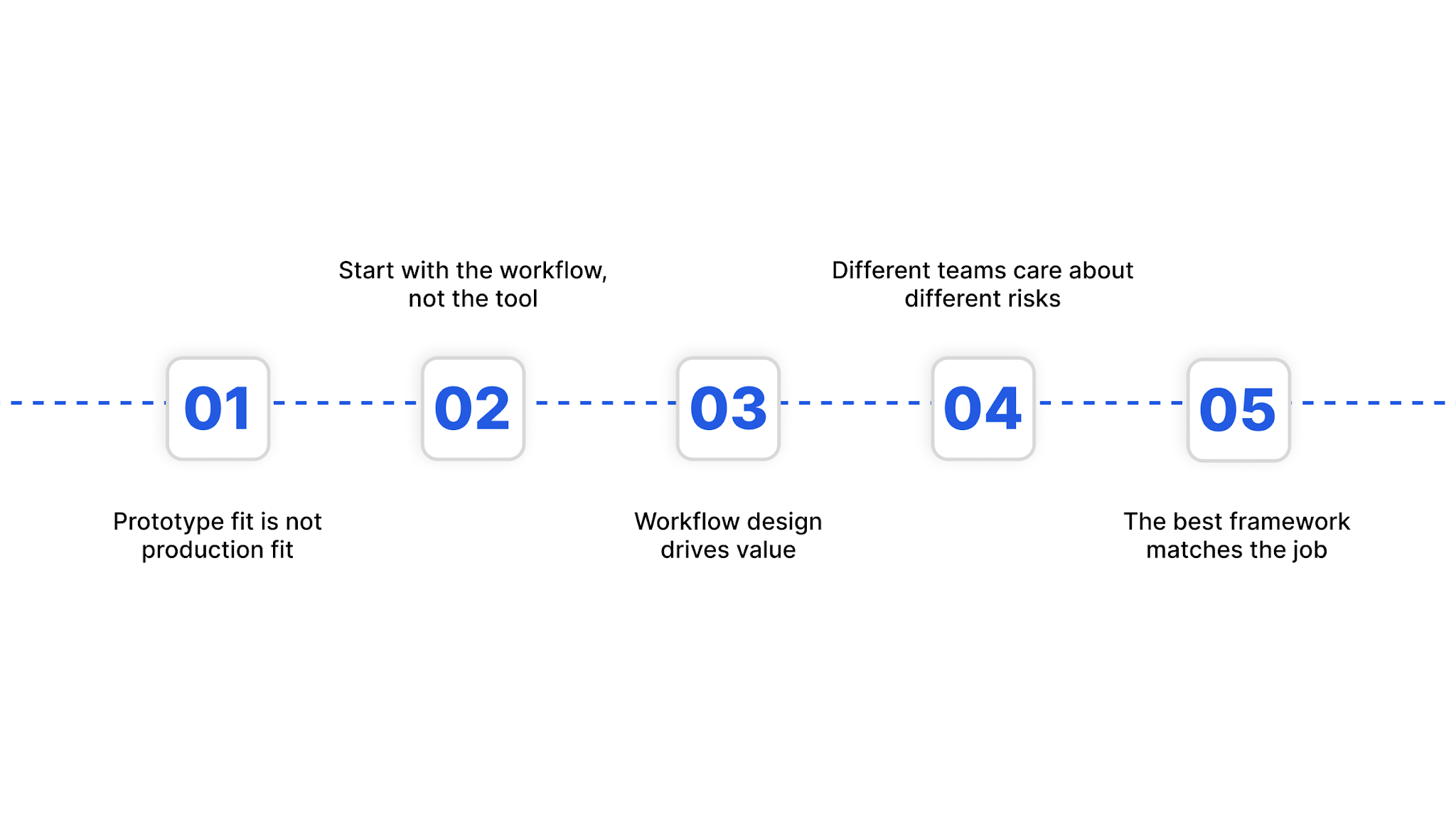
Choosing the best ai agent framework becomes easier when you stop looking at frameworks as generic tools. In enterprise environments, the right choice depends on the workflow the agent needs to complete, the systems it must connect with, and the level of control your team needs once the agent is live. Here are the main reasons why the best AI agent framework depends on your custom workflow:
- Prototype fit is not production fit: A framework that helps your team build a quick demo may not hold up when the agent has to work with live customers, real systems, and messy inputs. Production agents need error handling, escalation rules, monitoring, and governance from day one.
- Start with the workflow, not the tool: A support agent, sales agent, and document-processing agent all need different capabilities. One may need call handling and ticket updates, while another may need lead routing, calendar booking, or document review.
- Workflow design drives value: Enterprise AI works best when it is built into daily operations, not added as a separate experiment. McKinsey’s State of AI survey found that workflow redesign had the biggest effect on whether organizations saw earnings before interest and taxes impact from generative AI.
- Different teams care about different risks: A chief technology officer may care about architecture and security, while a support leader may care about containment and escalation quality. The right framework should give each team enough visibility and control without slowing the workflow down.
- The best framework matches the job: There is no single best AI agent framework for every enterprise. The right choice is the one that can support the full workflow, from the first request to the final action, with enough control to improve over time.
Core Evaluation Criteria for Enterprise AI Agent Frameworks
Once you know the workflow, evaluate the AI agent framework like an operating layer, not just a development tool. The question is not only whether your team can build an agent. It is whether the agent can run safely across real conversations, systems, approvals, and business rules.
This matters more in enterprise environments because AI agents often touch customer data, revenue workflows, support queues, and internal operations. A weak framework may still produce a good demo, but it can create gaps when the agent has to retrieve data, update systems, escalate cases, or explain its decisions.
Use the checklist below to compare frameworks with practical selection in mind.
Enterprise AI Agent Framework Evaluation Checklist
- Workflow orchestration
- Can the framework manage multi-step tasks and route work between agents or systems?
- Can it maintain context across different stages of a workflow?
- Does it support approvals, escalations, and exception handling?
- System integrations
- Can it connect with customer relationship management systems, enterprise resource planning platforms, helpdesks, databases, and internal APIs?
- Can agents both retrieve information and take actions within connected systems?
- How much custom development is required for integrations?
- Voice and chat capabilities
- Does it support both voice and text interactions?
- Can it handle interruptions, long conversations, and context switching?
- Does it maintain a consistent experience across channels?
- Observability and monitoring
- Can teams track response quality, latency, task completion rates, and escalation frequency?
- Are conversation logs and workflow traces available for troubleshooting?
- Does it provide actionable insights for optimization?
- Governance and security
- Does it support role-based access controls and audit trails?
- How does it handle sensitive data and personally identifiable information?
- Does it align with your organization's compliance requirements?
- Scalability and maintenance
- Can the framework support additional workflows, teams, and channels without major redesign?
- How easy is it to update workflows and agent behavior over time?
- Does it minimize ongoing operational overhead?
A practical way to evaluate any framework is to map it against one real workflow. For example, take a support call, lead qualification flow, contract review process, or internal ticketing workflow. Then ask whether the framework can handle every step from the first request to the final action.
This is where enterprise-focused platforms become easier to assess. NuPlay, for example, is relevant when the workflow needs voice and chat AI agents, orchestration, integrations, observability, and security in one production-ready setup. The point is not to choose the most complex framework. It is to choose the one that reduces the most operational gaps for the workflow you actually need to automate.
Best Types of AI Agent Frameworks by Enterprise Use Case
Not every AI agent framework is built for the same kind of work. Some are useful for technical teams building custom agents from scratch. Others are better suited for customer-facing workflows where agents need to speak, listen, retrieve information, update systems, and hand work off with context.
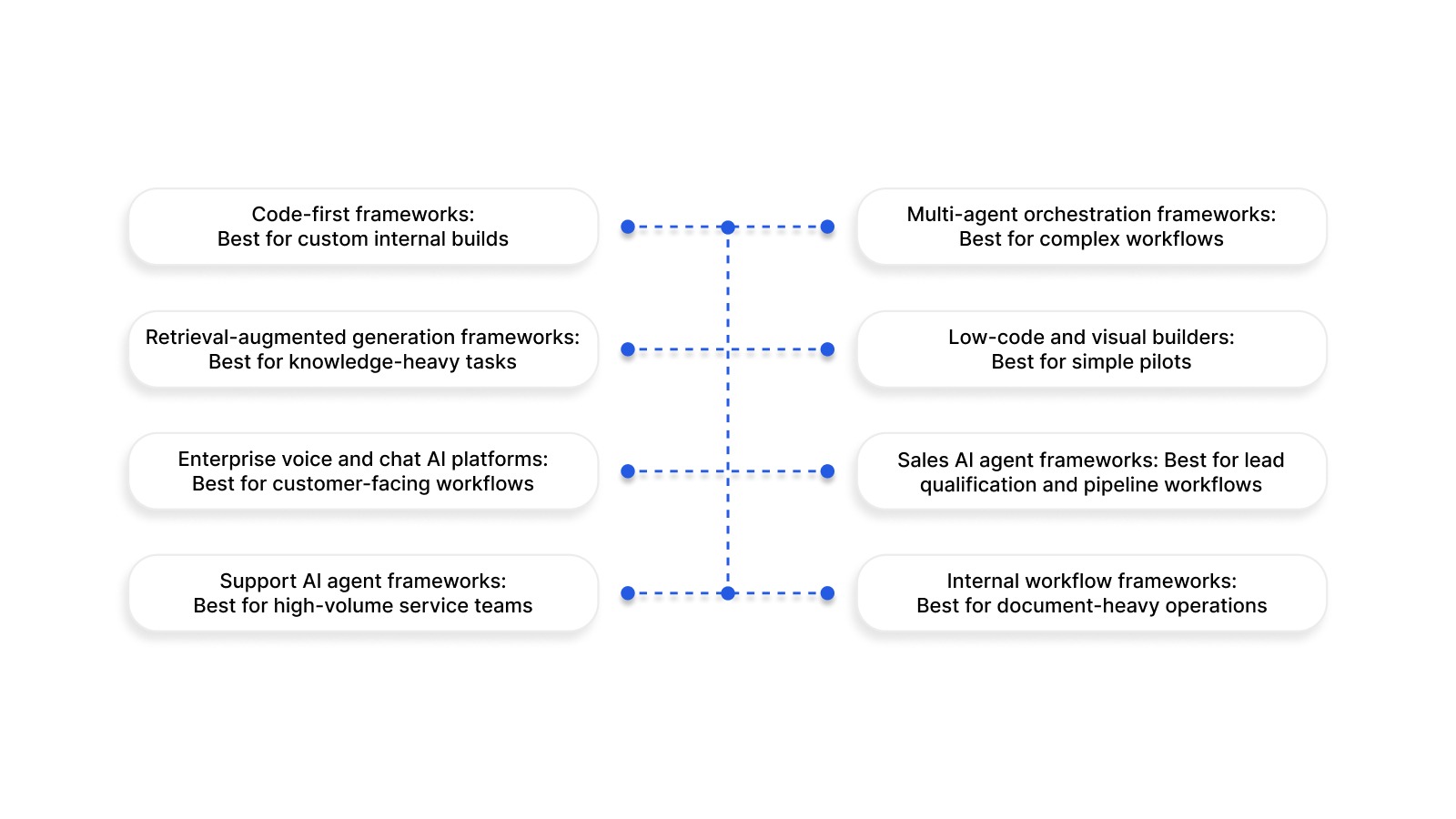
For enterprise buyers, the better question is not “Which framework has the most features?” It is “Which framework type fits the workflow we need to automate?”
- Code-first frameworks: Best for custom internal builds
Code-first frameworks work well when engineering teams want full control over agent logic, tools, memory, and model behavior. They are useful for experiments, internal applications, and highly customized workflows.
The tradeoff is that your team may need to build or assemble many production layers separately, including monitoring, governance, voice capability, security controls, and enterprise integrations. - Multi-agent orchestration frameworks: Best for complex workflows
Multi-agent orchestration frameworks are useful when one agent cannot handle the entire task alone. For example, one agent may classify intent, another may retrieve data, and another may route the request or trigger the next action.
This type of framework fits workflows with multiple steps, approvals, and handoffs. It becomes especially important when the goal is not just to answer a question, but to complete a process across teams and systems. - Retrieval-augmented generation frameworks: Best for knowledge-heavy tasks
Retrieval-augmented generation, or RAG, helps agents pull information from approved company sources before responding. This is useful for support knowledge bases, policy documents, product information, internal playbooks, and research-heavy workflows.
RAG alone is not always enough for enterprise automation. If the agent also needs to update records, escalate cases, book meetings, or route work, it must connect with orchestration and system integrations. - Low-code and visual builders: Best for simple pilots
Low-code frameworks can help teams test AI agent workflows quickly without heavy development effort. They are useful for simple internal workflows, early proofs of concept, or teams that want to validate demand before investing in a full deployment.
The risk is that low-code setups may become limiting when workflows require advanced voice handling, deeper integrations, auditability, or strict governance. They should be evaluated carefully before being used for high-volume enterprise processes. - Enterprise voice and chat AI platforms: Best for customer-facing workflows
Enterprise voice and chat AI platforms are a stronger fit when agents need to handle live conversations across sales, support, and operations. These workflows often require low-latency voice, long-context handling, human handoffs, customer relationship management updates, and real-time monitoring.
This is where NuPlay becomes relevant. It is built for enterprise-grade voice and chat AI agents that can support orchestration, integrations, observability, and security in one production-ready setup. - Sales AI agent frameworks: Best for lead qualification and pipeline workflows
Sales workflows need agents that can capture intent, ask qualification questions, route prospects, schedule meetings, and update the customer relationship management system. A basic agent framework may help with conversation, but it may not support the full revenue workflow.
For teams focused on lead engagement, guided selling, or sales development representative automation, Sales AI Agents are a better fit than a generic framework that stops at tool calling. - Support AI agent frameworks: Best for high-volume service teams
Support workflows need fast responses, accurate routing, ticket creation, escalation logic, and visibility into customer issues. If the agent cannot resolve or route requests with context, it may reduce response time but still create operational friction.
For contact centers, service teams, and customer experience leaders, Support AI Agents are more relevant when the goal is to reduce wait times, improve containment, and keep handoffs clean. - Internal workflow frameworks: Best for document-heavy operations
Some enterprise agents do not talk to customers at all. They help teams process requests, read documents, summarize information, route approvals, or extract data from contracts, proposals, and reports.
For these use cases, an AI Work Assistant is more useful than a conversation-only framework. The priority is not just natural language response, but reliable document handling, routing, traceability, and human review where needed.
The practical takeaway is simple: choose the framework type based on the workflow. If your team is building a small internal prototype, a flexible code-first framework may be enough. If the agent needs to handle real customers, voice conversations, sales handoffs, support queues, or document-heavy workflows, enterprise readiness matters much more.
That is why the best AI agent framework is not always the most flexible one. It is the one that can carry the workflow from first input to final action with the right balance of automation, control, visibility, and human oversight.
Why Production AI Agents Need More Than a Developer Framework
So far, we have talked about framework types, workflow fit, and evaluation criteria. But here is the real question enterprise teams should ask before choosing any AI agent framework:
What happens after the demo works?
That is usually where the gap appears. A developer framework may help your team build an agent that can reason, call tools, and complete a controlled task. But production is different. Real users ask unclear questions, systems fail, data is incomplete, and some decisions need human approval.
This is where a framework needs to do more than help you build. It needs to help you operate.
- What happens when the agent gets the answer wrong?
In a demo, a wrong answer is a small issue. In production, it can create a bad customer experience, a compliance concern, or extra work for your team.
Your framework should make it easy to review responses, trace the source of the answer, and improve the agent without rebuilding the entire workflow. - What happens when a connected system fails?
AI agents often depend on customer relationship management systems, helpdesks, calendars, databases, and internal application programming interfaces. If one system fails, the agent should not simply stop or guess.
Look for fallback logic, escalation paths, retry rules, and clear failure handling. These are the details that separate a usable production agent from a fragile prototype. - What happens when the task needs a human?
Not every workflow should be fully automated. A high-value lead, frustrated customer, unusual support case, or sensitive document may need a human decision.
A production-ready framework should support human-in-the-loop handoffs with full context. The human should see what the agent captured, what it tried, and why the case needs review. - What happens when the conversation moves across channels?
Enterprise customers may start on chat, continue on voice, and later follow up by email or text. If the agent loses context between channels, the customer experience breaks.
For customer-facing workflows, the framework should support continuity across voice, chat, and connected systems. Otherwise, your team may reduce response time but still create repeated explanations and messy handoffs. - What happens after launch?
Many teams plan for deployment but not optimization. Once the agent is live, you need to know where people drop off, which intents fail, how often escalations happen, and which workflows actually complete.
This is why observability matters. A production agent should come with logs, metrics, conversation review, and performance signals your support, sales, operations, and compliance teams can use.
A simple way to test any framework is to map one real workflow from start to finish. Then ask:
- Can the agent understand the request?
- Can it retrieve the right information?
- Can it take action inside the right system?
- Can it escalate with context?
- Can your team monitor what happened?
- Can you improve the workflow without starting again?
If the answer is no, the framework may still be useful for development, but it is not enough for production.
The real value of enterprise AI agents comes from reliable execution. That means the framework must support not only reasoning and tool use, but also orchestration, monitoring, governance, system integration, and human oversight.
Where NuPlay Fits in Enterprise AI Agent Framework Decisions
AI agent frameworks are becoming central to how enterprises automate conversations, decisions, and workflows. But choosing one is not just about features or model capabilities. It is about selecting a platform that can perform reliably in production, integrate with existing systems, control risk, and show measurable business value.
Start with operational risk, not the framework name
Choosing an AI agent framework is not only a technical decision. It is an operational risk decision. The wrong framework can create unowned automations, weak handoffs, uncontrolled data access, poor audit trails, and workflows that look impressive in a demo but fail under real customer volume.
That risk is not theoretical. Gartner predicts that over 40% of agentic AI projects will be canceled by the end of 2027 because of escalating costs, unclear business value, or inadequate risk controls. Gartner also estimates that only about 130 of the thousands of agentic AI vendors are truly agentic.
Evaluate the framework by production readiness
A risk-first AI agent framework decision should look at seven areas: use-case fit, integration depth, permission controls, auditability, escalation design, performance analytics, and measurable ROI.
This matters because agentic AI is moving from experimentation into business execution. Gartner predicts that by 2028, 15% of day-to-day work decisions will be made autonomously through agentic AI, and 33% of enterprise software applications will include agentic AI, up from less than 1% in 2024. The question is no longer whether AI agents will enter enterprise workflows. The question is whether they will be governed well enough to create value without increasing exposure.
Use governance as a value driver
The strongest AI agent frameworks are not the ones with the most impressive demos. They are the ones that can be governed, measured, and improved inside real workflows.
McKinsey’s AI research shows that bottom-line impact is linked to governance, workflow redesign, KPI tracking, adoption roadmaps, feedback loops, and trust-building practices. That makes governance a growth enabler, not just a compliance requirement.
Reduce avoidable AI security exposure
The risk case is clear. IBM’s 2025 Cost of a Data Breach Report puts the global average breach cost at USD 4.44 million and found that 97% of organizations with an AI-related security incident lacked proper AI access controls. It also found that 63% lacked AI governance policies, while extensive use of AI in security delivered USD 1.9 million in cost savings compared with organizations that did not use those solutions.
For enterprise leaders, the framework choice becomes practical: select the platform that can connect to real systems, control what agents can do, measure outcomes, and keep humans in the loop where risk is high.
Where NuPlay fits
This is where NuPlay fits into the decision. NuPlay is built for enterprise customer-facing teams that need AI voice and chat agents to engage, qualify, resolve, and hand off conversations reliably in production.
Nurix positions NuPlay as more than a chatbot layer, with enterprise capabilities across analytics, security, integrations, access controls, auditability, and CRM or ticketing workflows. Instead of adding another disconnected AI tool, NuPlay gives teams a production-ready way to deploy voice and chat agents with the controls, analytics, and integrations needed to scale responsibly.
To see how this works for your workflows, talk to Nurix and explore how NuPlay can help your team automate customer-facing operations without creating new operational risk.
Conclusion
Choosing an AI agent framework is not about selecting the most advanced-sounding tool. It is about choosing a platform that can support real enterprise work without creating avoidable operational risk. The right framework should connect to existing systems, control what agents can do, provide visibility into performance, support human handoffs, and prove business value through measurable outcomes.
That is why the decision should start with the workflow, not the technology label. Enterprises need to ask where AI agents can safely create value, where automation is enough, and where human review still matters. This is especially important as Gartner warns that many agentic AI projects may be canceled because of cost, unclear value, or inadequate risk controls.
This is also where NuPlay becomes relevant for enterprise teams. NuPlay gives businesses a production-ready way to deploy AI voice and chat agents across customer-facing workflows such as sales, support, lead qualification, and service resolution. With enterprise capabilities across integrations, analytics, security, auditability, and human handoff, NuPlay helps teams move from AI experimentation to governed execution.
If your team is evaluating AI agent frameworks for real customer operations, talk to Nurix to see how NuPlay can help you automate conversations, improve workflow efficiency, and scale AI agents without adding unnecessary operational risk.