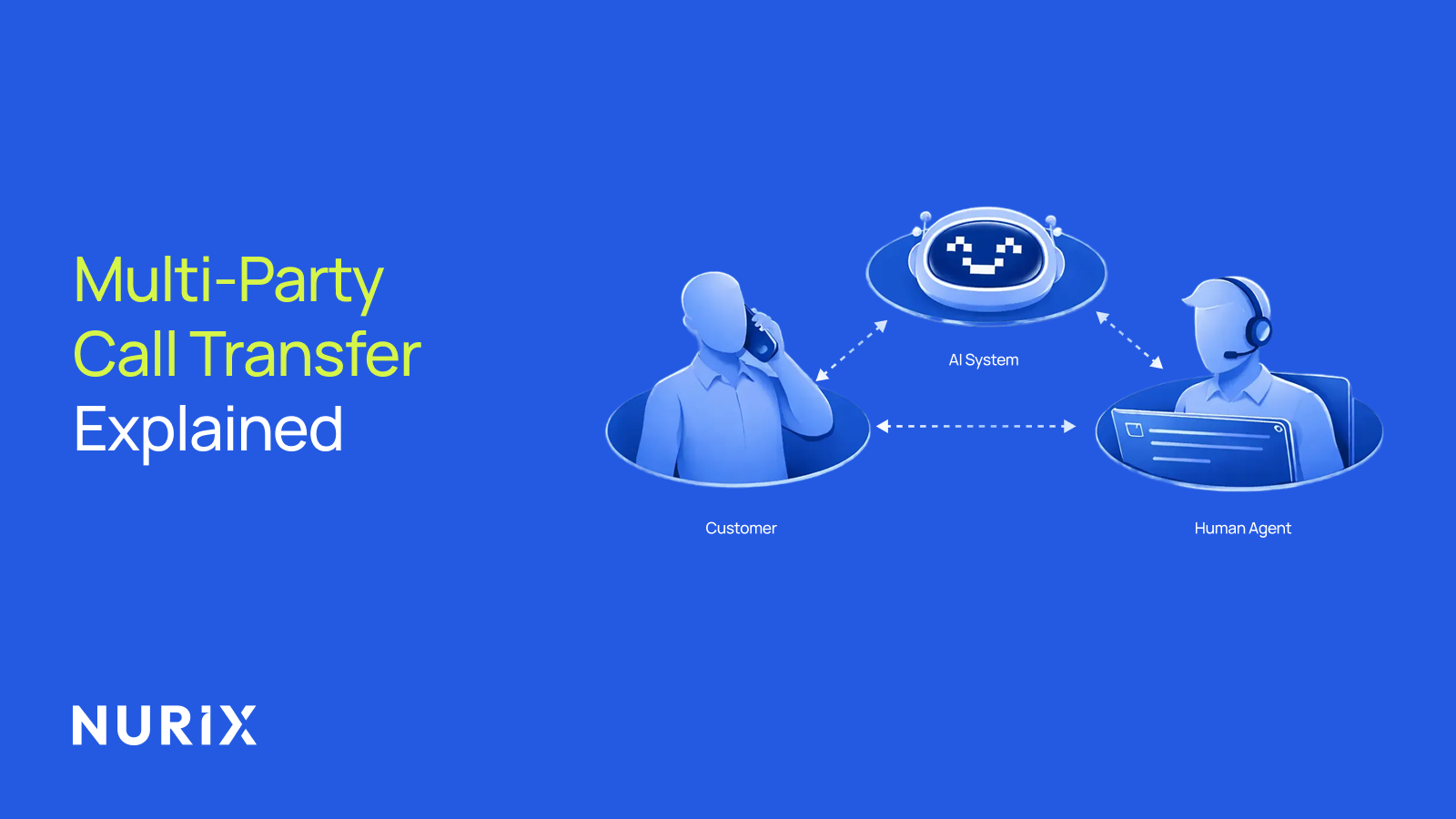

For decades, enterprise voice support operated on a simple two-party structure: a customer and a human agent. While functional, this model was never designed for real-time AI voice orchestration, intelligent context preservation, or seamless call transitions.
As customer expectations accelerate and operational costs rise, enterprises deploying AI voice agents are rethinking how live conversations should function. Today, AI is no longer limited to deflection or menu routing. It is becoming an active third participant in live customer conversations preserving context, coordinating specialists, and assisting human agents in real time.
This shift marks a structural evolution in how enterprise contact centers operate.
Key Takeaways
- Enterprise voice support is evolving from a two-party model to a Multi-Party model where AI acts as an active third participant alongside the customer and the human agent. Modern AI voice agents are no longer limited to routing; they orchestrate entire conversations.
- Traditional IVR and routing systems lose context during transfers, leading to repetition, higher average handle time (AHT), and lower first contact resolution (FCR). According to the SQM Group Call Center Industry Benchmark Report, FCR rates typically range between 70–75%, meaning repeat contacts remain a major operational cost driver.
- Reducing customer effort is directly tied to loyalty and cost efficiency. Research from Gartner and Forrester highlights that eliminating repetition and friction is one of the strongest predictors of customer satisfaction and retention.
- AI voice orchestration preserves conversation state across transitions, enabling seamless specialist coordination and real-time backend execution through deep enterprise integrations.
- Multi-Party Call Transfer reduces repeat calls, improves FCR, lowers AHT, and enhances customer satisfaction. McKinsey research indicates AI-enabled automation can reduce customer service operational costs by up to 30% when implemented strategically (McKinsey AI productivity research).
- The shift from routing to orchestration marks the next phase of contact center modernization moving from automation experiments to scalable enterprise AI agents that manage end-to-end service workflows.
What Is Multi-Party Call Transfer?
Multi-Party Call Transfer is Nurix’s enterprise framework where AI operates as a continuous third participant in live customer conversations—coordinating between the customer and the human agent during before, during and after call transfer.
Powered by NuPlay, Nurix’s enterprise AI voice platform, this model ensures that AI:
- Captures structured intent from the first second of engagement
- Preserves conversation state across transfers
- Coordinates and briefs human specialist before they join the call
- Assists human specialist during the live interaction
- Executes backend actions across enterprise systems
Unlike traditional IVR systems that exit once escalation occurs, NuPlay by Nurix’s orchestration engine stays embedded in the conversation lifecycle.
This is the architectural foundation of modern enterprise voice support.
Why Traditional Call Transfers Fail
Legacy contact center systems rely heavily on IVR and static routing logic. While effective at distributing call volume, these systems struggle with context continuity.
According to the SQM Group Call Center Industry Benchmark Report, average First Contact Resolution (FCR) rates across call centers range between 70–75%, meaning up to 30% of issues require repeat contact.
Additionally:
- McKinsey & Company reports that improving customer experience can reduce service costs by 15–20% when automation is properly implemented.
- Forrester Research consistently ranks “having to repeat information” among the top customer service frustrations.
- Gartner research on customer effort highlights that reducing customer effort is one of the strongest predictors of loyalty in service interactions.
Fragmented automation contributes directly to:
- Increased average handle time (AHT)
- Lower first contact resolution (FCR)
- Higher abandonment rates
- Reduced CSAT and NPS
Organizations investing in AI call center automation are increasingly recognizing that routing alone does not solve context fragmentation.
The issue is not automation itself. It is automation without orchestration.
The Business Cost of Poor Transfers
The financial impact of inefficient transfers is significant.
According to the ContactBabel U.S. Contact Center Decision-Makers Guide, the average cost per inbound live call ranges between $5–$12 depending on complexity and industry. Repeat contacts increase total resolution cost by 15–40%.
For enterprises processing millions of calls annually, even a small reduction in repeat interactions translates into millions in operational savings.
This is why orchestration, not just deflection, is becoming a strategic investment area for enterprise leaders.
Industry Shift Toward Orchestration
Enterprise analysts increasingly point to AI-enabled workflow automation as a structural shift in service operations.
- Gartner’s forecast on conversational AI in contact centers predicts significant labor cost reductions as AI adoption accelerates.
- McKinsey research on AI in operations indicates AI-enabled automation can reduce customer service operational costs by up to 30%.
- Deloitte Digital’s perspective on intelligent automation highlights workflow orchestration as a defining capability in next-generation service organizations.
However, most current implementations still focus on deflection rather than real-time orchestration.
The Third Participant Model represents the next maturity layer: AI that remains active inside the conversation.
Routing vs. Orchestration: What’s the Difference?
Routing
- Moves a call from point A to point B
- Based on static rules
- Loses conversational nuance during transfer
- Ends automation once a human joins
Orchestration
- Maintains real-time conversation context
- Preserves structured state across systems
- Briefs specialists before they join
- Remains active during live interaction
- Syncs with CRM, ERP, and CCaaS platforms
Modern enterprise orchestration platforms depend on deep integrations to preserve conversation state across backend systems.
In enterprise environments, orchestration transforms AI from a traffic director into a live intelligence layer embedded within the conversation itself.
AI as the Third Participant
In the orchestration model, AI does more than answer or route.
It operates as a continuous participant:
- Initial engagement and identity verification
- Context structuring and system synchronization
- Specialist briefing before connection
- Live next-best-action assistance
This is not escalation. It is orchestration.
How NuPlay Enables Multi-Party Call Transfer
NuPlay is purpose-built for enterprise-grade voice orchestration — not just call routing.
It enables the Multi-Party Model through:
1. Real-Time Context Preservation
NuPlay maintains structured conversational state across:
- Voice turns
- Identity verification
- CRM updates
- Workflow progression
- Compliance checkpoints
When a human joins the call, they enter a fully informed interaction — not a reset conversation.
2. Multi-Agent Specialist Coordination
NuPlay can:
- Notify multiple specialists simultaneously
- Brief them with structured interaction data
- Connect the first qualified responder
- Merge them into a live three-way call
AI does not hand off and disappear.
It orchestrates and remains active.
3. Enterprise-Grade Action Execution
With 300+ integrations across CRM platforms, NuPlay can:
- Update customer records
- Trigger backend workflows
- Validate policy or account data
- Execute transactional actions
All in real time, during the conversation.
Nurix was also featured among the Top Agentic AI Companies of 2026 — recognizing its leadership in enterprise AI orchestration and next-generation conversational automation.
Nurix is helping enterprises move beyond automation toward true orchestration — where AI doesn’t just answer calls, it actively drives resolution alongside human teams.
What do Enterprises Gain?
When NuPlay powers Multi-Party Call Transfer inside enterprise voice environments, the business impact becomes measurable across cost, efficiency, and customer satisfaction:
- Higher first contact resolution
- Reduced repeat call volume
- Lower average handle time
- Faster specialist engagement
- Reduced abandonment
- Lower cost per resolved interaction
For enterprises handling millions of annual calls, even marginal improvements compound into multi-million-dollar operational gains.
Conclusion: From Routing to Real-Time Orchestration
Enterprise customer service is moving beyond deflection.
The traditional two-party conversation model, customer, and agent was built for an era without intelligent automation. Today’s expectations demand something different: speed, continuity, intelligence, and seamless human collaboration.
The Third Participant Model redefines live conversations by embedding AI directly into the interaction itself.
Instead of handing off and stepping away, AI:
- Captures context from the first second
- Preserves conversation state across systems
- Briefs specialists before they join
- Assists human agents in real time
- Ensures compliance and workflow continuity
This is not incremental improvement.
It is a structural shift in how enterprise voice support operates.
As enterprises modernize contact centers with AI voice agents and orchestration platforms, the competitive advantage will belong to organizations that eliminate friction at every transition.
Routing was the first phase of automation.
Orchestration is the next.
And the enterprises that adopt it early will define the future of live customer conversations.



.jpg)
.jpg)
.jpg)