Enterprise voice interactions power millions of customer conversations, yet large organizations still struggle to automate them reliably. Voice systems often struggle to connect with enterprise data, workflows, and operational platforms.
On February 24, 2026, IBM and Deepgram announced a partnership that embeds speech-to-text (STT) and text-to-speech (TTS) capabilities into IBM watsonx Orchestrate.
This integration brings enterprise-grade voice capabilities into IBM’s automation platform. The move signals that voice AI is shifting from experimental pilots to enterprise infrastructure.
In this blog, you’ll explore what the IBM and Deepgram partnership signals for enterprise voice AI and why enterprises need more than speech technology to automate real customer conversations.
Key Takeaways:
- IBM–Deepgram Partnership Signals Enterprise Voice AI Momentum: Embedding speech-to-text (STT) and text-to-speech (TTS) into IBM watsonx Orchestrate shows voice AI moving into enterprise automation platforms.
- Voice AI Is Becoming Part of Enterprise Infrastructure: Large software providers are integrating voice capabilities directly into enterprise automation systems.
- Enterprise Voice AI Adoption Has Faced Structural Challenges: Limited integrations, accuracy issues, and fragmented technology stacks have slowed voice automation in enterprise environments.
- Speech Technology Alone Cannot Automate Customer Conversations: Enterprise voice automation requires conversational AI, workflow orchestration, and integration with operational systems.
- Technology Leaders Are Evaluating Voice AI Platforms: CIOs and contact center leaders are benchmarking voice AI solutions to automate high-volume interactions and improve service efficiency.
Why the IBM and Deepgram Partnership Matters for Enterprise Voice AI?
When a major enterprise software provider like IBM embeds voice AI directly into its automation platform, it signals a broader shift in enterprise technology strategy. Voice interfaces are moving beyond experimental tools used in isolated pilots and are becoming part of enterprise infrastructure.
This partnership shows that voice AI is now mature enough to support production-grade automation across customer service, sales operations, and internal workflows.
Here’s why the IBM and Deepgram partnership matters for enterprise voice AI:
- Voice AI Can Integrate With Enterprise Automation Platforms: Voice agents can connect with orchestration systems to retrieve customer data, trigger workflows, update CRM records, and route service requests during conversations.
- Voice Automation Can Expand Across Contact Center Workflows: Voice AI connected to enterprise systems can automate call triage, customer verification, ticket creation, and knowledge retrieval during customer support interactions.
- Teams Can Test Voice AI Within Existing Technology Stacks: Organizations using IBM platforms can test voice-enabled workflows inside watsonx Orchestrate. This simplifies integration testing with CRM systems, support tools, and enterprise knowledge bases.
- Growing Enterprise Demand for Voice Automation: IBM's embedding of voice capabilities into its orchestration platform signals rising enterprise demand for voice-driven automation across customer interactions and operational workflows.
To see how enterprise voice AI can execute real operational workflows and support high‑volume interactions inside business systems, explore How Voice AI Helps High‑Volume Call Center Teams Stay Ahead.
While partnerships like IBM and Deepgram show the potential of voice AI, it’s important to understand why adoption has faced challenges in enterprise environments.
Why Voice AI Has Struggled in Enterprise Environments?
Enterprises have experimented with voice automation for years, but many deployments remained limited to pilots or narrow contact center use cases. The main challenge has been connecting voice systems with enterprise data, workflows, and operational systems.
Below are some structural limitations that have slowed enterprise adoption of voice AI:
- Limited Integration With Enterprise Systems: Early voice systems operated as standalone tools and struggled to connect with CRM platforms, ticketing systems, knowledge bases, and enterprise workflow engines.
- Low Accuracy in Complex Conversations: Speech recognition models often struggled with accents, background noise, domain-specific terminology, and multi-turn conversations, which are common in customer service interactions.
- Difficulty Automating End-to-End Workflows: Many voice solutions could answer basic questions, but could not execute actions such as updating customer records, creating tickets, or triggering operational workflows.
- Fragmented Voice Technology Stack: Organizations often had to integrate with multiple vendors for speech recognition, conversational AI, telephony infrastructure, and workflow automation, increasing integration complexity.
- Enterprise Security and Compliance Concerns: Voice interactions involve sensitive customer data and require strict controls for data protection, access management, and regulatory compliance.
Platforms such as NuPlay, an enterprise conversational AI and voice AI platform that deploys AI agents to automate sales, support, and operational workflows, are designed to address these integration and automation challenges.
Addressing these struggles requires strong integration, which is where Deepgram’s technology works with IBM watsonX Orchestrate.
How Does Deepgram’s Speech Technology Integrate With IBM watsonX Orchestrate?
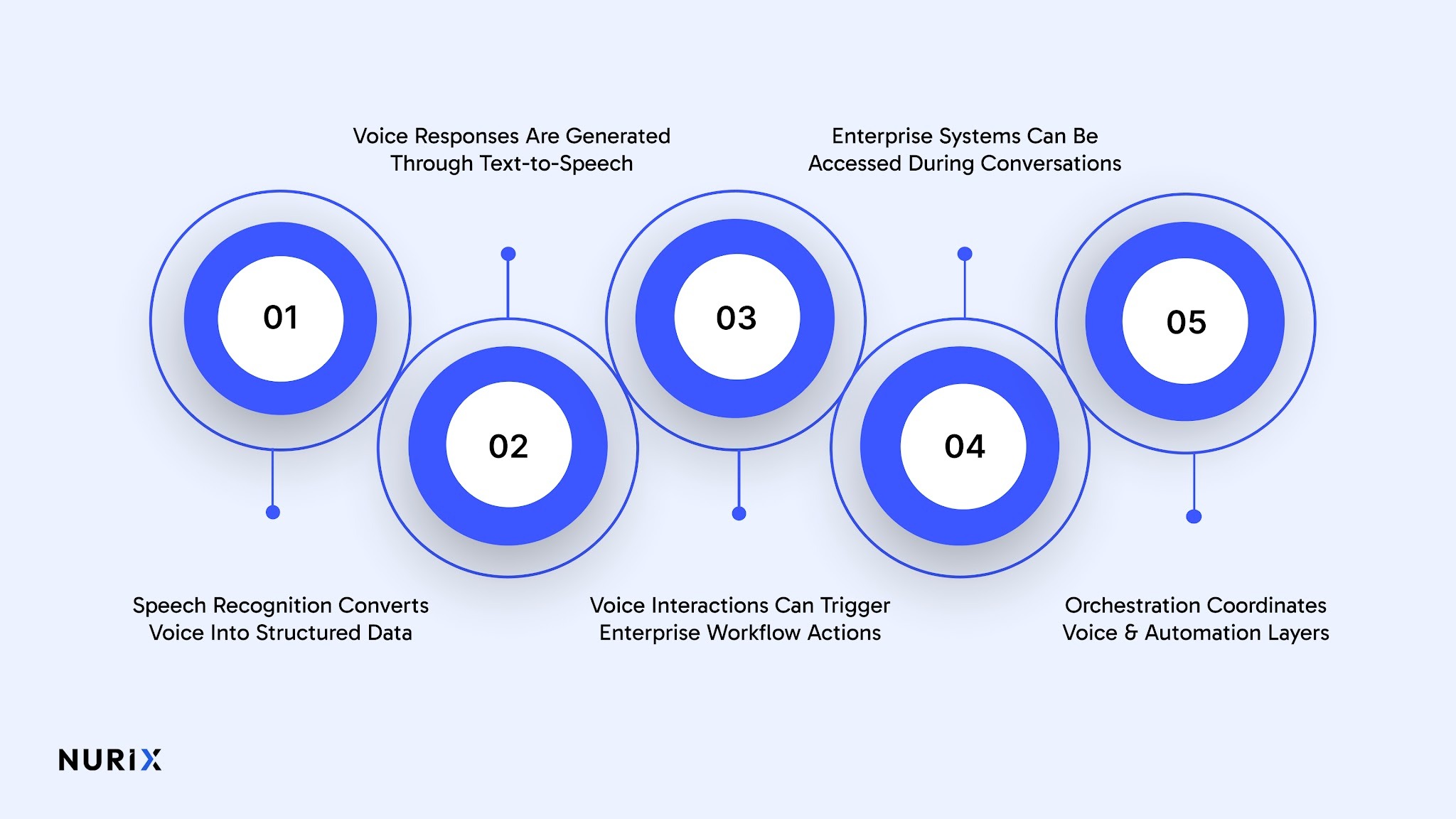
The IBM–Deepgram partnership embeds speech recognition and voice synthesis directly into IBM watsonx Orchestrate. This enables voice interactions to connect with enterprise automation workflows.
Instead of working as a separate interface, voice input can now trigger actions across enterprise systems.
Here’s how Deepgram’s speech technology integrates with IBM watsonX Orchestrate:
1. Speech Recognition Converts Voice Into Structured Data
Deepgram’s speech-to-text (STT) engine turns live audio from calls or voice interfaces into structured text streams. IBM watsonx Orchestrate can then read this text, understand requests, and route them through enterprise workflows. This way, voice interactions are treated the same as other system inputs.
2. Voice Responses Are Generated Through Text-to-Speech
Once a request is handled, watsonx Orchestrate creates responses based on workflow results or retrieved enterprise data. Deepgram’s text-to-speech (TTS) technology turns these responses into a natural-sounding voice. This enables automated systems to respond to customers or employees via voice in real time.
3. Voice Interactions Can Trigger Enterprise Workflow Actions
After voice input is transcribed and understood, watsonx Orchestrate can take action across connected systems. For example, it can create support tickets, update customer records, or route service requests. This makes voice conversations start real business processes, not just share information.
4. Enterprise Systems Can Be Accessed During Conversations
Voice workflows linked to watsonX Orchestrate can pull data from enterprise systems such as CRM platforms, order databases, and knowledge repositories. This lets voice interactions use real-time enterprise data as they talk. As a result, automated voice systems can respond with up-to-date information.
5. Orchestration Coordinates Voice and Automation Layers
IBM watsonx Orchestrate handles the logic that links speech processing to enterprise automation workflows. It controls how requests move between speech recognition, enterprise data, and workflow actions. This orchestration lets voice interactions work smoothly within larger enterprise processes.
For a deeper understanding of how modern conversational AI systems coordinate speech, context, and enterprise workflows across multiple layers of automation, check out What Is Conversational AI? Complete Guide for 2026.
Understanding how these technologies integrate also helps explain the broader implications of the IBM-Deepgram partnership for enterprise voice AI.
What the IBM-Deepgram Deal Signals for Enterprise Voice AI
The partnership between IBM and Deepgram signals an important shift for enterprise technology leaders. When a major platform integrates voice capabilities into its automation stack, it shows that voice AI is becoming part of mainstream enterprise architecture.
CIOs and technology leaders in Fortune 500 companies closely track these moves when evaluating emerging technologies.
As IBM watsonx Orchestrate introduces voice capabilities, CIOs and contact center leaders will begin evaluating how voice AI fits into their automation strategies.
- Internal proposals to explore voice AI adoption
- Pilot programs to test voice automation in contact centers
- Platform evaluations to assess enterprise-grade voice AI solutions
Technology teams are also exploring how voice AI can support operational improvements.
- Automate customer interactions across support and service channels
- Improve contact center efficiency and response times
- Connect voice conversations directly with enterprise workflows and systems.
These signals from the IBM-Deepgram partnership also help explain why large enterprises are actively benchmarking voice AI platforms.
5 Reasons Why Large Enterprises Are Benchmarking Voice AI Platforms
Large enterprises are increasing evaluations of voice AI platforms as customer interaction volumes grow and operational efficiency becomes a priority. Voice remains the dominant channel in contact centers and remains a key area for automation.
Here’s why large enterprises are benchmarking voice AI platforms:
1. Rising Contact Center Interaction Volumes
Contact centers in large enterprises handle thousands to millions of voice interactions every month. Many of these calls cover repetitive tasks such as identity checks, account inquiries, and basic service requests. Enterprises are exploring voice AI to manage high-volume interactions more efficiently.
2. Demand for Faster Customer Response Times
Customers now expect instant responses across digital and voice channels. Long call queues and slow issue resolution hurt satisfaction and performance. Enterprises are considering voice AI platforms to automate common requests and speed up response times.
3. Need to Connect Conversations With Enterprise Systems
Enterprise conversations often need access to data spread across multiple systems. Technology leaders are evaluating voice AI platforms that can pull information from CRM systems, knowledge bases, billing platforms, and order management systems during live calls. This ensures automated conversations give accurate answers.
4. Operational Cost Pressure in Contact Centers
Voice-based support accounts for a large share of customer service costs. Enterprises are exploring voice AI to automate repetitive requests and reduce calls requiring human agents. This improves efficiency without adding more staff.
5. Advances in Conversational AI and Voice Technology
Recent progress in speech recognition, natural language processing, and conversational AI has made voice automation more reliable. These improvements help voice platforms understand requests accurately and respond in real time. Large enterprises are now rethinking voice AI as part of their automation strategy.
To understand how modern voice AI systems have changed from simple IVR menus into intelligent agents capable of handling real conversation flows and enterprise workflows, explore The Evolution of Voice AI, From IVRs to Intelligent Agents.
Evaluating these platforms makes it evident that true enterprise automation requires more than just speech recognition.
Why Speech Technology Alone Cannot Automate Enterprise Conversations?
Speech technology can turn voice into text and generate spoken responses, but it can’t complete business tasks by itself. Enterprise conversations often need data retrieval, rule application, and actions across multiple systems.
Here’s why speech technology alone cannot automate enterprise conversations:
- Speech Recognition Only Converts Audio to Text: Speech technology mainly turns spoken audio into text and can generate spoken responses from text. It doesn’t interpret intent or decide how enterprise systems should handle a request.
- Enterprise Conversations Require Intent Understanding: Customer interactions often include follow-ups, clarifications, and contextual requests. Conversational AI models need to detect intent and manage multi-step conversations.
- Enterprise Requests Often Involve Multi-Step Workflows: Customer interactions typically require several steps, including identity verification, data retrieval, and service execution. Workflow orchestration is needed to coordinate these actions across systems.
- Operational Controls and Human Escalation Are Necessary: Some interactions need human judgment or involve sensitive decisions. Voice automation systems must spot these cases and escalate them to human agents with full conversation context.
For a closer look at how conversational systems go beyond basic speech recognition to manage context, timing, and interaction nuance, all critical to true business automation workflows, check How Dialog Management Handles Real Conversations.
Recognizing the limitations of speech technology highlights the key considerations enterprises must address when deploying voice systems.
5 Deployment Considerations for Enterprise Voice Systems
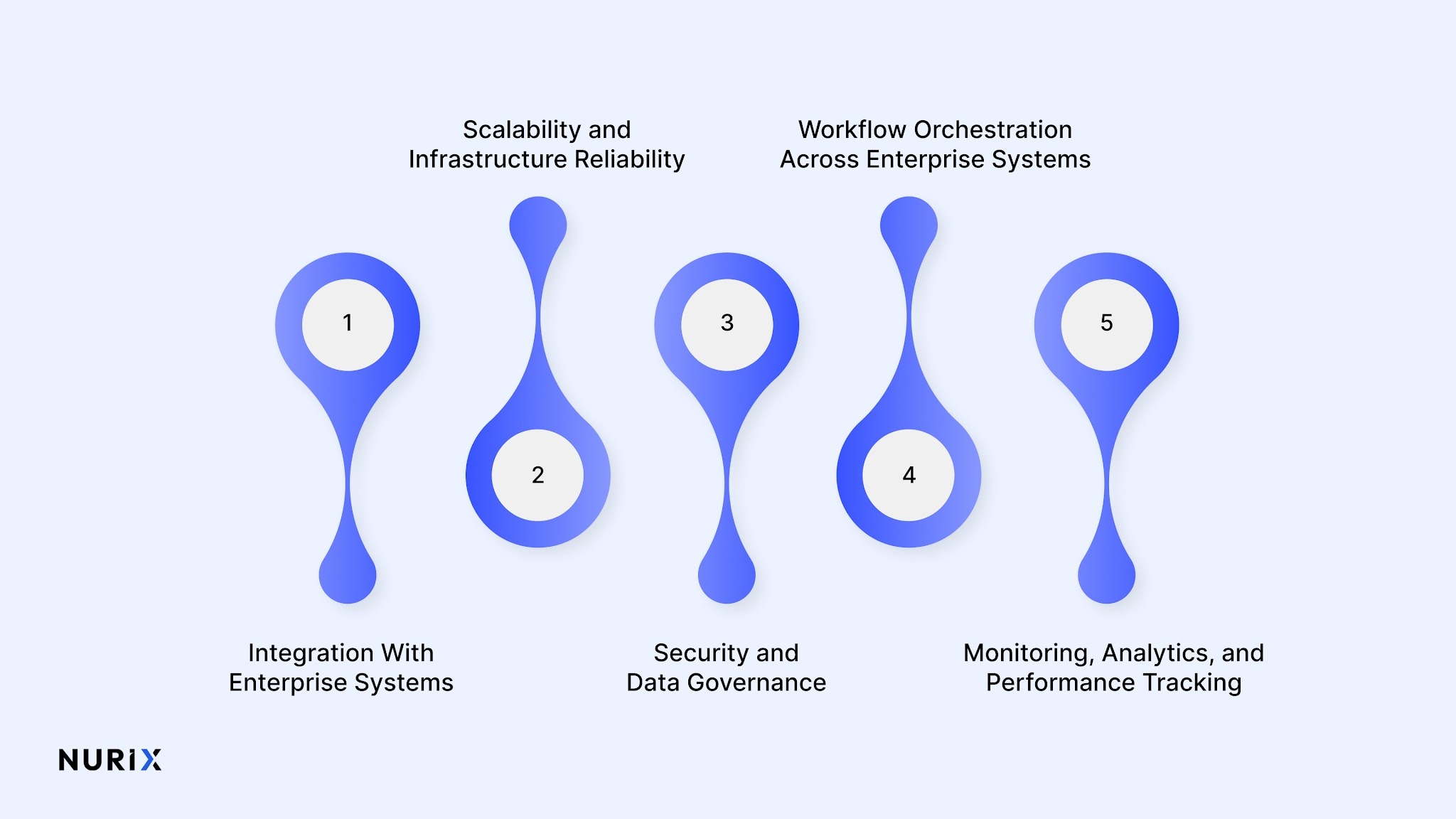
Enterprises evaluating voice AI platforms need to assess how these systems fit with existing infrastructure and workflows. Deployment decisions usually focus on integration complexity, reliability, and enterprise governance.
Below are the deployment considerations for enterprise voice systems.
1. Integration With Enterprise Systems
Enterprise voice systems need to integrate with platforms such as CRM systems, customer support software, order management systems, and knowledge bases. Without these links, voice interactions can’t access real-time data or complete business actions.
Technology leaders usually evaluate how easily a platform integrates with existing infrastructure.
2. Scalability and Infrastructure Reliability
Large enterprises handle high volumes of voice interactions, especially in customer support. Voice systems must process calls quickly and stay stable during peak demand. Platforms are assessed for their ability to scale across thousands of simultaneous conversations.
3. Security and Data Governance
Voice interactions often include sensitive information like account details, payment data, and customer records. Enterprise deployments must support encryption, access controls, and compliance with data protection rules. Security is a key factor when evaluating voice AI platforms for production use.
4. Workflow Orchestration Across Enterprise Systems
Customer conversations often trigger tasks like updating records, creating tickets, or routing cases. Voice systems need to connect with workflow orchestration layers to automate these multi-step processes. This lets voice interactions carry out real enterprise actions.
5. Monitoring, Analytics, and Performance Tracking
Enterprises need visibility into how voice systems perform in real interactions. Analytics help teams track automation rates, call outcomes, and efficiency metrics. These insights allow organizations to refine automation strategies and improve system performance over time.
These considerations provide a foundation for looking ahead at the next generation of voice AI in enterprise platforms.
The Future of Voice AI in Enterprise Platforms
Enterprise platforms are starting to add voice capabilities as part of wider automation strategies. Improvements in conversational AI, speech processing, and enterprise integrations are expanding how voice systems support operational workflows.
Here’s how the future of voice AI in enterprise platforms seems today:
- Voice Interfaces Will Become a Standard Enterprise Interaction Layer: Voice capabilities will be built into enterprise applications alongside chat and digital interfaces, enabling customers and employees to interact with systems through natural-language conversations.
- Contact Centers Will Expand Automation Through Voice AI: Enterprises will use voice AI to automate high-volume tasks such as call routing, identity verification, and basic service requests in contact centers.
- Voice Systems Will Access Enterprise Data During Conversations: Voice platforms will pull information from CRM systems, knowledge bases, and operational databases to respond with real-time data.
- Voice AI Will Operate Alongside Human Agents: Automated voice systems will handle routine interactions while escalating complex issues to human agents with full conversation context.
Final Thoughts
The partnership between IBM and Deepgram shows that voice AI is moving from isolated pilots into core enterprise automation platforms. As voice capabilities connect with orchestration systems such as IBM watsonx Orchestrate, conversations can begin triggering real business workflows instead of simply responding to requests.
Platforms such as NuPlay operationalize this shift. NuPlay powers 799,982 conversations every month, allowing companies to achieve 65% cost savings, 80% automation coverage, and a 50% efficiency boost across sales and service workflows.
Ready to explore how voice AI can support enterprise automation? Schedule a demo to see how NuPlay powers enterprise-grade voice agents across sales, support, and operational workflows.
Author: Sakshi Batavia — Marketing Manager
Sakshi Batavia is a marketing manager focused on AI and automation. She writes about conversational AI, voice agents, and enterprise technologies that help businesses improve customer engagement and operational efficiency.