
Enterprise leaders face mounting pressure to cut operational costs while maintaining exceptional customer experiences. Conversational AI solves this challenge by automating support, sales, and complex workflows with human-like interactions that scale instantly. The technology has evolved far beyond basic chatbots—modern AI agents now complete real work, from resolving customer inquiries to analyzing contracts and routing qualified leads.
The global conversational AI market reached $11.58 billion in 2024 and will hit $41.39 billion by 2030, growing at 23.7% annually. This explosive growth reflects proven business outcomes: enterprises deploying advanced platforms like NuPlay (previously Nurix)---an enterprise AI platform for deploying conversational voice and chat agents at scale—report 40-65% cost reductions and measurable improvements in customer satisfaction. Understanding how conversational AI works and where it delivers ROI equips you to make strategic adoption decisions that transform operations.
In Short: Conversational AI uses natural language processing (NLP), large language models (LLMs), and workflow automation to enable machines to hold natural conversations and execute tasks across enterprise systems. It reduces costs by 40–65% and automates up to 80% of support interactions.
What Is Conversational AI?
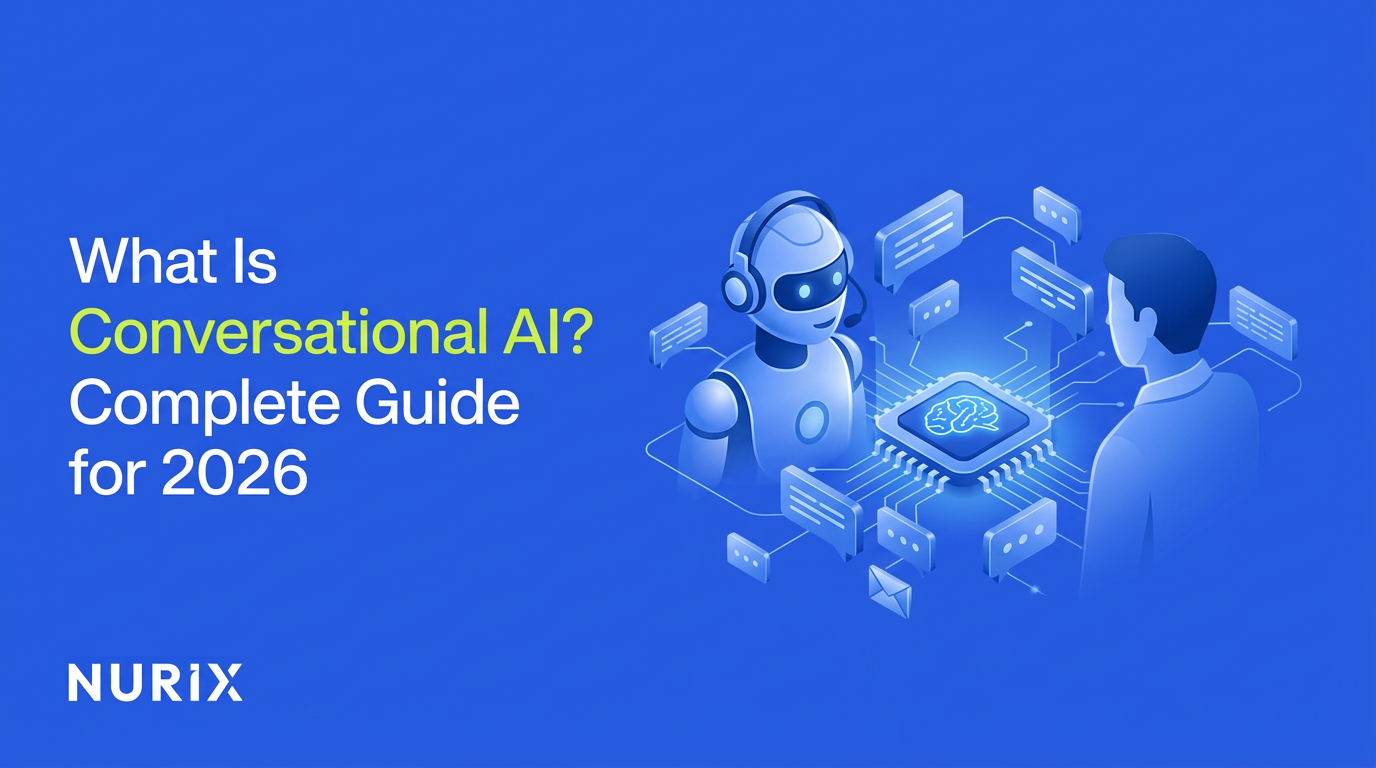
Conversational AI enables machines to engage in natural, human-like dialogues through voice or text interfaces. Unlike rigid scripted systems, it understands context, interprets intent, and responds dynamically to user needs. The technology powers everything from customer service automation to sales qualification and document processing.
At its core, conversational AI combines Natural Language Processing (NLP), machine learning, and large language models to create interactions that feel genuinely human. These systems don't just recognize words—they grasp meaning, maintain conversation context across multiple exchanges, and execute actions within enterprise systems. A customer asking about order status gets an immediate, accurate response pulled from live inventory data, not a generic script.
The evolution from basic chatbots to enterprise AI agents represents a fundamental shift. Early chatbots followed decision trees with limited flexibility.
Modern conversational AI reasons about problems, accesses multiple data sources, and completes multi-step workflows autonomously. This capability transforms how businesses handle high-volume operations in retail, insurance, real estate, and business process outsourcing.
How Conversational AI Works
The mechanics behind conversational AI involve several sophisticated layers working in concert. When a user speaks or types, the system first converts speech to text if needed, then processes that input through Natural Language Understanding (NLU) to extract intent and key entities. This parsing reveals what the user wants and the critical details needed to help them.
Dialog management maintains conversation state, tracking what's been discussed and what comes next. Large language models provide contextual reasoning, enabling the AI to understand nuance and generate appropriate responses. Natural Language Generation (NLG) crafts replies that sound natural and address the user's specific situation.
The real power emerges through orchestration layers that connect AI to enterprise systems. When a customer requests a refund, the AI doesn't just talk about the process—it verifies order details in the CRM (Customer Relationship Management), checks return eligibility against business rules, initiates the refund transaction, and updates the customer record. This end-to-end automation delivers tangible business value that basic chatbots can't match.
Key Concepts and Terminology
Understanding conversational AI requires familiarity with several technical concepts that define how these systems operate.
Natural Language Understanding (NLU) parses user input to extract intent and entities using machine learning algorithms. When someone says "I need to change my delivery address," NLU identifies the intent (address modification) and recognizes that delivery address is the specific entity requiring action.
Natural Language Generation (NLG) crafts coherent, contextually appropriate responses from structured data. Rather than selecting from pre-written templates, advanced NLG produces unique replies tailored to each conversation. This creates more natural interactions that adapt to user preferences and communication styles.
Dialog State Tracking maintains conversation context across turns, remembering what's been discussed and what information still needs collection. This allows users to provide details gradually without repeating themselves. Grounding anchors AI responses in verified enterprise data to prevent hallucinations—the phenomenon where AI systems generate plausible but false information.
Workflow Orchestration coordinates AI actions with backend systems, enabling agents to book appointments, update CRM records, trigger approval processes, and execute complex business logic. This transforms conversational AI from a communication tool into a workforce automation platform.
Real-World Examples and Use Cases
Enterprise deployments of conversational AI demonstrate clear operational impact across multiple functions, from customer service automation to sales acceleration and document processing.
In customer support, NuPlay Support Voice AI Agents resolve 80% of inquiries instantly through natural voice conversations. Customers get immediate help with order tracking, returns, account updates, and billing questions without waiting for human agents. This automation handles demand spikes and provides 24/7 coverage without staffing constraints.
Sales teams use conversational AI to qualify leads and accelerate pipeline growth. NuPlay Sales Voice AI engages prospects at the top of the funnel, captures buying intent through natural dialogue, applies qualification logic, and routes high-quality leads directly into CRM systems. This automation boosts SQL conversion rates by 30% while freeing sales development representatives to focus on closing deals rather than initial outreach.
Document-intensive workflows see dramatic efficiency gains through AI automation. NuPilot Workflow Automation analyzes contracts, RFPs, and proposals, extracting key terms, identifying deviations from standards, and routing documents for appropriate review. Legal and procurement teams accelerate contract reviews by 50%, cutting cycle times from weeks to days.
The financial services sector particularly benefits from conversational AI, with banking, insurance, and investment firms holding 23% of market adoption. These organizations handle massive interaction volumes for account inquiries, claims processing, and compliance documentation—all areas where AI agents deliver immediate cost savings and service improvements.
For a deeper look at industry-specific deployments, explore these conversational AI use cases and examples.
Benefits and Importance of Conversational AI
The business case for conversational AI centers on measurable financial impact and operational efficiency. Enterprises implementing advanced platforms cut operational costs by 40-60% through automation at scale. Each AI-handled interaction costs a fraction of human-assisted service, with savings compounding across thousands of daily conversations.
Customer satisfaction improves through instant, accurate responses delivered 24/7. Modern voice AI achieves under one-second latency, creating conversations that feel more responsive than many human interactions. 90% of consumers prefer immediate responses for service questions, and AI agents deliver this consistently regardless of volume or time of day.
Revenue impact extends beyond cost savings. Conversational AI drives sales through guided product recommendations, automated upselling, and 3x pipeline coverage compared to human-only teams. The technology enables businesses to engage every prospect and customer at optimal moments, capturing opportunities that would otherwise slip through capacity constraints.
Industries with high interaction volumes see the fastest ROI. Retail operations handle peak shopping seasons without temporary staffing. Insurance companies process claims inquiries instantly.
Healthcare organizations manage appointment scheduling and patient questions, with chatbot adoption growing 33.72% annually through 2028. The common thread: conversational AI excels where volume, consistency, and speed determine business outcomes.
Common Misconceptions About Conversational AI
Many organizations still confuse conversational AI with basic chatbots, missing the fundamental capabilities that separate these technologies. Enterprise AI agents don't just answer questions—they complete workflows. Platforms like NuPlay execute multi-step processes including data validation, system updates, and transaction processing. This distinction matters: chatbots reduce inquiry volume, while true conversational AI eliminates entire job functions.
Concerns about AI hallucinations—instances where systems generate false information—reflect real risks with poorly implemented solutions. However, grounding techniques that anchor responses in verified enterprise data eliminate this problem.
Production-grade systems retrieve information from authoritative sources rather than generating answers from training data alone. When properly architected with retrieval-augmented generation and human oversight for edge cases, conversational AI maintains accuracy rates exceeding 95%.
Scalability worries often stem from early chatbot experiences that broke under load. Modern enterprise platforms handle thousands of simultaneous conversations with consistent performance and enterprise-grade security. Cloud infrastructure and optimized model architectures enable the same AI agent to serve one customer or ten thousand without degradation.
The perception that conversational AI represents experimental technology ignores documented financial returns. Organizations implementing full-stack platforms achieve ROI within 3-6 months, with some reporting 237% returns within 90 days. These aren't pilot projects—they're production systems automating real revenue-generating and cost-saving workflows.
Conversational AI Trends for 2026
The shift toward multi-modal AI agents defines the current evolution in conversational AI. Modern systems seamlessly handle voice calls, text chats, and document processing within unified workflows.
A customer might start a support inquiry via chat, upload a photo of a damaged product, and switch to voice for complex troubleshooting—all with the same AI agent maintaining full context.
Advanced analytics capabilities transform how enterprises optimize AI performance. Tools like NuPulse Analytics provide real-time insights into conversation quality, sentiment trends, and automation rates.
Leaders use this intelligence to refine agent behavior, identify training gaps, and measure business impact with precision. The feedback loop between deployment and optimization accelerates continuously.
Hybrid deployment models address compliance and data sovereignty requirements that block some enterprises from cloud-only solutions. On-premises and hybrid architectures enable organizations in regulated industries to deploy conversational AI while maintaining complete data control. This flexibility expands adoption in healthcare, financial services, and government sectors.
Brand-aligned AI personas ensure consistent enterprise voice across all customer touchpoints. NuRep Brand Personas let organizations define exactly how AI agents sound, behave, and represent company values. This control matters increasingly as AI becomes the primary customer interface—brand reputation depends on every automated interaction reflecting organizational standards.
74% of companies plan to deploy agentic AI within two years, with most focusing on autonomous task execution rather than simple question-answering. This trend toward AI agents that reason, plan, and act independently represents the next frontier in enterprise automation.
Implementing Conversational AI in Enterprises
Successful implementation starts with identifying high-volume workflows where automation delivers quick wins. Assess support queues for repetitive inquiries, sales processes with predictable qualification criteria, and document workflows consuming excessive human hours. Target areas where current costs are quantifiable and automation impact can be measured clearly.
Choosing the right platform determines long-term success. For a detailed comparison, see our guide to the best conversational AI platforms in 2026. Full-stack solutions with deep integrations outperform point products that require extensive custom development.
Evaluate platforms on their ability to connect with existing CRM, ERP (Enterprise Resource Planning), helpdesk, and communication systems. The AI needs to act within your tech stack, not just talk about it.
Pilot deployments should focus on metrics that matter: automation rate, customer satisfaction, cost per interaction, and resolution time. Aim for 70% automation in initial deployments, with clear escalation paths for complex cases requiring human expertise. Track CSAT scores to ensure automation improves rather than degrades customer experience.
Scale securely by prioritizing compliance-first architecture from day one. Enterprise conversational AI handles sensitive customer data, payment information, and proprietary business intelligence. Security controls including data encryption, access management, and audit logging aren't optional—they're foundational requirements that prevent costly breaches and regulatory violations.
Change management often determines whether AI adoption succeeds or stalls. Communicate clearly with teams about how automation augments rather than replaces their roles. The best implementations redeploy human agents to higher-value activities like complex problem-solving and relationship building while AI handles routine transactions.
Conclusion
Conversational AI has matured from experimental technology into a proven enterprise automation platform delivering measurable financial returns. The systems deployed in 2026 don't just chat—they complete real work across support, sales, and document-intensive workflows. Organizations implementing platforms like NuPlay achieve 40-65% cost reductions while improving customer satisfaction through instant, accurate, 24/7 service.
The technology will continue advancing toward more autonomous agentic AI, expanded multi-modal capabilities, and deeper enterprise integration. But the fundamentals remain constant: conversational AI succeeds when it solves genuine business problems with quantifiable impact.
Start by identifying your highest-volume pain points, choose platforms built for enterprise scale and security, and measure results relentlessly. The competitive advantage goes to organizations that deploy AI agents strategically, not experimentally.