
“Hi, I need to change my delivery address.”
“Sure, let me check that for you.”
…then the silence stretches long enough for the customer to move on.
That small delay shows up across support, sales, and post-purchase journeys, where timing and follow-through matter. The U.S. Bureau of Labor Statistics estimates over 2.9 million customer service representatives are employed in the U.S., which shows how much of the service still depends on manual coordination.
In this guide, you will explore the most practical conversational AI use cases across service, sales, commerce, and operations, along with real examples, deployment challenges, and how enterprise teams measure impact before rollout.
Executive Summary 2026: Conversational AI use cases address the challenge of managing high volumes of interactions that still depend on manual coordination. They combine natural language understanding, system integrations, and orchestration to execute workflows, enabling enterprises to reduce delays, improve operational throughput, and deliver consistent outcomes across service, sales, and internal processes.
Key Takeaways
- Intent To Action Mapping: Conversational AI use cases succeed when NLU (natural language understanding) maps user intent to executable workflows, triggering APIs (application programming interfaces) instead of returning static responses.
- System-Connected Execution: High-impact deployments integrate with CRM (customer relationship management), OMS (order management systems), and policy engines to complete tasks like updates, approvals, and transaction handling.
- Orchestration Over Single Agents: Multi-agent orchestration coordinates specialized agents, ensuring correct routing, state management, and continuity across multi-step interactions without losing context.
- Failure and Control Design: Production systems require confidence scoring, fallback logic, and human-in-the-loop escalation to handle edge cases and prevent workflow breakdowns.
- Outcome-Driven Measurement: Enterprise ROI models prioritize containment, workflow completion rate, latency, and resolution accuracy over surface metrics like conversation volume or engagement.
What Is Conversational AI?
Conversational AI is a technology that enables human-like conversations through text and voice by using natural language processing, machine learning, and large language models to understand intent, retain context, and generate relevant responses. Unlike scripted chatbots, it can handle complex interactions and support actions across business systems.
Why Conversational AI Matters for Modern Customer Experience
Modern customer experience depends on speed, continuity, and execution across digital touchpoints. Conversational AI matters because it helps enterprises resolve routine requests, reduce service friction, and support personalized interactions across voice and chat while connecting conversations to back-end systems and measurable operating outcomes.
Several market and operating shifts are making conversational AI a more important part of customer experience delivery.
- Ecommerce Expansion: U.S. ecommerce sales reached $1,233.7 billion in 2025 and accounted for 16.4% of total retail sales.
- AI Agent Growth: Deloitte forecasts that 25% of enterprises using generative artificial intelligence will deploy AI agents in 2025, rising to 50% by 2027.
- Mobile-First Expectations: Pew Research found that 95% of U.S. adults use the internet and 90% own a smartphone, raising demand for always-available digital service.
- Operational Efficiency: McKinsey reported that one energy company reduced billing call volume by around 20% and cut customer authentication time by up to 60 seconds using an artificial intelligence voice assistant.
- Trust-Linked Spending: Deloitte found consumers who trust technology providers to protect their data spent 50% more on connected devices in the past year than those with low trust.
As customer interactions become more digital and service expectations rise, conversational AI is moving from a support feature to a system-level layer for faster, more connected customer experience delivery.
To see why responsiveness and conversation quality matter more once customer expectations shift across channels, watch Building a Voice AI That Feels Human in Every Conversation.
Top Conversational AI Use Cases Across Key Industries
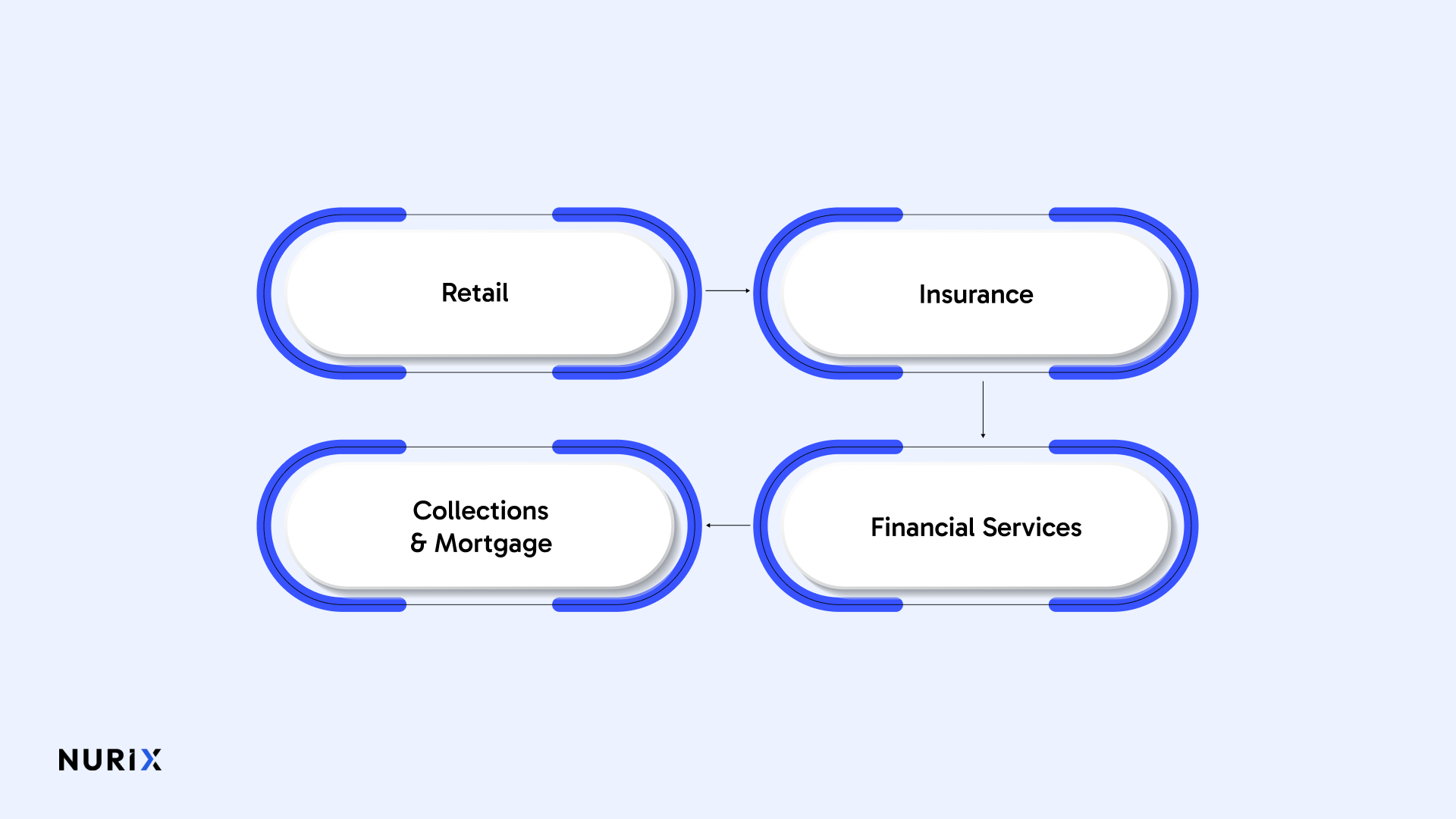
Conversational AI delivers the most value when it is embedded in industry workflows with clear rules, repeat requests, and system-driven next steps. In retail, insurance, financial services, and collections or mortgage servicing, the strongest deployments do more than answer questions. They verify, retrieve, route, document, and move the workflow forward.
1. Retail
Retail use cases work best when conversational AI is tied to live catalog data, order systems, promotion logic, and post-purchase workflows. The goal is not better chat for its own sake. It is to reduce buying friction, protect conversion, and keep service demand from eating into margin.
Retail teams usually see the most value in workflows where customer intent can be matched to product, fulfillment, or account data in real time.
- Product Discovery: Interprets natural-language shopping requests like budget, use case, size, and delivery timing, then maps them to live inventory and merchandising rules.
- Checkout Recovery: Resolves the exact blocker, whether that is stock availability, shipping dates, payment confusion, or promo eligibility, before the basket is abandoned.
- Post-Purchase Service: Handles order tracking, return initiation, exchange logic, and restock questions using order history and policy rules, not static FAQ content.
What This Does For The Leader: It supports revenue at the point of intent, lowers avoidable service contacts, and gives retail teams a more scalable way to protect both conversion and repeat purchase behavior.
2. Insurance
Insurance workflows benefit when conversational AI is grounded in policy language, claims logic, document requirements, and servicing rules. That matters because the real pain is rarely just response speed. It is the cost of repeated handoffs, incomplete intake, and delayed movement across claims and policy service processes.
Insurance teams typically get the strongest return in workflows where intake quality, servicing consistency, and status visibility directly affect cost and customer effort.
- First Notice Of Loss: Captures incident details, validates required fields, and starts claims intake in a structured way so adjusters do not waste time fixing incomplete submissions.
- Policy Servicing: Handles billing, renewal, endorsement, and coverage questions using approved policy logic, which reduces inconsistency across high-volume service interactions.
- Claims Progress Updates: Gives customers clear status visibility, missing-document prompts, and next-step guidance without forcing them to call for routine claim tracking.
What This Does For The Leader: It improves intake quality, reduces servicing overhead, and helps claims and service leaders manage volume without sacrificing process control.
3. Financial Services
In financial services, conversational AI becomes more useful when it is connected to authenticated account workflows, product guidance, and dispute or service processes. The real value is not in general banking chat. It is in handling routine servicing and growth-oriented interactions inside secure, policy-bound journeys.
Financial services teams usually see the most impact where account context, product fit, and service execution need to work together.
- Authenticated Account Service: Supports balance checks, transaction explanations, card controls, and routine maintenance after identity checks and account-level permissions are confirmed.
- Deposit And Product Guidance: Matches customer needs to checking, savings, or related products using account context and product rules instead of generic recommendations.
- Dispute And Request Handling: Starts dispute workflows, gathers supporting details, and updates customers on request status without requiring repeated contact-center intervention.
What This Does For The Business: It reduces cost-to-serve, strengthens digital servicing, and creates more consistent opportunities to connect service conversations with deposit and retention goals.
4. Collections and Mortgage
Collections and mortgage servicing require consistency, timing, and clear next-step communication across sensitive customer interactions. Conversational AI is most effective here when it supports structured outreach, servicing requests, and status communication without losing workflow control or escalation discipline.
The highest-value use cases are the ones where repetitive borrower contact, servicing logic, and document or payment workflows create operational drag.
- Payment Resolution Support: Handles reminders, self-serve payment options, and promise-to-pay capture in a structured way that improves follow-through without making outreach feel fragmented.
- Mortgage Servicing Requests: Answers escrow, payment, statement, and account-servicing questions while guiding borrowers through routine account actions with policy-based logic.
- Workflow Status Communication: Keeps borrowers updated on servicing, repayment, or document-related steps so teams are not buried under avoidable follow-up calls.
What This Does For The Business: It improves outreach consistency, reduces servicing friction, and gives collections and mortgage teams a more controlled way to manage high-volume borrower communication.
Real-World Examples of Conversational AI in Business
Recent NuPlay by Nurix AI deployments show how conversational AI is gaining traction in revenue and support environments with visible performance movement.
- Revenue Conversion Proof: NuVision Auto Glass reached 76%+ lead contact rate, while Artium Academy saw 30% of learners join demo calls via agent-led follow-up.
- Support and Engagement Proof: Cult.fit achieved 95% issue resolution, and the International Cricket Council handled 100k+ conversations in five days.
Industry-specific conversational AI works best when it is trained on the right policies, connected to the right systems, and designed to complete the next operational step, not just return an answer.
If your team is moving from use case exploration to platform evaluation, NuPlay by Nurix AI brings multilingual handling, real-time orchestration, and per-language visibility through NuPulse into one enterprise workflow layer, so schedule a custom demo.
Best Conversational AI platforms Worth Looking At in 2026
The top conversational AI platforms in 2026 are being evaluated on more than voice quality. Enterprise teams are comparing integration depth, compliance controls, testing, observability, and workflow execution. The strongest platforms do not just answer prompts. They connect conversations to production systems, security requirements, and measurable business outcomes.
Conversational AI Platforms: Comparative Table in 2026
Enterprise buyers usually compare platforms on workflow depth, security posture, integration flexibility, and pricing visibility before they look at voice quality alone.
- NuPlay: NuPlay by Nurix AI is an enterprise voice and chat AI platform built for orchestration, observability, and governed workflow execution. It fits teams needing 400+ system integrations, role-based access control, audit logs, and personally identifiable information redaction in one lifecycle platform.
- Retell AI: Strong for telephony-heavy teams that need SIP trunking, existing number support, Salesforce and HubSpot integrations, and compliance with HIPAA, SOC 2 Type II, and GDPR.
- Synthflow: Stands out for no-code voice deployment, 200+ integrations, direct telephony control, audit logs, region-based hosting, and certifications across SOC 2, HIPAA, PCI DSS, and GDPR.
- Bland AI: Appeals to engineering-led teams that want phone-agent infrastructure, compliance guardrails, structured post-call outcomes, real-time monitoring, and transcript-level data extraction for workflow automation.
- Vapi: Fits developer-centric teams that prioritize API-native control, automated testing, 40+ app integrations, multilingual support, hallucination guardrails, and SOC 2, HIPAA, and PCI compliance.
The strongest platform choice depends on whether the priority is enterprise orchestration, telephony control, no-code deployment, engineering flexibility, or compliance-heavy production rollout.
Common Challenges in Conversational AI Deployment
Conversational AI deployments usually fail at the workflow layer, not the demo layer. The hardest problems are grounding answers in trusted data, integrating with production systems, handling edge cases, and controlling risk in regulated environments where hallucinations, privacy failures, and weak escalation design can create real operational exposure.
The table below maps the most common deployment risks to the operating issue leaders actually need to solve.
Strong deployments win when leaders design for data trust, system action, escalation discipline, and governance from day one, not after launch.
If your team is weighing workflow failures against orchestration quality and escalation design, it helps to compare Chatbot vs Conversational AI: Explaining the Key Differences.
How Enterprises Measure Conversational AI ROI
Enterprises measure conversational AI return on investment by linking deployment metrics to operating outcomes, not vanity usage. The most credible models track cost-to-serve, containment, conversion lift, agent productivity, and customer experience changes against implementation cost, integration effort, and governance overhead across specific workflows.
The strongest return on investment models combine efficiency, revenue, and experience signals instead of relying on one headline metric.
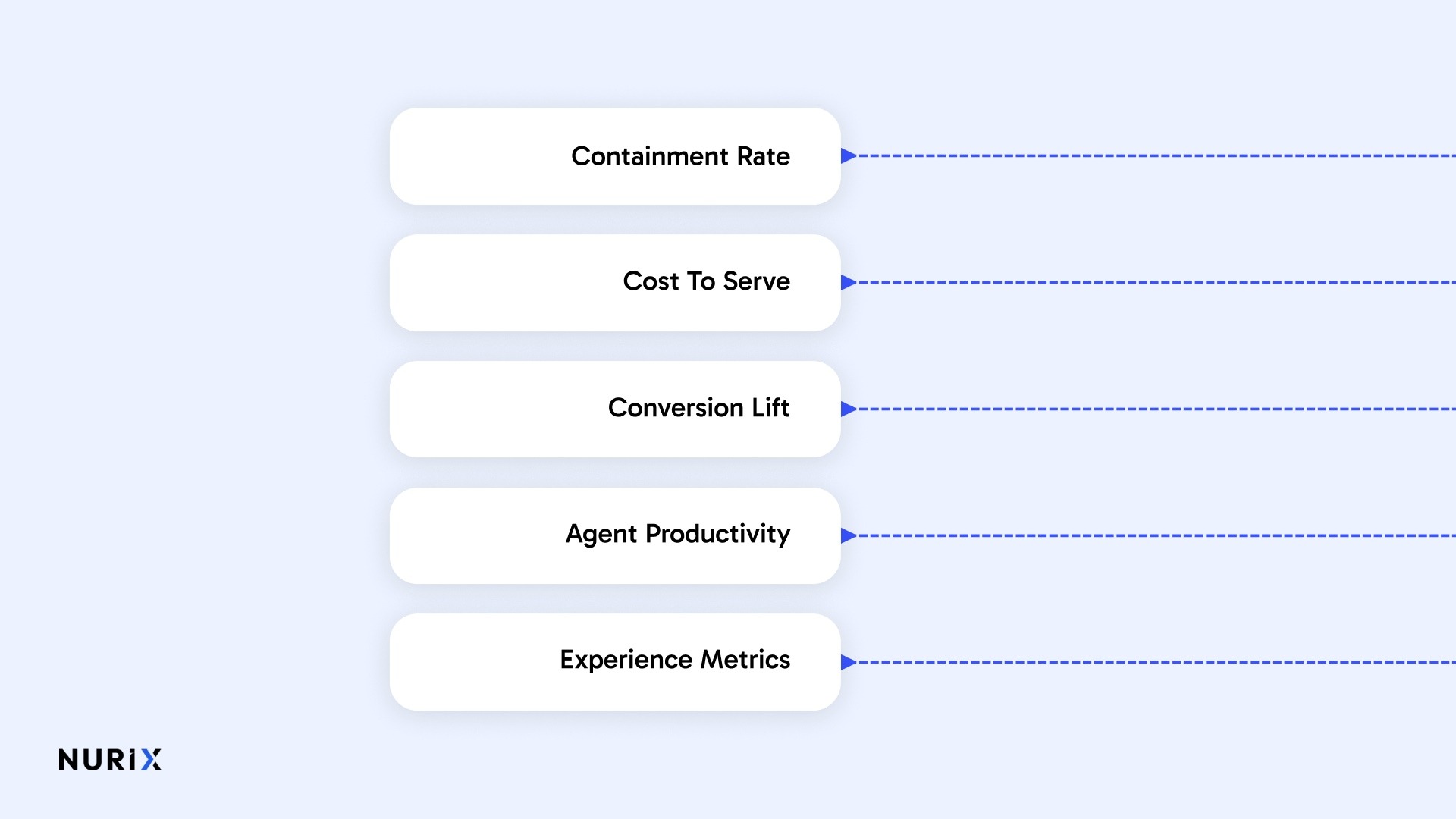
- Containment Rate: Measures how many interactions finish without human handoff, which directly affects staffing pressure and operating cost.
- Cost To Serve: Tracks labor and handling savings per workflow, especially in service operations where artificial intelligence often shows the clearest cost benefit.
- Conversion Lift: Measures revenue impact from faster qualification, next-best-action guidance, or reduced purchase friction in sales and commerce flows.
- Agent Productivity: Quantifies time saved through summarization, drafting, routing, and reduced wrap-up work across service and operations teams.
- Experience Metrics: Tracks customer satisfaction, first contact resolution, Net Promoter Score, and customer effort to confirm the automation is improving outcomes, not just shifting workload.
Strong conversational AI business cases win when leaders tie each deployment to one workflow, one owner, and a measurable operating baseline before launch.
When ROI depends on faster approvals, lower servicing drag, and cleaner execution across lending workflows, the clearest next watch is Why Fast Execution is KEY to Lending Success
Conversational AI Trends Shaping Customer and Employee Interactions
Conversational AI is shifting from scripted assistance to workflow-aware execution across customer and employee touchpoints. The most important trends are not just better responses. They include action-taking agents, tighter system orchestration, stronger governance, and designs that support both automation and human oversight inside production environments.
The trends below show how enterprise deployments are becoming more operational, controlled, and outcome-oriented.
- Agentic Execution: Conversational systems are moving beyond answers into task completion, including updating records, initiating workflows, and triggering downstream actions.
- Human-In-The-Loop Design: More deployments are being built with explicit human review, escalation, and override layers for sensitive or exception-heavy interactions.
- Employee Co-Pilots: Internal use is expanding through case summarization, response drafting, knowledge retrieval, and guided decision support for frontline teams.
- Channel-Conscious Experiences: Enterprises are designing interactions differently for voice, chat, and messaging instead of forcing one conversational pattern across every channel.
- Governed Orchestration: Deployment maturity increasingly depends on auditability, policy controls, and secure integration with enterprise systems, not just model quality.
The next wave of conversational AI will be shaped by execution quality, governance discipline, and how well automation fits real service and work patterns.
If you want to see where orchestration, observability, and deployment maturity are pushing the category next, continue with Top Conversational AI Leaders for 2025
How NuPlay by Nurix AI Supports Enterprise Conversational AI Workflows
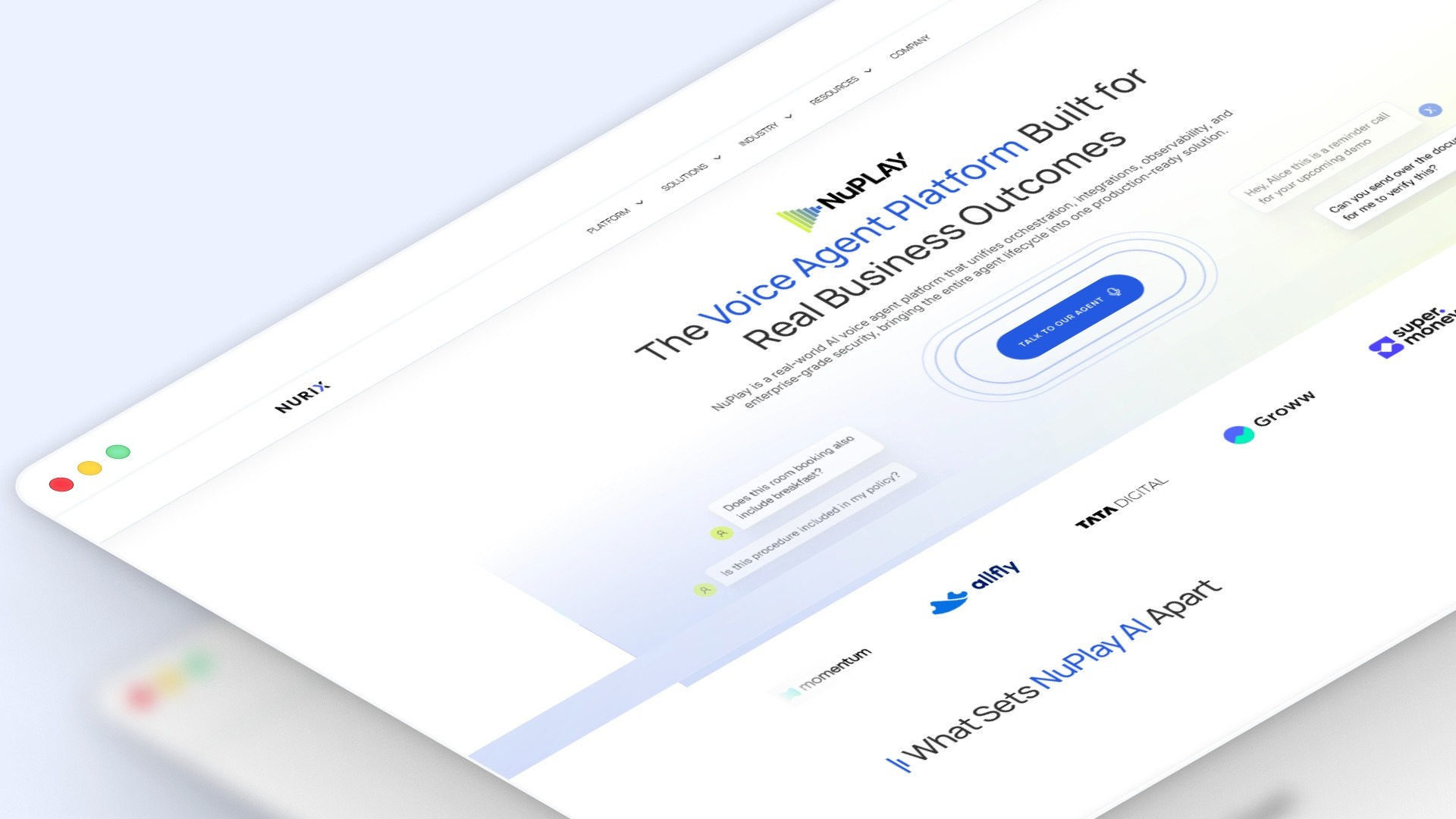
NuPlay by Nurix AI supports enterprise conversational AI workflows by combining multi-agent orchestration, live observability, brand control, and security governance in one platform. Instead of stopping at answer generation, it helps teams route tasks, monitor execution quality, enforce conversation standards, and operate agents within enterprise access and compliance requirements.
NuPlay’s workflow support is built around five production layers that matter once automation moves beyond pilot use.
- Multi-Agent Orchestration: Routes work through specialist agents using a central orchestrator, keeping multi-step conversations and downstream actions coordinated.
- Live Observability: NuPulse tracks response time, containment, resolution rate, alerts, logs, and conversational analytics for ongoing workflow optimization.
- Brand Voice Control: NuRep applies tone rules, approved terminology, content learning, and voice customization so agents sound aligned with the business.
- Security Governance: Supports role-based access control, single sign-on, audit logs, and regional data residency for enterprise deployment requirements.
- Knowledge and Integrations: Connects models to documents, customer relationship management systems, help centers, wikis, and other enterprise data sources
NuPlay by Nurix AI fits enterprises that need workflow execution, operational visibility, controlled brand behavior, and governed deployment, not just a conversational layer on top.
Final Thoughts!
Conversational AI only delivers value when it actually gets work done, not just when it sounds good. The most effective conversational AI use cases are the ones that reduce back-and-forth, complete tasks in one flow, and take pressure off teams handling high volumes every day.
What matters operationally is how well the system connects to your tools, follows your rules, and holds up under real demand. That is where platforms like NuPlay by Nurix AI stand out, with orchestration, live performance visibility, and built-in controls that let you manage quality at scale.
If you are exploring this space, pick one workflow and test it end-to-end before expanding. Schedule a custom demo!