Insurance teams are under growing pressure to improve response speed, customer engagement, and operational efficiency across fragmented workflows. A recent Genpact study found that 46% of insurance customers support Artificial Intelligence (AI) adoption when it helps speed up claims processing, while 29% are more likely to choose insurers that offer automated and digital interactions.
Many insurers already use AI tools across sales, claims, and customer support operations, but disconnected automation often creates workflow gaps and inconsistent customer experiences. As insurance operations become more complex, orchestration and workflow continuity are becoming increasingly important.
In this article, you will learn why insurance teams are choosing NuPlay for AI automation in 2026 and how orchestration, integrations, and operational visibility improve insurance workflows at scale.
Executive Summary (2026): Insurance AI automation is evolving beyond isolated chatbots and disconnected tools as insurers face growing operational complexity across sales, support, and customer engagement workflows. Orchestration, integrations, and workflow visibility are becoming critical for scalable automation. NuPlay is an enterprise voice and chat AI platform built to automate support, sales, and workflow operations across channels.
Key Takeaways:
- Orchestration improves workflow continuity: Connected automation workflows perform better than isolated AI tools across complex insurance operations.
- Operational visibility improves optimization: Workflow analytics help insurance teams identify bottlenecks, delays, and engagement gaps earlier.
- Integrations reduce fragmentation: CRM, support, and communication integrations help maintain more consistent insurance workflows.
- Automation improves response consistency: AI-driven qualification, routing, and engagement workflows support faster customer interactions.
- Enterprise scalability requires governance: Insurance AI deployments increasingly depend on observability, workflow control, and operational flexibility.
Why Insurance AI Automation Is Becoming More Operationally Complex
Insurance operations rarely run inside a single platform. Sales, claims, underwriting, customer service, and policy management teams often work across multiple systems simultaneously, which makes workflow coordination increasingly difficult as operations scale.
Most insurance workflows now involve:
- Customer Relationship Management (CRM) systems
- Claims management platforms
- Policy databases
- Customer support systems
- Communication channels such as voice, chat, email, and SMS
As customer interactions move across these systems, maintaining workflow continuity becomes more operationally complex. Teams often struggle with duplicated tasks, inconsistent customer context, and fragmented engagement across channels.
Fragmented Automation Creates Workflow Gaps
Many insurers already use Artificial Intelligence (AI) tools for customer support, qualification, or engagement workflows. However, disconnected automation often creates operational gaps when workflows cannot coordinate across systems and teams effectively.
This commonly leads to:
- Disconnected customer journeys
- Manual handoffs between teams
- Inconsistent routing workflows
- Delayed customer responses
- Limited operational visibility
For example, a lead qualification workflow may operate separately from claims support or policy servicing systems, which forces agents to manually transfer context between workflows. These gaps can slow down response times and create inconsistent customer experiences.
Insurance Teams Need More Than Basic AI Assistants
As insurance workflows become more interconnected, teams increasingly need automation platforms that can execute workflows instead of only responding to customer queries. Basic Artificial Intelligence assistants often struggle when workflows require multi-step coordination, cross-platform execution, or operational monitoring.
Insurance teams now prioritize:
- Workflow execution across systems
- Orchestration of multi-step processes
- Operational visibility and monitoring
- Scalable automation across channels
This shift is one reason enterprise insurers are moving toward orchestration-driven AI platforms that can support workflow continuity, integrations, and operational control across complex insurance environments.
Also Read: Claims Automation in Insurance [2026]: Process and Use Cases
What Insurance Teams Now Expect From AI Automation Platforms
Insurance teams increasingly expect Artificial Intelligence (AI) platforms to execute workflows instead of simply responding to customer questions.
As insurance operations become more interconnected, automation platforms must coordinate actions across systems, workflows, and teams without creating additional manual work.
Modern insurance teams now prioritize:
- Action-oriented AI: Automation platforms should handle operational tasks such as qualification, routing, scheduling, and workflow coordination instead of functioning only as conversational interfaces.
- Workflow completion: Insurance workflows often involve multiple steps across sales, support, underwriting, and servicing operations that need coordinated execution.
- Cross-system coordination: AI platforms increasingly need to operate across Customer Relationship Management (CRM) systems, policy platforms, communication tools, and support workflows simultaneously.
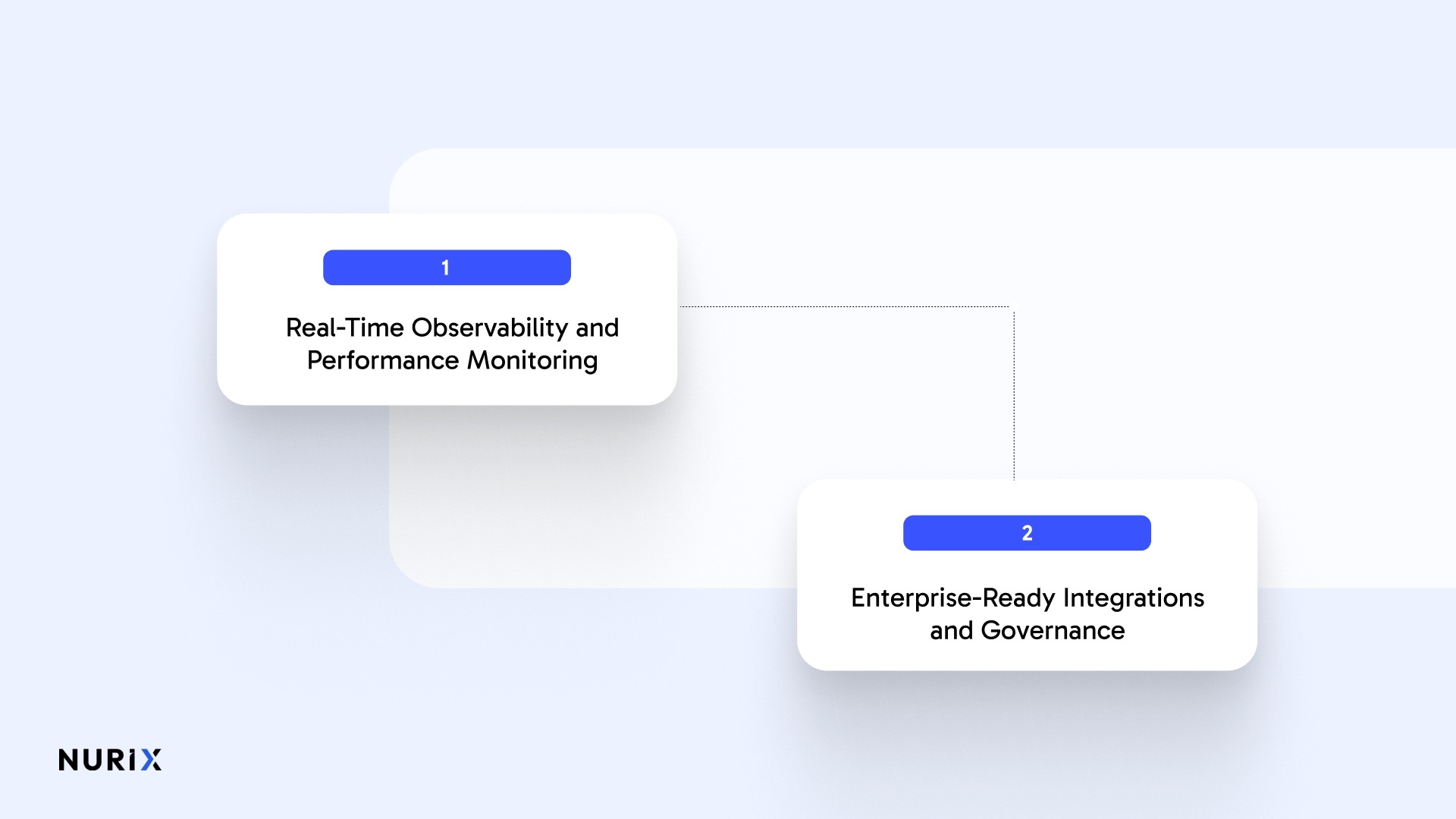
Real-Time Observability and Performance Monitoring
As insurance workflows scale, operational visibility becomes critical for maintaining workflow quality and conversion performance. Teams need better monitoring capabilities to identify workflow gaps, delayed handoffs, and customer engagement issues earlier.
Insurance teams increasingly expect:
- Workflow analytics: Visibility into qualification performance, workflow completion, and operational efficiency across insurance workflows.
- Conversion visibility: Monitoring how automation workflows impact lead engagement, customer interactions, and conversion outcomes.
- Escalation tracking: Better visibility into routing failures, delayed handoffs, and unresolved workflow bottlenecks.
- Operational monitoring: Real-time observability across customer engagement workflows, support operations, and automation systems.
Enterprise-Ready Integrations and Governance
Insurance operations depend heavily on connected systems and governed workflows. AI automation platforms must integrate reliably across operational environments while supporting scalability and workflow control.
Enterprise insurance teams now evaluate:
- CRM integrations: Connected workflows between automation systems, customer databases, and insurance operations platforms.
- Auditability: Workflow tracking and operational visibility for monitoring automation performance and customer interactions.
- Governance controls: Better oversight across automation workflows, escalation handling, and operational execution.
- Deployment flexibility: Scalable automation that can operate across multiple systems, teams, and customer engagement channels.
Also Read: How to Increase Insurance Sales Through Automation Techniques
The NuPlay by Nurix AI’s Edge in Insurance AI Automation
Insurance workflows rarely follow a single linear path. Lead qualification, claims servicing, policy support, underwriting coordination, and customer engagement often involve multiple systems, teams, and workflow decisions operating simultaneously.
This is where orchestration becomes a major differentiator between enterprise AI platforms and isolated automation tools.
NuPlay is designed around multi-agent orchestration, which helps insurance teams coordinate complex workflows instead of relying on disconnected automation steps.
Insurance teams use orchestration to support:
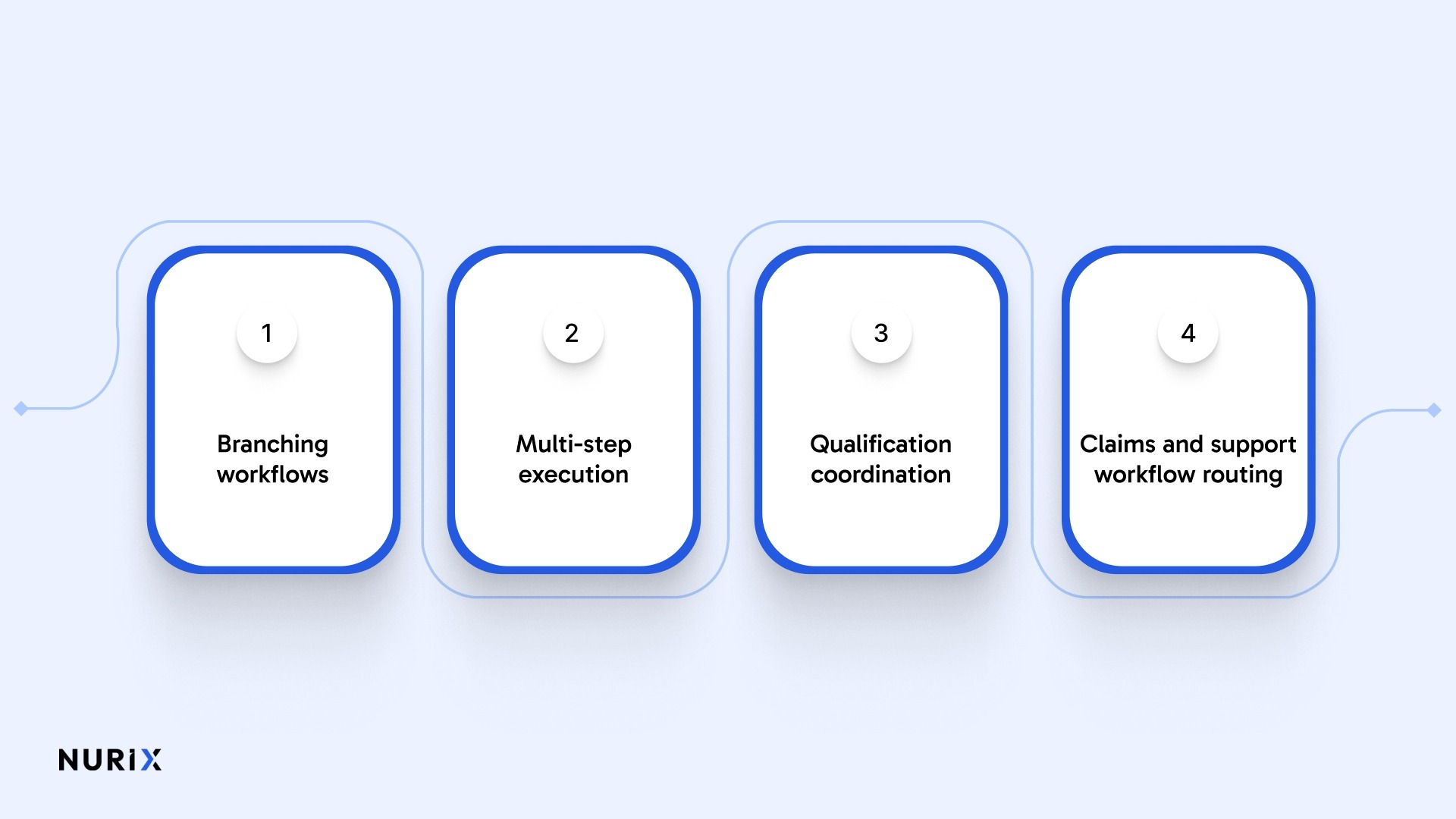
- Branching workflows: Insurance interactions often change dynamically based on customer intent, eligibility, policy type, claims status, or escalation conditions, which requires workflows that can adapt in real time.
- Multi-step execution: Qualification, servicing, and support workflows frequently involve several coordinated actions such as collecting customer information, validating records, updating systems, and routing interactions automatically.
- Qualification coordination: Insurance lead qualification workflows often require routing, follow-up scheduling, prioritization, and data synchronization across multiple systems and teams.
- Claims and support workflow routing: Customer interactions may move between support teams, claims handlers, servicing departments, and escalation workflows while maintaining workflow continuity.
This orchestration-driven approach helps insurance teams reduce operational fragmentation while improving workflow execution across customer-facing operations.
Enterprise Workflow Automation Across Channels
Insurance customer journeys increasingly span voice, chat, email, and digital engagement channels simultaneously. Customers often expect interactions to continue smoothly across channels without repeating information or restarting workflows.
NuPlay helps support:
- Voice automation: AI-driven voice workflows for qualification, support coordination, customer servicing, and inbound engagement.
- Chat automation: Conversational workflows across digital engagement channels for customer support and operational coordination.
- Email workflow coordination: Automated engagement and follow-up workflows connected to broader insurance operations.
- Omnichannel continuity: Workflow coordination across channels that helps maintain more consistent customer experiences.
This improves:
- Context continuity: Customer interactions can continue across workflows and channels without losing operational context.
- Customer journey consistency: Teams can maintain more connected engagement experiences across sales, servicing, and support operations.
- Reduced repetition: Customers and agents spend less time repeating information during workflow transitions and escalations.
This becomes increasingly important as insurance teams manage larger engagement volumes across distributed customer operations.
Deep Integrations Across Insurance Operations
Insurance automation workflows depend heavily on connected operational systems. Disconnected platforms often create workflow delays, duplicated tasks, and inconsistent customer engagement across teams.
NuPlay supports operational coordination through:
- CRM connectivity: Workflow integration across Customer Relationship Management (CRM) platforms and insurance engagement systems.
- Policy system coordination: Connected workflows between customer interactions, policy databases, servicing operations, and workflow execution layers.
- Workflow orchestration across platforms: Coordinated execution between communication channels, operational tools, and automation systems.
- Operational execution support: Automated workflows that can trigger actions, update systems, and coordinate processes across insurance environments.
NuPlay also supports 400+ integrations, which helps insurance teams reduce fragmentation across customer engagement and operational workflows.
Real-Time Observability Through NuPulse
As insurance automation scales, visibility into workflow performance becomes increasingly important for maintaining operational quality and conversion efficiency. Many automation platforms operate as black-box systems where teams have limited insight into workflow performance, escalation gaps, or customer engagement outcomes.
NuPulse helps insurance teams improve operational visibility through:
- Workflow monitoring: Real-time visibility into workflow execution, routing performance, and operational activity.
- Drop-off visibility: Monitoring where customer engagement workflows fail, slow down, or lose continuity across interactions.
- Conversion analytics: Better visibility into qualification performance, engagement outcomes, and workflow effectiveness.
- Operational optimization: Monitoring workflow bottlenecks, escalation patterns, and automation performance to improve operational efficiency over time.
This level of observability helps insurance teams maintain stronger control over automation workflows while improving customer engagement consistency across large-scale operations.
Also Read: AI for Insurance Brokers: 9 Use Cases and KPIs That Matter
Where Insurance Teams Are Using NuPlay Today
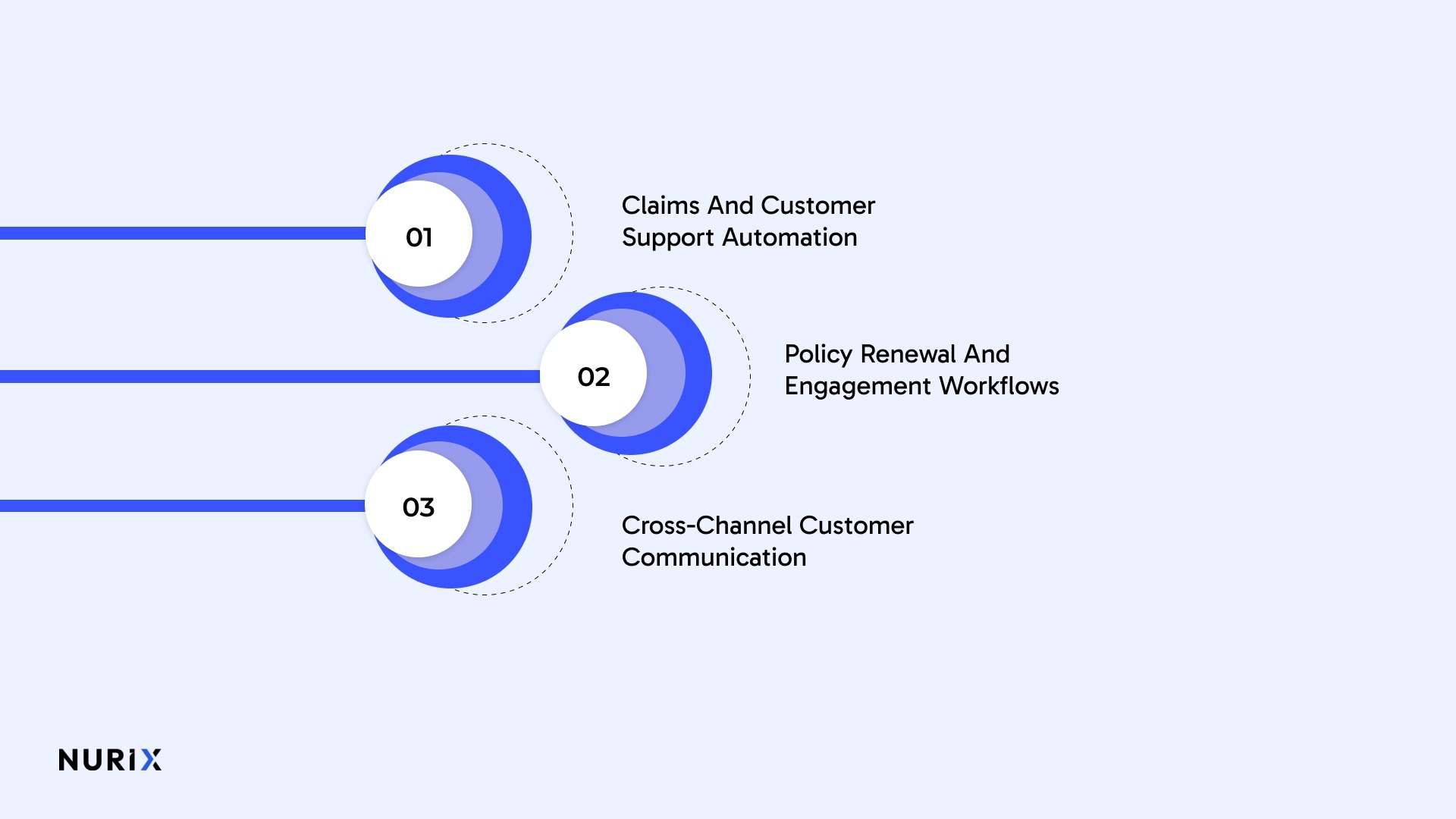
Insurance teams are using NuPlay to automate inbound lead qualification workflows across voice, chat, and digital engagement channels. Instead of relying on agents to manually collect customer information and route inquiries, AI-driven workflows can qualify leads based on policy type, urgency, location, intent, and eligibility criteria in real time.
For example, when a customer requests information about health or motor insurance, the workflow can automatically gather qualification details, update the Customer Relationship Management (CRM) system, prioritize the lead, and route the interaction to the appropriate sales or advisory team without requiring multiple manual handoffs.
Claims and Customer Support Automation
Insurance support operations often experience high inquiry volumes during claims events, policy servicing requests, and customer escalations. NuPlay helps automate repetitive support workflows while maintaining workflow continuity across servicing and claims operations.
Teams use these workflows to manage claim status inquiries, collect customer verification details, route support interactions, and coordinate escalation handling more efficiently. This reduces operational pressure on support teams while helping customers receive faster responses across voice, chat, and digital engagement channels.
Policy Renewal and Engagement Workflows
Policy renewal workflows often involve multiple customer touchpoints across reminders, payment coordination, servicing updates, and renewal confirmations. Manual follow-ups can create delays and inconsistent customer communication, especially during high-volume renewal periods.
Insurance teams use NuPlay to automate renewal engagement workflows through personalized reminders, follow-up coordination, payment notifications, and customer servicing interactions. These workflows help maintain more consistent customer communication while reducing the administrative workload associated with renewal operations.
Cross-Channel Customer Communication
Insurance customers increasingly move between communication channels during a single interaction. A customer may begin with a chatbot inquiry, continue through voice support, and later receive follow-up communication through email or SMS.
NuPlay helps insurance teams maintain workflow continuity across these interactions by coordinating customer engagement across channels instead of treating each touchpoint separately. This helps reduce repeated information collection, improves customer journey consistency, and supports more connected engagement experiences across insurance operations.
Also Read: Top 10 Strategies Using AI for Insurance Lead Management
Why NuPlay Fits Enterprise Insurance Operations Better Than Fragmented AI Tooling
Many insurance teams use separate Artificial Intelligence (AI) tools across qualification, support, servicing, and engagement workflows. Over time, this often creates fragmented operations where workflows cannot coordinate effectively across systems and teams.
NuPlay takes a centralized orchestration-driven approach that helps insurance teams coordinate workflows across channels, systems, and operational functions from a unified automation layer. This improves workflow continuity while reducing operational fragmentation across customer-facing operations.
Workflow Continuity vs Isolated Automations
Basic automation tools often operate as isolated workflows that struggle to maintain continuity across qualification, servicing, escalation handling, and customer engagement processes.
NuPlay is designed to support workflow continuity across these operational environments. This helps insurance teams maintain customer context, reduce repeated data collection, and coordinate multi-step workflows more consistently across voice, chat, email, and support channels.
Operational Visibility vs Black-Box Automation
Many automation platforms provide limited visibility into workflow execution after deployment. Insurance teams may struggle to identify routing failures, engagement drop-offs, or operational bottlenecks when monitoring capabilities remain limited.
Through NuPulse, NuPlay helps teams monitor workflow execution, qualification performance, escalation handling, and operational activity in real time. This gives insurance operations stronger visibility into how automation workflows perform across customer engagement environments.
Enterprise Governance vs Lightweight Deployments
Enterprise insurance operations require stronger governance, workflow control, and deployment flexibility than lightweight automation environments. Insurance workflows often involve regulated customer data, operational oversight, and cross-system coordination requirements.
NuPlay is built to support enterprise-scale insurance workflows through orchestration, integrations, operational monitoring, and workflow governance capabilities that help teams maintain greater operational control as automation scales.
How NuPlay Supports Insurance Teams at Scale
As insurance operations scale, maintaining workflow continuity across sales, support, servicing, and customer engagement environments becomes increasingly difficult. Insurance teams often manage large interaction volumes across multiple systems, communication channels, and operational workflows simultaneously, which creates challenges around routing, visibility, escalation handling, and operational coordination.
NuPlay is an enterprise voice and chat AI platform built to automate support, sales, and workflow operations across channels. Its orchestration-driven approach helps insurance teams coordinate customer engagement workflows while maintaining stronger operational visibility across systems and teams.
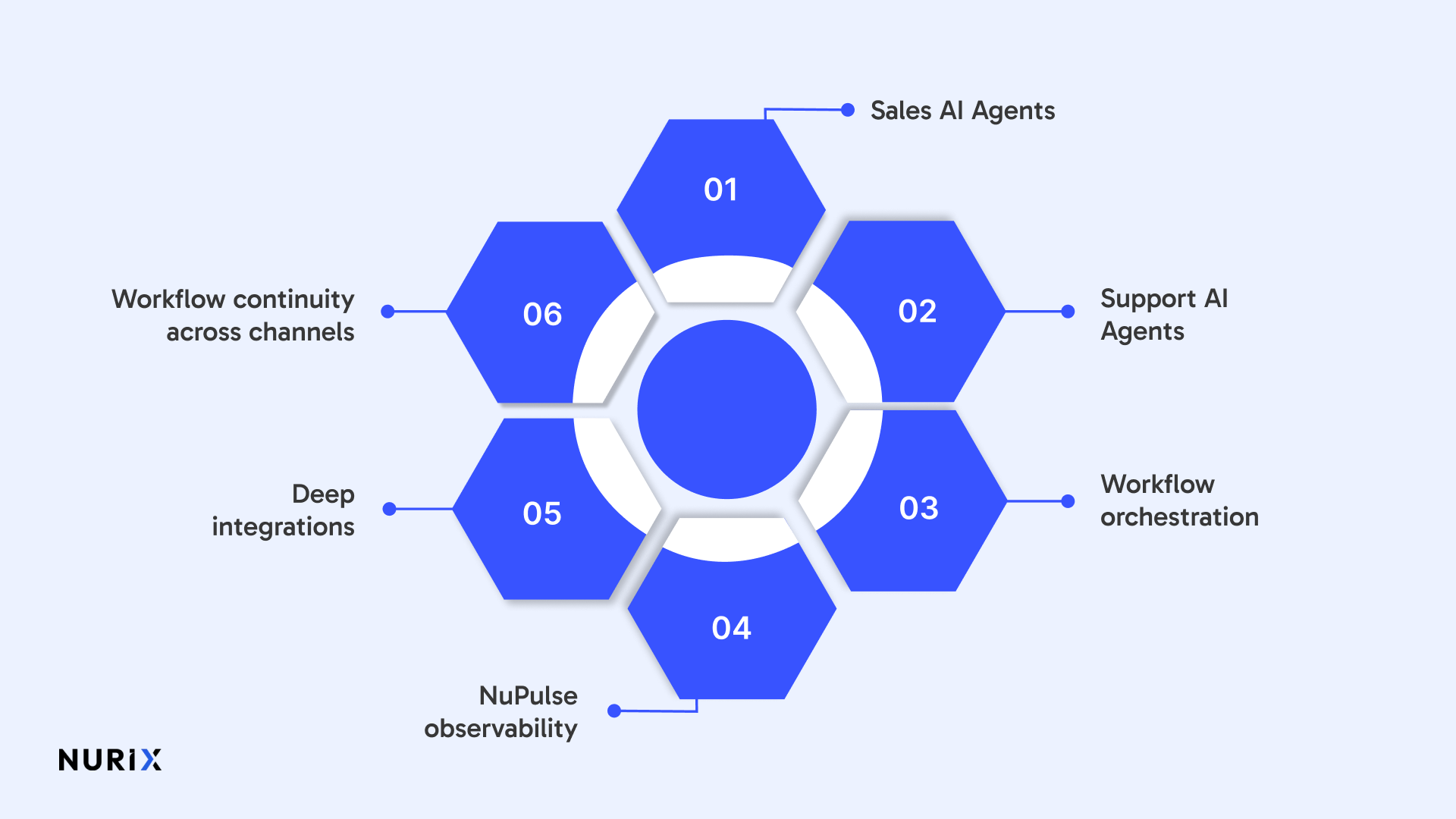
Insurance teams use NuPlay to support:
- Sales AI Agents: Automating lead qualification, routing, appointment scheduling, and customer engagement workflows across inbound insurance channels.
- Support AI Agents: Coordinating customer support, claims servicing, escalation handling, and policy servicing interactions across voice, chat, and digital support environments.
- Workflow orchestration: Managing multi-step workflows across qualification, servicing, escalation, and engagement operations without relying on disconnected automation systems.
- NuPulse observability: Monitoring workflow execution, operational performance, qualification outcomes, escalation handling, and customer engagement activity in real time.
- Deep integrations: Connecting Customer Relationship Management (CRM) systems, policy platforms, communication tools, and operational workflows across insurance environments.
- Workflow continuity across channels: Maintaining customer context and operational coordination across voice, chat, email, and customer support interactions.
This orchestration-driven approach helps insurance teams reduce operational fragmentation while improving workflow execution, customer engagement consistency, and operational visibility across high-volume insurance operations.
Final Thoughts
Insurance AI automation is becoming increasingly operational as insurers work to improve response speed, workflow continuity, and customer engagement across complex environments. Disconnected automation tools often struggle to support multi-step insurance workflows at scale, especially when customer interactions span multiple systems and channels.
One practical way to evaluate your current automation environment is to identify where workflows still rely heavily on manual routing, fragmented systems, or inconsistent handoffs. These operational gaps often create the biggest impact on efficiency and customer experience.
Insurance automation works best when orchestration, workflow visibility, integrations, and cross-channel continuity operate together across customer-facing workflows.
If your team is evaluating enterprise insurance AI workflows, book a Custom Demo to see how NuPlay supports insurance automation across sales, support, and operational workflows.