
Claims automation helps insurers process claims faster, reduce manual work, and maintain control at scale. When claim volumes rise, manual intake, document review, and follow-ups create delays that increase costs and frustrate customers.
With claims automation, voice calls, chat interactions, and documents are converted into structured workflows. This allows faster triage, consistent decisions, and clear audit trails without increasing headcount.
Adoption is picking up across the industry, with the global claims automation market projected to reach USD 14.3 billion by 2033 (Growth Market Reports) as insurers invest in more reliable and scalable claims operations.
Teams using automation report shorter cycle times, lower cost per claim, and stronger fraud detection across high-volume workflows.
In this guide, you will learn what claims automation is, where claims operations slow down, which use cases deliver the most value, and what to look for when selecting an enterprise solution.
Key Takeaways
- Automation Reduces Cycle Time: AI-driven workflows remove manual delays across intake, validation, and routing, improving time-to-decision in high-volume claims environments.
- Cost Per Claim Drops Significantly: Automating repetitive tasks like data extraction and validation reduces manual effort and lowers operational costs at scale.
- STP Rates Improve With AI: Straight-Through Processing (STP) increases as machine learning handles low-complexity claims without human intervention.
- Fraud Detection Becomes Consistent: Multi-signal AI models apply standardized risk scoring across claims, improving anomaly detection and reducing leakage.
- Scalability Without Headcount Growth: Automation handles volume spikes without proportional hiring, maintaining performance during peak claim periods.
What Is Claims Automation in Insurance and How Does It Work?
Claims automation uses AI and workflow orchestration to execute structured claims tasks such as intake, data extraction, validation, routing, and decision support. It converts voice, chat, and documents into structured claim data while maintaining auditability, exception handling, and human oversight for complex or high-risk scenarios.
Key capabilities that define enterprise-grade claims automation systems:
- Multichannel Intake Capture: Ingests First Notice of Loss (FNOL) from voice, chat, email, and portals into structured claim records without manual entry.
- Intelligent Data Extraction: Uses Optical Character Recognition (OCR) and Natural Language Processing (NLP) to extract policy numbers, loss details, and invoice data from documents and images.
- Policy Validation Engine: Matches extracted data against policy administration systems (PAS) to verify coverage, limits, and deductibles in real time.
- Dynamic Workflow Routing: Applies business rules and machine learning (ML) models to route claims to straight-through processing (STP) or human review queues.
- Audit Trail And Explainability: Logs every automated action, model output, and human override to support compliance, traceability, and regulatory audits.
Claims automation shifts insurers from manual, fragmented workflows to structured, traceable systems that increase processing speed, reduce errors, and maintain control across high-volume operations.
Why Do High-Volume Insurers Use Claims Automation?
Claims automation directly impacts cycle time, cost per claim, and operational control in high-volume environments. By replacing manual intake, validation, and routing with AI-driven workflows, insurers reduce backlog accumulation, improve straight-through processing rates, and apply consistent fraud and policy checks across large claim volumes without increasing headcount.
Operational impact areas that define value in high-volume claims environments:
- Cycle Time Compression: AI-driven triage and routing reduce time-to-decision by eliminating manual handoffs and queue delays across First Notice of Loss (FNOL) workflows.
- Cost Per Claim Reduction: Automating data extraction and validation lowers manual effort per claim, reducing operational expenditure while maintaining processing throughput at scale.
- Straight-Through Processing Expansion: Machine learning (ML) models increase Straight-Through Processing (STP) rates by resolving low-complexity claims without human intervention.
- Fraud Signal Standardization: AI applies consistent anomaly detection using multi-signal inputs, improving fraud identification across the entire claims portfolio.
- Volume Elasticity Without Staffing: Automation absorbs surge volumes during catastrophe events or seasonal spikes without proportional increases in staffing or operational cost.
Claims automation enables insurers to process higher volumes with controlled costs, predictable outcomes, and consistent risk evaluation, making it critical for maintaining margins in large-scale claims operations.
To understand why claims automation is necessary, start by examining the Key Pain Points of AI Chatbots in the Insurance Industry
What Are the Key Claims Automation Use Cases in Insurance?
.jpg)
Claims automation applies AI, document processing, and workflow orchestration to specific stages of the claims lifecycle. It reduces manual intervention in intake, validation, decisioning, and communication, allowing insurers to process high volumes with consistent logic, faster turnaround, and controlled exception handling across multiple claim types.
Adoption is accelerating as insurers look to operationalize these capabilities at scale, with the global AI in claims processing market expected to grow at a compound annual growth rate (CAGR) of 23.5% from 2025 to 2033, reaching USD 24.2 billion by 2033 (Research Intelo).
1. FNOL Intake Automation
AI captures First Notice of Loss (FNOL) across voice, chat, and digital channels, converting unstructured inputs into structured claim records without manual data entry or call logging.
Operational components that drive FNOL automation efficiency:
- Multichannel Data Capture: Ingests claim details from voice calls, chat sessions, and web forms using Automatic Speech Recognition (ASR) and Natural Language Processing (NLP) to structure inputs.
- Real-Time Claim Creation: Automatically generates claim IDs and records in claims management systems immediately after data capture, reducing intake delays and manual backlog formation.
- Context Preservation Across Channels: Maintains continuity when claimants switch from voice to chat or upload documents, preventing data loss and duplicate claim creation.
Teams should know this because intake delays directly impact cycle time, and structured FNOL capture sets the foundation for downstream automation accuracy and processing speed.
2. Document Processing and Data Extraction
AI processes claim documents, invoices, and images to extract structured data fields required for validation, routing, and decision support without manual review.
Core technical capabilities enabling document automation:
- Optical Character Recognition (OCR): Converts scanned documents and images into machine-readable text, enabling the extraction of policy numbers, claim amounts, and incident details.
- Field-Level Data Mapping: Maps extracted data to predefined schema fields in claims systems, ensuring consistency across formats such as PDFs, images, and handwritten forms.
- Confidence Scoring Mechanism: Assigns confidence levels to extracted data, triggering human review only when thresholds are not met, reducing unnecessary manual intervention.
Teams should know this because manual document review is one of the largest time sinks, and automation directly reduces processing delays and transcription errors.
3. Policy Validation and Coverage Checks
Automation verifies claim details against policy data to confirm eligibility, coverage limits, and deductibles before claims move to decision or payment stages.
Key validation mechanisms used in automated systems:
- Policy Administration System (PAS) Integration: Connects with backend systems to fetch real-time policy data for validation without manual lookup or reconciliation.
- Rule-Based Coverage Checks: Applies predefined business rules to validate claim eligibility, coverage scope, and exclusions based on policy terms.
- Exception Flagging Logic: Identifies mismatches such as expired policies or uncovered incidents and routes them to adjusters for further review.
Teams should know this because early validation prevents downstream rework, reduces claim leakage, and ensures only eligible claims proceed through automated workflows.
4. Fraud Detection and Risk Scoring
AI evaluates claims using multi-signal analysis to identify anomalies, suspicious patterns, and high-risk cases before payout decisions are made.
Signals and models used for fraud detection:
- Behavioral Pattern Analysis: Detects irregular claimant behavior across interaction history, submission timing, and claim frequency using machine learning (ML) models.
- Cross-Data Signal Correlation: Combines inputs from documents, voice transcripts, and historical claims data to identify inconsistencies and fraud indicators.
- Real-Time Risk Scoring Engine: Assigns risk scores during claim processing, enabling automated routing of high-risk claims to investigation teams.
Teams should know this because undetected fraud directly impacts loss ratios, and early-stage risk scoring improves detection accuracy without slowing legitimate claims.
5. Claims Triage and Routing
Automation routes claims to the appropriate processing path based on complexity, risk, and predefined business rules, reducing manual assignment delays.
Routing logic and execution layers include:
- Dynamic Workflow Orchestration: Uses rule engines and ML models to determine whether claims qualify for Straight-Through Processing (STP) or require human review.
- Priority-Based Queue Management: Assigns claims to queues based on urgency, severity, and service-level agreements (SLAs) to optimize processing order.
- Load Balancing Across Teams: Distributes claims across adjusters or departments to prevent bottlenecks and maintain consistent throughput.
Teams should know this because inefficient routing creates bottlenecks, while automated triage ensures faster processing and better resource utilization across teams.
In Short: Claims automation use cases span intake, document processing, validation, fraud detection, and routing, enabling insurers to replace manual workflows with structured, scalable systems that improve speed, accuracy, and operational control across the entire claims lifecycle.
As automation takes over repetitive claims tasks, insurers must rethink workflows and responsibilities, as explained in How AI Is Changing Insurance Agent Roles
Manual vs Automated Claims Processing: What Is the Difference?
Manual claims processing relies on human-driven intake, validation, and decision steps, which increases cycle time, variability, and operational cost. Automated claims processing uses AI, workflow orchestration, and system integrations to standardize execution, reduce manual intervention, and improve processing speed, accuracy, and scalability across high-volume claim environments.
Operational differences across core claims lifecycle stages:
Automated claims processing replaces manual variability with structured execution, enabling faster decisions, consistent validation, and scalable operations while maintaining auditability and control across enterprise claims workflows.
To see how these workflows come together in real operations, explore AI Automation in Insurance Claims Processing
What Are Common Claims Automation Challenges and How Can You Avoid Them?
Claims automation fails when strategy, data, and system design are misaligned. Without clear goals, clean data, system integration, and human oversight, AI workflows create bottlenecks instead of efficiency. Avoiding these pitfalls requires structured planning, measurable targets, and continuous performance monitoring across the claims lifecycle.
Key risks and corresponding prevention strategies across enterprise claims automation deployments:
Avoiding these pitfalls keeps claims automation accurate, scalable, and reliable while maintaining compliance, operational visibility, and consistent performance across high-volume insurance workflows.
Claims automation is one part of a larger shift, and you can see broader implementations in Practical Uses and Applications of AI and Machine Learning in Insurance
How Do You Choose the Right Claims Automation Vendor?
Evaluating claims automation vendors requires validating technical depth, integration capability, compliance readiness, and measurable business impact. Enterprise teams must assess whether the platform can execute real-time workflows, scale across claim volumes, and maintain auditability while aligning with existing systems and operational requirements.
Evaluation criteria that determine vendor suitability in enterprise claims environments:
- Proven Operational Outcomes: Validate case studies showing improvements in Straight-Through Processing (STP), cycle time reduction, and cost per claim using real production benchmarks, not pilot results.
- System Integration Depth: Confirm Application Programming Interface (API) coverage across Policy Administration Systems (PAS), Customer Relationship Management (CRM), and document systems for real-time data synchronization.
- Compliance And Audit Controls: Check for SOC 2 compliance, encryption standards, and audit logs that track every automated action for regulatory reporting and traceability.
- Human-In-The-Loop Design: Ensure Human-In-The-Loop (HITL) workflows allow exception handling, decision overrides, and visibility into model outputs to maintain trust and control.
- Real-Time Execution Capability: Assess whether the platform processes voice, chat, and documents in real time; NuPlay fits this requirement with enterprise AI voice and chat workflows across claims operations.
Choosing the right vendor ensures claims automation delivers consistent performance, integrates cleanly with core systems, and scales without introducing risk, inefficiencies, or operational blind spots.
Why NuPlay Fits Enterprise Claims Automation Needs
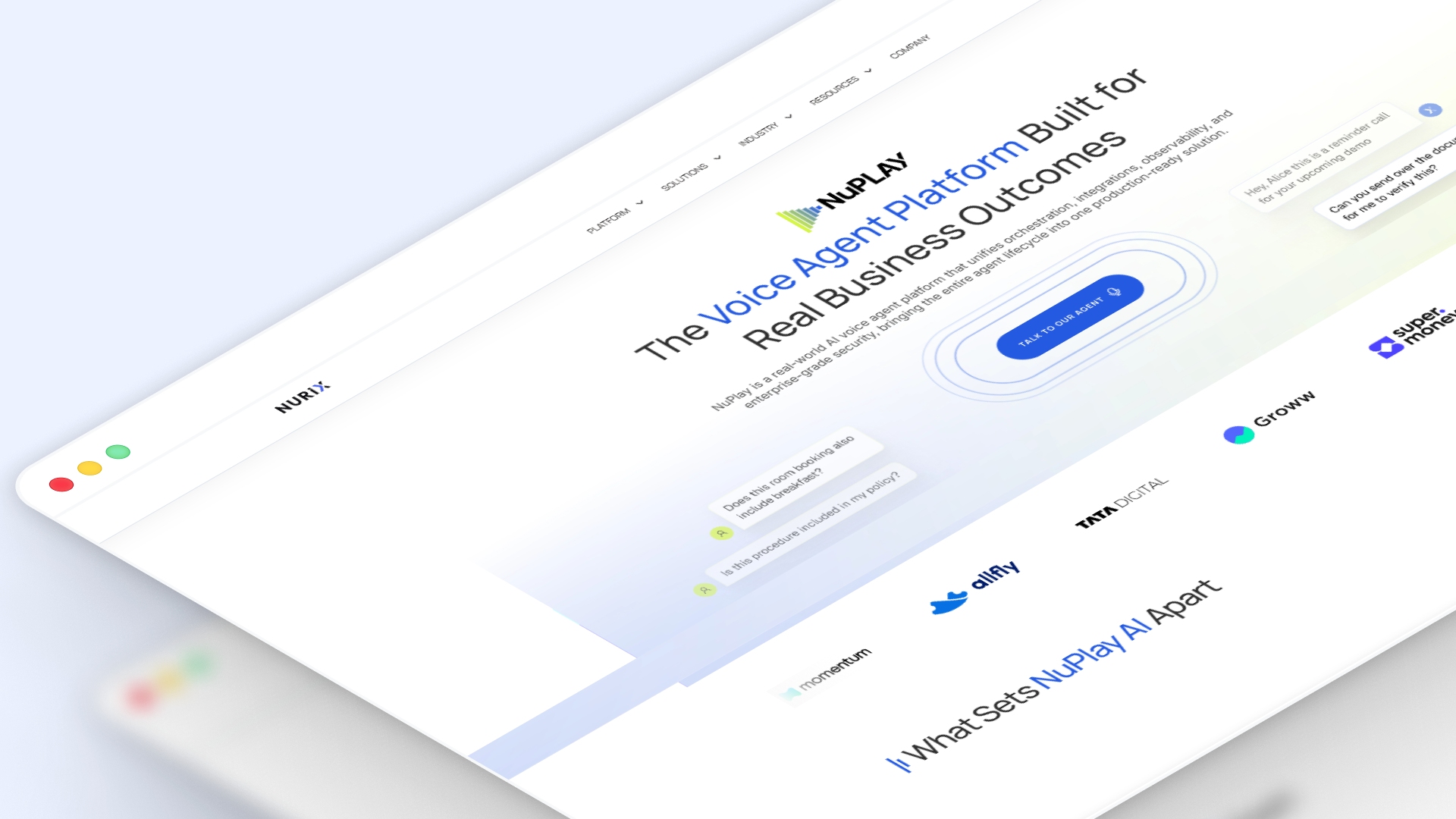
NuPlay is an enterprise AI voice and chat platform that executes claims workflows across voice, chat, and documents in real time. It reduces manual intake, accelerates triage, and maintains auditability while supporting human-in-the-loop decision control for complex or high-risk claims.
Core capabilities that align with enterprise claims automation requirements:
- Unified Multichannel Intake: Handles calls, chat, SMS, and email in one workflow, converting interactions into structured claim data without manual entry delays.
- Document And Conversation Processing: Extracts data from PDFs, images, and transcripts using document AI, linking all inputs into a single claim record for faster triage.
- Human-In-The-Loop Control: Enables Human-In-The-Loop (HITL) oversight with clear decision visibility, allowing teams to review and override automated recommendations when required.
- Real-Time Workflow Execution: Processes claims events instantly across channels, reducing lag between intake, validation, and routing decisions in high-volume environments.
- Auditability And Compliance: Maintains detailed logs of actions, decisions, and overrides to support regulatory compliance and operational transparency.
Case Study: First Mid Insurance and Claims Automation
First Mid Insurance improved training speed and operational consistency by replacing static manuals with an AI-driven system. This reduced onboarding time, improved compliance accuracy, and supported claims automation by making process knowledge instantly accessible and actionable for teams.
What NuPlay Delivered:
- Converted manuals into a conversational AI assistant using a Knowledge Retrieval Engine for real-time query resolution.
- Provided step-by-step guidance with policy-level accuracy and compliance traceability.
Measured Impact:
- 100% workflows digitized from static documentation
- 95% guidance accuracy across training and compliance
- 25% increase in team productivity
- 237% ROI within 90 days
NuPlay enables insurers to replace fragmented tools with a single execution layer that improves speed, control, and consistency across claims processing without increasing operational complexity.
Conclusion
Claims automation must deliver clear, measurable outcomes you can act on. Prioritize platforms that run production-ready voice and chat agents, turn conversations and documents into actionable work, and provide real-time visibility and enterprise-grade security so you can scale with confidence.
When you require those capabilities, you move from pilots to reliable operational gains and faster, provable ROI.
For a focused look at how this works in practice, explore NuPlay's conversational agent platform and knowledge-retrieval capabilities, which connect voice, chat, documents, and core systems while providing analytics and enterprise controls.
Schedule a custom demo to see NuPlay, live integrations, and analytics applied to one high-volume claims subprocess.
Author: Sakshi Batavia — Marketing Manager
Sakshi Batavia is a marketing manager focused on AI and automation. She writes about conversational AI, voice agents, and enterprise technologies that help businesses improve customer engagement and operational efficiency.