.jpg)

Sales teams today are dealing with constant call volumes, slow handoffs, and too much post-call work that eats into actual selling time. It often leads to missed leads, messy CRM data, and deals taking longer to close. What teams really need is a way to capture what happens on calls and turn it into action without adding more tools.
Real outcomes are already visible: for example, a major tech firm reported more than $500 million (Reuters) in call-center savings after rolling out AI-driven automation in 2024. Surveys and industry studies also show AI is delivering clear revenue and efficiency gains for sales and service teams.
Voice AI helps by turning conversations into usable data, triggering follow-ups, and keeping everything moving. In this guide, you will learn how it works, what to look for, and how to scale it effectively.
What is Voice AI for Sales?
Voice AI for sales is an enterprise system that converts live sales conversations into structured data, automates CRM updates, provides real-time agent assistance, and triggers follow-up actions across business workflows.
Key Takeaways
- Conversation To Action: Voice AI converts calls into structured data, automatically updating CRM systems and triggering follow-ups without manual input.
- Speed-To-Lead Advantage: Instant call engagement and automated qualification help capture high-intent prospects early, improving conversion rates across the sales funnel.
- End-To-End Automation: Real value comes from automating full workflows, including routing, task creation, and post-call execution, not from transcription alone.
- Enterprise-Grade Requirements: Platforms must deliver high STT accuracy, sub-800ms latency, and deep integration with CRM and telephony systems for reliable performance.
- Workflow-Centric ROI: The biggest gains come from automating high-friction workflows like lead qualification, follow-ups, and CRM updates, where manual effort directly slows revenue generation.
Why Is Voice AI for Sales Important for Enterprise Teams Today?
Voice AI for sales is becoming critical for teams managing high call volumes, fragmented workflows, and delayed follow-ups. It improves speed-to-lead, reduces manual effort, and standardizes execution by combining STT, Natural Language Processing (NLP), and workflow automation into a single operational layer.
Key factors driving adoption and immediate business impact across enterprise sales operations:
- Speed-To-Lead Acceleration: Initiates calls within seconds of lead capture, reducing response delays and increasing conversion probability during peak buyer intent windows.
- Transcription As Infrastructure: STT converts calls into structured data, allowing automation, analytics, and downstream workflow execution across Customer Relationship Management (CRM) systems.
- Real-Time Workflow Execution: NLP extracts intent and triggers actions such as routing, task creation, and follow-ups without manual intervention.
- Cost Reduction At Scale: Automates repetitive call tasks, reducing agent workload and lowering operational costs across high-volume sales and contact center environments.
- Standardized Sales Execution: Applies consistent qualification, routing, and follow-up logic across all calls, improving pipeline quality and reducing variability in sales processes.
Voice AI transforms sales operations into a faster, more consistent system where every call generates structured data, triggers actions, and directly contributes to measurable revenue outcomes.
What Does Voice AI for Sales Do Across the Sales Funnel?
.jpg)
Voice AI for sales executes end-to-end funnel operations by combining NLP and real-time automation to handle prospecting, engagement, deal execution, and retention. It reduces manual workload while increasing speed-to-lead, consistency, and conversion by turning conversations into structured, actionable workflows.
The global conversation intelligence software market is projected to grow at a Compound Annual Growth Rate (CAGR) of around 18% (DiMarket) between 2025 and 2033, reflecting rising demand for systems that capture and act on sales conversations at scale.
1. Top-of-Funnel: Prospecting And Lead Qualification
Voice AI handles high-volume outreach, qualifies leads using predefined criteria, and ensures instant engagement, allowing teams to identify high-intent prospects without manual intervention or delays.
Core actions performed at this stage to identify and qualify high-value opportunities:
- High-Volume Outbound Calling: Executes thousands of concurrent outbound calls, navigates Interactive Voice Response (IVR) systems, and engages prospects using dynamic, human-like conversational flows at scale.
- Instant Speed-To-Lead Response: Triggers calls within seconds of form submission, reducing lead decay and improving conversion probability during peak buyer intent windows.
- Automated Qualification Logic: Applies frameworks like Budget, Authority, Need, Timeline (BANT) to filter leads, capture structured data, and update CRM records automatically.
Sales teams gain faster pipeline entry, reduced manual prospecting effort, and higher-quality leads by engaging prospects instantly and consistently at scale.
2. Middle-of-Funnel: Nurturing And Engagement
Voice AI maintains deal momentum by managing follow-ups, scheduling meetings, and re-engaging inactive leads, ensuring continuous interaction without relying on manual outreach.
Key engagement workflows that keep deals active and progressing:
- Calendar-Based Scheduling Automation: Integrates with tools like Google Calendar and Outlook to book meetings in real time, eliminating back-and-forth coordination during live conversations.
- Cold Lead Reactivation Campaigns: Identifies dormant leads in CRM systems and re-engages them through personalized outreach based on historical activity.
- Behavior-Driven Follow-Ups: Uses interaction data, industry signals, and engagement patterns to trigger contextual follow-up calls or messages customized to each prospect.
Sales teams maintain consistent engagement across the pipeline, reduce drop-offs, and improve meeting conversion rates without increasing outreach workload.
3. Bottom-of-Funnel: Deal Management And Closing
Voice AI supports closing by assisting reps in real time, handling objections, and automating final-stage workflows that accelerate deal completion.
Critical capabilities that drive deal closure and reduce friction:
- Real-Time Agent Assist Systems: Provides live prompts, technical answers, and contextual recommendations during calls using real-time conversation analysis and decision engines.
- Objection Handling Automation: Delivers structured responses to pricing, timing, or competitor concerns, supporting multi-turn conversations to resolve hesitation effectively.
- Buyer Readiness Detection: Analyzes tone, pace, and sentiment to identify hesitation or urgency, alerting teams when deals require intervention or acceleration.
Sales teams close deals faster, handle objections with consistency, and reduce dependency on manual support during critical negotiation stages.
4. Customer Success And Expansion
Voice AI extends value post-sale by supporting onboarding, renewals, and expansion opportunities through proactive and data-driven engagement.
Post-sale workflows that drive retention and revenue growth:
- Automated Onboarding Calls: Conducts welcome calls to guide customers through setup, ensuring faster adoption and reducing onboarding friction.
- Upsell And Renewal Triggers: Analyzes usage data and contract timelines to initiate proactive outreach for renewals and expansion opportunities.
- Feedback and NPS Collection: Runs large-scale surveys to collect Net Promoter Score (NPS) and qualitative feedback for continuous service improvement.
Sales and customer success teams increase retention, identify expansion opportunities earlier, and maintain consistent engagement without additional operational overhead.
5. Operational Support And Continuous Improvement
Voice AI automates backend processes, ensuring data consistency, performance tracking, and continuous system improvement without manual intervention.
System-level functions that improve efficiency and data accuracy:
- Automated CRM Data Logging: Transcribes calls and updates CRM records in real time with structured interaction data and outcomes.
- Conversation Intelligence Analysis: Analyzes transcripts to identify trends, performance gaps, and coaching opportunities for sales teams.
- Self-Optimizing Call Flows: Uses machine learning feedback loops to refine scripts, improve responses, and increase effectiveness over time.
Sales teams operate with cleaner data, better insights, and continuously improving workflows without spending time on manual updates or analysis.
In Short, Voice AI transforms every stage of the sales funnel into an automated, data-driven system where conversations trigger actions, improve continuously, and directly contribute to pipeline growth and revenue outcomes.
If you're planning to move from evaluation to deployment and need a clear execution path, follow How to Implement AI in Call Centers: A Step-by-Step Guide for 2025
How Does Voice AI for Sales Work in an Enterprise Environment?
Voice AI for sales operates through a pipeline that captures call audio, converts it into structured data, interprets intent using NLP, and triggers real-time or post-call actions. Enterprise systems rely on low-latency processing, accurate transcription, and deep integrations to automate workflows reliably.
Core components that allow end-to-end voice AI execution across enterprise sales workflows:
- Call Ingestion Layer: Captures audio via Contact Platform as a Service (CPaaS), Public Switched Telephone Network (PSTN), or softphones for real-time processing.
- Speech-To-Text Processing: Converts audio to text using STT models, optimized for noise handling, accents, and domain-specific vocabulary accuracy.
- Intent and Entity Extraction: NLP identifies intent, deal signals, entities, and sentiment to determine next actions within workflows.
- Real-Time Decision Engine: Matches live conversation context to predefined logic, triggering agent prompts, routing decisions, or workflow actions within milliseconds.
- Post-Call Automation Layer: Generates summaries, updates CRM records, assigns tasks, and triggers follow-ups using generative AI models.
When these components operate together with low latency and reliable integrations, voice AI becomes embedded in sales infrastructure, turning conversations into structured actions that accelerate deal velocity.
If you want a deeper look at how voice systems manage intent, context, and multi-turn conversations in real time, read How Dialog Management Handles Real Conversations?
Which Are the Top Voice AI for Sales Platforms in 2026?
The top voice AI for sales platforms in 2026 include NuPlay, Vapi, Retell AI, and Synthflow. These platforms help sales teams automate calls, capture insights, update CRM systems, and improve conversion rates through real-time assistance and post-call automation.
Voice AI for Sales Platforms (Quick Comparison)
Use this quick comparison to identify which voice AI platform aligns with your sales workflow, scale requirements, and integration needs.
Decision Logic: Choose NuPlay for enterprise workflow automation across CRM, telephony, and systems. Select Vapi for API-driven customization. Use Retell AI for low-latency call automation. Pick Synthflow for no-code deployment with built-in telephony. Prioritize platforms that execute workflows reliably at scale.
1. NuPlay
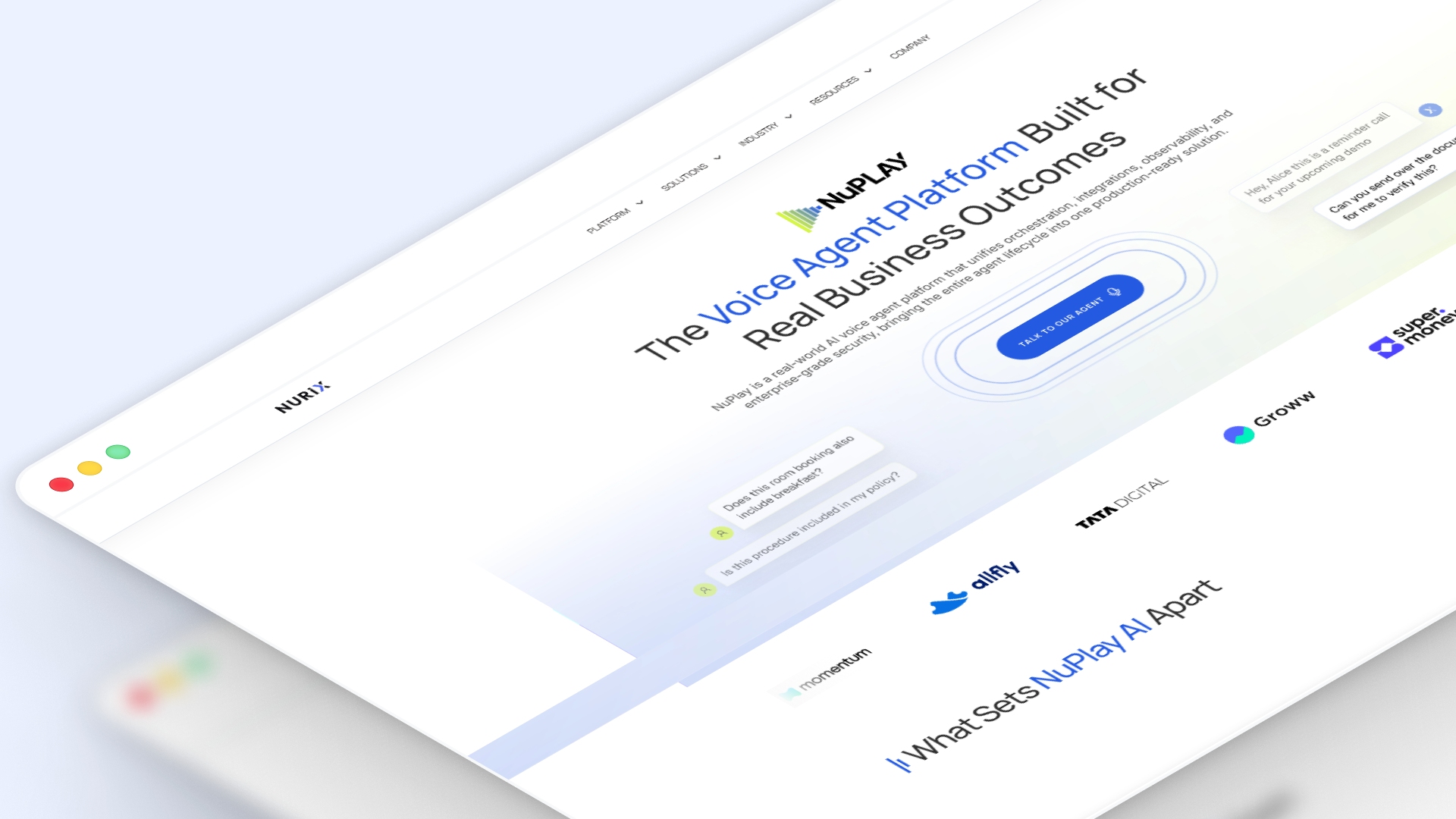
NuPlay is an enterprise AI voice agent platform that unifies orchestration, integrations, observability, and security to manage the full agent lifecycle, allowing businesses to deploy production-ready voice automation with measurable outcomes across sales and support workflows.
Key Features
- Multi-agent orchestration for handling complex, multi-step workflows
- Model-agnostic execution across STT (Speech-to-Text), LLM (Large Language Model), and TTS (Text-to-Speech)
- Real-time observability with performance insights and continuous optimization
Integration: Supports 400+ integrations across CRM, telephony systems, enterprise tools, and data sources for end-to-end workflow execution.
Price: Custom enterprise pricing based on workflow complexity, integrations, and scale; includes deployment support and outcome-driven implementation.
2. Vapi

Vapi - Build Advanced Voice AI Agents
Vapi is a developer-first voice AI platform designed to build, deploy, and scale voice agents using API-based architecture with high configurability across telephony, models, and workflows.
Key Features
- API-native platform with full control over voice agent workflows
- Bring your own models for STT (Speech-to-Text), LLM (Large Language Model), and TTS (Text-to-Speech)
- Automated testing and A/B experimentation for performance optimization
Integration: Supports 40+ integrations, including CRM, telephony providers, cloud storage, and AI model providers such as OpenAI, Twilio, and Salesforce.
Price: Pay-as-you-go pricing with $0.05 per minute for calls and $0.005 per message for chat; enterprise plans offer custom pricing and volume-based discounts.
3. Retell AI
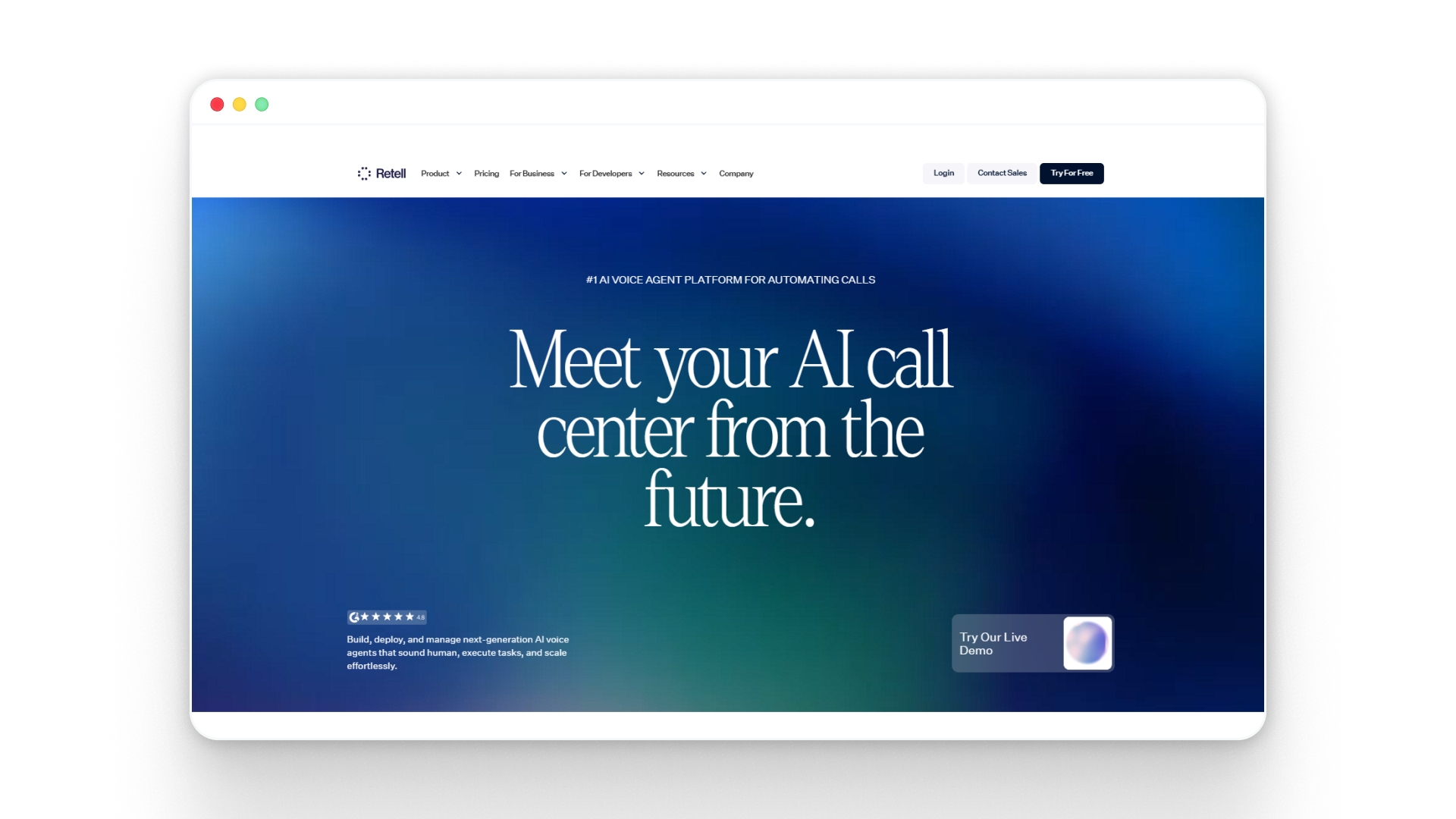
AI Voice Agent Platform for Phone Call Automation - Retell AI
Retell AI is a voice-first AI platform that allows businesses to build and scale human-like conversational agents using Large Language Models (LLMs) with low-latency call handling and real-time task execution.
Key Features
- Low-latency (~600ms) voice interactions for real-time conversations
- Function calling for booking, payments, and workflow execution
- Simulation testing and analytics for performance validation
Integration: Supports integrations with telephony providers, CRM systems, and APIs for custom workflows, including tools like Twilio and HubSpot.
Price: Pay-as-you-go pricing ranges from $0.07–$0.31 per minute for voice agents; enterprise plans offer custom pricing with dedicated infrastructure and support.
4. Synthflow
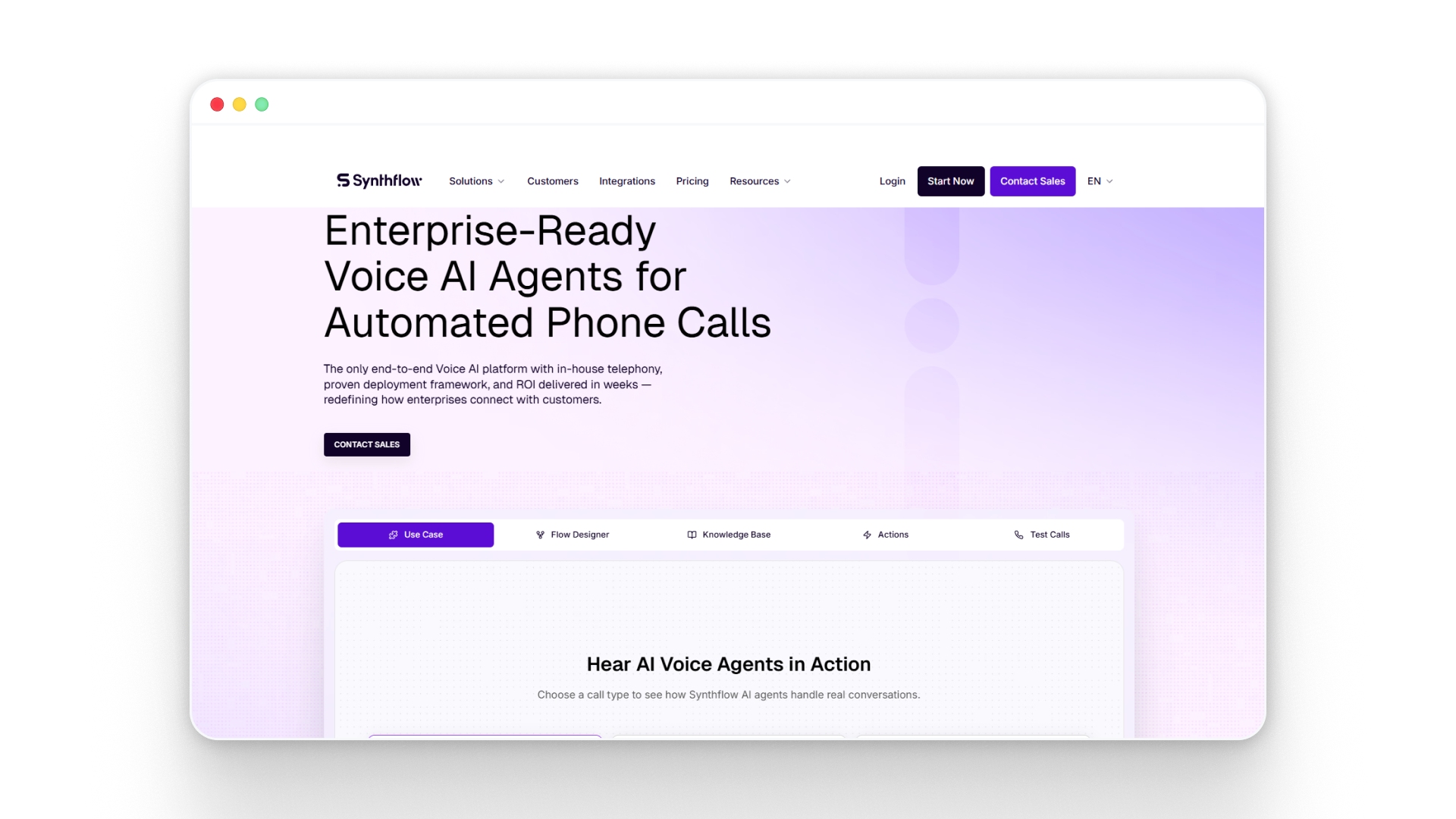
Synthflow is an end-to-end enterprise voice AI platform with in-house telephony, allowing businesses to build, deploy, and scale AI voice agents with controlled latency, workflow automation, and production-grade reliability.
Key Features
- No-code flow builder for designing multi-step voice workflows
- In-house telephony with <100ms latency and 99.99% uptime
- Built-in testing, monitoring, and auto-QA for continuous optimization
Integration: Supports 200+ integrations across CRM, Contact Center as a Service (CCaaS), telephony systems, and APIs including Salesforce, HubSpot, and Zapier.
Price: Pay-as-you-go starts with usage-based pricing (~$0.09/min voice engine) and add-ons; enterprise plans offer custom pricing with unlimited concurrency and advanced compliance features.
Use this comparison to identify which solution aligns with your sales motion, technical environment, and risk requirements so your next investment drives measurable pipeline and operational lift. Once you’ve seen the landscape, the focus shifts from features to fit.
If you're comparing platforms to understand differences in architecture, performance, and real-world execution, review Retell AI vs Nurix AI: Detailed Comparison of Voice Platforms
How Do You Choose the Right Voice AI Platform for Sales?
Choosing the right voice AI for sales depends on its ability to automate real call workflows with accurate transcription, low latency, and reliable integrations. Enterprise teams should test real-world performance, validate workflows, and confirm security and ROI before scaling.
Focus areas that determine whether a platform can move from pilot to production:
- Transcription Accuracy Benchmarking: Test STT accuracy on noisy calls, accents, and domain terms; measure word error rate (WER) under real call conditions.
- CRM and Telephony Sync Depth: Validate bi-directional CRM updates and telephony integration without manual exports or delayed data sync.
- Latency Under Live Conditions: Measure response time for real-time assist; sub-800ms latency ensures prompts arrive during conversations, not after decision points pass.
- Workflow Execution Reliability: Confirm automated actions such as task creation, follow-ups, and record updates complete without failure across integrated systems.
- Security and Compliance Controls: Verify SOC 2 (System and Organization Controls 2), encryption standards, audit logs, and data residency support for regulated environments.
A platform that meets these criteria consistently in real call environments is ready for enterprise-scale deployment without adding operational friction or manual overhead.
How Are Enterprises Using Voice AI for Sales in Real-World Scenarios?
A fast-growing B2B company (Anyteam) struggled to turn scattered data into timely actions. Sales reps spent five to six hours on research per account, slowing follow-ups and delaying deal progress.
What NuPlay Did:
NuPlay deployed an AI-native sales layer that unified data from CRM systems, emails, calendars, and web sources. It summarized key signals and delivered actionable insights directly within rep workflows, along with real-time conversational intelligence for live guidance.
The Practical Outcome:
Once the system was live, the team saw clear, measurable gains:
- 40% reduction in research time: Faster, smarter prep before meetings saved hours every week, freeing reps to focus on conversations instead of digging through data.
- 80% faster sales cycle time: Deals moved more quickly from first meeting to proposal because follow-ups and context were handled automatically.
- 71% increase in conversions: Better qualification and timely next actions helped turn more opportunities into closed deals.
- 40% more account coverage: Reps managed significantly more accounts without sacrificing call quality or responsiveness.
Why This Matters for You
When voice AI connects data, conversations, and workflows, teams respond faster, act with better context, and close deals more consistently without increasing workload.
If you want to see how an enterprise-grade system actually transforms call handling and automation at scale, explore NEX by Nurix: Supercharge Your Call Systems with AI Power
Conclusion
Voice AI for sales should be evaluated based on how well it executes real workflows, not feature lists. The right platform captures call data, triggers actions, and integrates directly into your sales systems without adding complexity.
NuPlay offers production-grade voice agents with multi-agent orchestration, low-latency audio handling, and built-in observability and governance.
Schedule a custom demo with NuPlay to run a focused pilot on your CRM and telephony data and get concrete metrics on time savings and conversion impact.
Author: Sakshi Batavia — Marketing Manager
Sakshi Batavia is a marketing manager focused on AI and automation. She writes about conversational AI, voice agents, and enterprise technologies that help businesses improve customer engagement and operational efficiency.