
You are under pressure to grow revenue, but your team is tied up in repeat work that slows deals. Reps spend time on routine messages, searching across systems, and updating records instead of engaging buyers. Delays build up, follow-ups slip, and scaling becomes difficult without adding headcount.
Generative AI for sales is changing how teams operate by automating high-volume tasks, reducing manual delays, and improving execution across enterprise workflows. Gartner predicts that by 2027, 95% of seller research workflows will begin with AI, making AI-assisted execution a competitive requirement rather than an experiment.
In this guide, you will learn what generative AI for sales means, key use cases, and how to implement it effectively.
In Short
Generative AI for sales allows teams to generate outputs and take actions within connected systems, reducing delays between insight and execution. By combining data access, context retrieval, and workflow triggers, it helps sales teams respond faster, maintain accuracy, and operate with greater control across complex sales processes.
Key Takeaways on Generative AI for Sales
- Generative AI Executes Sales Workflows: It creates outputs and completes actions across Customer Relationship Management (CRM) systems, helping teams move deals forward.
- Enterprise AI Agents Go Beyond Chatbots: They use context, system access, and business logic to handle tasks across the full sales lifecycle.
- Use Cases Focus On High-Volume Tasks: Lead routing, proposal creation, call summaries, and quoting are key areas where AI delivers measurable impact.
- System Integration Drives Results: Connecting AI with CRM, CPQ (Configure Price Quote), and internal data sources is critical for accuracy and execution.
- Successful Adoption Requires Structured Rollout: Clean data, governed workflows, and KPI-driven pilots are necessary to scale AI across sales operations.
What Is Generative AI for Sales and Why It Matters
Generative AI for sales uses enterprise AI systems to create and execute sales outputs using internal data sources. It connects to systems like CRM and applies RAG to produce compliant emails, proposals, summaries, and workflow actions aligned with business rules.
Why this matters for enterprise sales teams:
- Reduces Time Spent On Admin Work: Automates repetitive tasks like email drafting, data entry, and follow-ups, allowing reps to focus on active selling.
- Improves Response Speed Across Channels: Allows faster replies to leads and customers, increasing engagement and reducing drop-offs in early funnel stages.
- Maintains Consistency In Sales Outputs: Ensures proposals, messaging, and summaries follow approved pricing, policies, and brand guidelines.
- Increases Conversion Through Contextual Actions: Uses CRM data and buyer signals to generate relevant next steps that move deals forward.
- Supports Scalable Sales Operations: Handles high-volume workflows without increasing headcount, improving pipeline coverage and operational throughput.
Generative AI for sales helps teams execute faster, stay consistent, and scale revenue operations without increasing manual workload.
Enterprise AI Agents vs Chatbots: What Is the Difference?
Enterprise AI agents go beyond chatbots by executing multi-step sales workflows using system integrations and persistent context. Unlike chatbots that only respond to prompts, they interact with CRM systems, apply business logic, and complete actions such as updating records and routing leads.
With sales representatives spending only 28% of their time actively selling (Market and Markets, 2025), execution-focused systems are critical for improving productivity and deal velocity.
AI Chatbots vs Enterprise AI Agents
Key operational differences between chatbots and enterprise AI agents:
Enterprise AI agents convert conversational inputs into structured actions across systems, allowing measurable workflow execution, stronger governance, and scalable automation aligned with enterprise sales operations.
For a clearer view of how AI improves pipeline movement, conversion stages, and deal velocity, read How AI Is Reshaping Sales Funnel Management: Key Benefits
Top 6 Generative AI Use Cases in Sales Teams
.jpg)
Once you understand what generative AI for sales helps and why enterprise AI agents matter, the next step is identifying where it delivers measurable impact. The strongest results come from high-volume workflows where delays, manual effort, and data fragmentation affect conversion and speed across the sales lifecycle.
1. Automate Lead Qualification & Intelligent Routing
Sales teams process large volumes of inbound leads across channels. Manual triage delays response time and reduces conversion probability for high-intent prospects.
AI action:
An enterprise AI agent evaluates each lead using CRM data, firmographic attributes, and behavioral signals. It can:
- Score leads based on predefined qualification models such as industry, role, and urgency.
- Enrich records with external firmographic and technographic data.
- Detect intent signals from forms, chat interactions, and email activity.
- Route leads to the correct rep, territory, or queue based on rules.
Outcome / KPIs:
- Faster first-response times for high-value leads.
- Higher lead → sales-qualified lead (SQL) conversion.
- Improved routing accuracy and balanced rep workloads.
2. Generate & Personalize Proposals at Scale
Proposal creation slows deal velocity due to manual drafting, pricing validation, and compliance checks across multiple systems.
AI action: A RAG engine connects to approved sources such as price books, SKU catalogs, and contract templates. The system:
- Pulls only approved pricing and legal language
- Applies deal-specific configuration rules (region, contract length, volume tiers)
- Generates a fully structured proposal draft aligned to the buyer’s industry, use case, and buying stage
Outcome / KPIs
- Proposal creation time reduced from days to minutes
- Fewer pricing, legal, and versioning errors per deal
- Faster approval cycles and higher proposal-to-close conversion rates
3. Provide Real-Time Call Assistance for Reps
During live conversations, reps manage discovery, objections, and positioning, often missing critical signals or next steps.
AI action:
A real-time assistant processes call audio or transcripts and delivers contextual guidance within the rep interface. It can:
- Surface relevant account history, open tickets, or past purchases
- Suggest next-best questions based on the conversation stage
- Highlight product details, pricing ranges, or case studies tied to the buyer’s industry
- Flag potential compliance risks or unapproved discount discussions
- Prompt clear next-step language before the call ends
Outcome / KPIs:
- Higher conversion from discovery to next-stage meetings
- Fewer missed follow-ups or unclear next steps
- Faster ramp time for new reps through embedded guidance
4. Summarize Calls & Extract Action Items
Inconsistent note-taking leads to poor CRM data quality and missed follow-ups, impacting pipeline visibility and deal progression.
AI action:
After each call, an AI system processes the transcript and automatically:
- Produces a concise summary of goals, pain points, objections, and commitments
- Extracts action items with owners and due dates
- Updates opportunity fields such as stage, deal size indicators, or product interest
- Draft a follow-up email that reps can review and send
- Tag the conversation by topic for future search and analysis
Outcome / KPIs:
- Higher rate of completed follow-up tasks
- More consistent and timely CRM updates
- Better data quality for forecasting and pipeline reviews
5. Automate Complex Quoting & Configuration (CPQ)
For configurable products, quoting involves dependencies, pricing rules, and approval logic that slow deal execution and increase risk.
AI action:
A generative AI assistant supports Configure Price Quote (CPQ) workflows using structured inputs and natural language. It can:
- Ask guided questions to narrow down product requirements
- Validate selections against technical and commercial constraints
- Recommend compatible bundles or upsell options based on similar deals
- Apply pricing logic, discount thresholds, and approval triggers
- Generate a quote that feeds directly into CPQ and approval workflows
Outcome / KPIs:
- Shorter quote turnaround times
- Fewer configuration and pricing errors
- Improved margin control through policy-aware recommendations
6. Handle High-Volume Post-Sale Requests & Escalations
Post-sale teams manage large volumes of repetitive requests that increase operational load and delay resolution times.
AI action:
An AI service agent manages incoming post-sale requests across email, portals, or chat. It can:
- Classify requests by type, urgency, and account tier
- Resolve common issues automatically using knowledge base content and account data
- Execute simple actions such as updating contact details or sharing order status
- Route complex or high-risk cases to the right team with full context
- Identify patterns that signal churn risk or likely escalation
Outcome / KPIs:
- Lower cost per ticket for routine requests
- Reduced escalation rates and faster resolution times
- Stronger SLA adherence and improved customer satisfaction
Generative AI for sales delivers the most value when applied across the full sales lifecycle. The pattern remains consistent: reduced manual effort, improved consistency, and faster execution without increasing operational complexity.
See how NuPlay enables real-time voice and chat automation with sub-800ms latency, deep CRM integrations, and end-to-end workflow execution that improves conversion, speed, and sales performance.
How Generative AI for Sales Works Step by Step
Generative AI for sales follows a sequential workflow where enterprise systems ingest data, retrieve relevant context using RAG, generate outputs, validate them against policies, and execute actions across CRM and sales platforms to complete tasks end-to-end.
.jpg)
The sequence below shows how generative AI processes inputs and executes sales workflows in order:
- Step 1: Data Ingestion: Collects data from CRM (Customer Relationship Management), emails, call transcripts, and product systems for processing.
- Step 2: Context Retrieval: Uses RAG to fetch relevant, approved data such as pricing, contracts, and account history.
- Step 3: Output Generation: Large Language Models (LLMs) generate proposals, summaries, or responses based on retrieved enterprise data.
- Step 4: Policy Validation: Applies pricing rules, compliance checks, and approval logic to ensure outputs align with internal governance.
- Step 5: Workflow Execution: Updates CRM records, triggers workflows, assigns tasks, or sends follow-ups across connected sales systems.
Generative AI for sales operates as a sequential execution pipeline, converting inputs into validated outputs and system actions, allowing consistent automation across complex sales workflows.
Why Generative AI Sales Projects Fail (Common Mistakes)
Generative AI sales projects fail when systems are deployed without clean data, workflow integration, or governance controls. Without CRM alignment, RAG grounding, and defined execution logic, outputs remain inconsistent, untrusted, and disconnected from real sales processes, limiting measurable business impact.
Key failure points that prevent generative AI from delivering production-level outcomes:
- Poor CRM Data Quality: Incomplete or outdated CRM data leads to incorrect outputs, weak personalization, and unreliable automation decisions.
- Lack Of Workflow Integration: AI systems that do not write back to CRM or trigger workflows fail to move deals forward beyond content generation.
- Ungrounded Model Outputs: Absence of RAG (Retrieval-Augmented Generation) causes reliance on generic model knowledge instead of approved enterprise data sources.
- Missing Governance Controls: No Role-Based Access Control (RBAC), audit logs, or policy enforcement leads to compliance risks and limits enterprise adoption.
- Undefined Success Metrics: Projects without clear KPIs, such as conversion rate, response time, or pipeline velocity, fail to demonstrate measurable return on investment (ROI).
Generative AI succeeds when tightly integrated with data, workflows, and governance systems, ensuring outputs are accurate, actionable, and directly tied to measurable sales outcomes.
See how AI agents qualify, score, and route leads in real-world scenarios in AI Agents for Lead Qualification: 12 Real Use Cases
Best Practices for Implementing Generative AI in Sales
Implementing generative AI in sales requires aligning systems with business goals, integrating CRM, and grounding outputs using RAG. Success depends on controlled pilots, governed workflows, and measurable Key Performance Indicators (KPIs) tied directly to revenue, conversion, and operational efficiency.
The practices below outline how enterprise teams deploy generative AI into production-ready sales workflows:
- Define KPI-Driven Use Cases: Select use cases tied to measurable KPIs such as response time, Sales Qualified Lead (SQL) conversion, or proposal turnaround.
- Prioritize Clean Data Environments: Ensure CRM (Customer Relationship Management) data is structured, deduplicated, and enriched to support accurate model outputs.
- Implement RAG-Based Architecture: Use RAG (Retrieval-Augmented Generation) to ground outputs in approved pricing, contracts, and product documentation.
- Design System-Level Integrations: Help bidirectional data flow where AI reads from and writes to CRM, CPQ (Configure Price Quote), and workflow systems.
- Establish Governance And Oversight: Apply Role-Based Access Control (RBAC), audit logs, and human review layers for pricing, compliance, and contract outputs.
A structured implementation approach ensures generative AI systems operate within governed workflows, deliver measurable outcomes, and scale reliably across enterprise sales environments without introducing operational risk.
Understand how enterprise systems move beyond chat interfaces to execute real workflows across sales operations in What are Enterprise AI Agents? Use Cases and How They Work
How to Choose the Right Generative AI Sales Platform
Choosing a generative AI sales platform requires evaluating execution capability, system integration, latency, and governance. Platforms must connect with CRM, use RAG, and execute workflows reliably. The right choice directly impacts conversion rates, response speed, and operational scalability.
The criteria below define how enterprise teams evaluate production-ready generative AI sales platforms:
- Execution Capability: Updates CRM records, assigns tasks, and triggers workflows beyond generating content.
- Low-Latency Performance: Sub-800ms response time ensures real-time interactions across voice and chat without delays.
- Deep System Integrations: Native connections with CRM, CPQ (Configure Price Quote), and sales tools allow bidirectional data flow.
- Governance and Access Control: Role-Based Access Control (RBAC), audit logs, and policy enforcement ensure compliance and controlled execution.
- RAG-Based Data Grounding: RAG ensures outputs use approved pricing, contracts, and product data.
Selecting a platform with execution, integration, governance, and grounded data ensures generative AI delivers measurable sales outcomes without adding operational complexity or compliance risk.
Explore platforms that support outreach automation, follow-ups, and workflow execution in Top AI Sales Tools for Boosting Startup Productivity
How NuPlay Allows Generative AI for Sales Teams
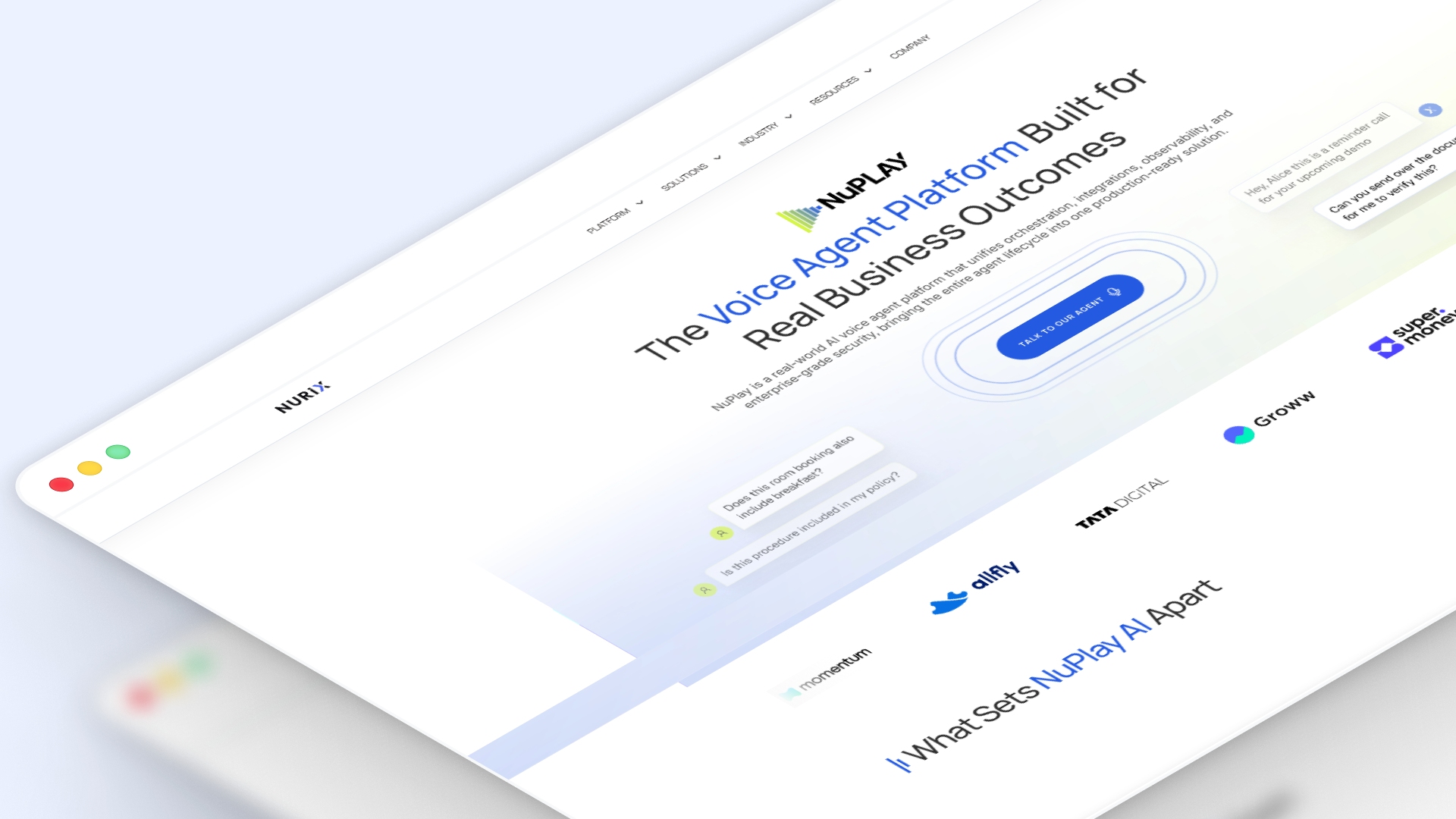
NuPlay is an enterprise AI voice and chat platform that delivers sub-800ms latency, supports 300+ integrations, and allows full-cycle sales automation. It powers AI agents across voice, chat, and documents, connecting with CRM systems to execute workflows using real-time, data-driven insights.
How NuPlay Helps:
- Real-time voice & chat AI agents that handle outreach, qualify leads, and capture intent on the call or chat.
- Automated SDR outreach & data enrichment to populate CRM records and push Sales-Qualified Leads for immediate routing.
- Agent Assist & real-time prompts that surface the right product or pricing info during live conversations (low-latency voice stack, barge-in support).
- RAG-friendly integrations and connectors so that generated proposals and quotes use approved product catalogs and pricing rules, and can write back to your CRM or CPQ.
- Automated transcription, call summaries, and conversation analytics (NuPulse) to extract action items, assign tasks, and keep an auditable trail.
Together, these capabilities help you apply generative AI for sales in a practical way. Instead of adding another tool, NuPlay fits into your existing workflows, reduces manual effort, and gives you the control and visibility you need to scale automation with confidence.
Conclusion
Start with a focused pilot tied to a single KPI such as response time or conversion rate. Use an enterprise platform that integrates with CRM systems and provides real-time performance visibility. This approach turns generative AI for sales into a measurable revenue impact.
NuPlay case studies show up to 35% higher Sales Qualified Lead (SQL) conversion, three times pipeline coverage, and 25% lower acquisition costs. With real-time voice and chat agents, deep integrations, and continuous analytics, NuPlay helps teams scale proven pilots into production workflows that drive consistent, trackable sales outcomes.
Schedule a custom demo to explore how NuPlay can help you move a targeted pilot toward measurable impact on your sales KPIs.
Author: Sakshi Batavia — Marketing Manager
Sakshi Batavia is a marketing manager focused on AI and automation. She writes about conversational AI, voice agents, and enterprise technologies that help businesses improve customer engagement and operational efficiency.