
Are your fintech sales and support teams losing qualified leads because they cannot quickly separate serious buyers from casual inquiries?
When thousands of loan, insurance, banking, or investment queries come in every month, every delayed response can mean a missed opportunity. High-intent leads get buried in queues, support agents waste time asking the same qualification questions, and revenue teams chase prospects who were never ready to convert.
The Consumer Financial Protection Bureau received more than 6.6 million consumer complaints in 2025, underscoring the high volume of demand financial companies face across service and response workflows. Over time, this slows pipeline growth, increases operational pressure, and creates a poor customer experience.
This blog covers what lead-scoring in financial services means, how AI agents automate lead qualification, which data matters, and how fintech teams can use it to improve sales workflows, reduce manual effort, and respond to high-value leads before they go cold.
TL;DR
- Lead Prioritization: AI lead scoring helps fintech teams rank prospects by intent, fit, and urgency, ensuring high-value leads receive immediate attention.
- Workflow Automation: Once scored, AI agents can route leads, update CRM records, and trigger follow-ups, reducing manual effort and operational delays.
- Insight Visibility: AI models analyze historical and real-time behavior to provide actionable insights into which leads are ready for sales or support intervention.
- Brand Consistency: Ensure AI interactions are aligned with your fintech brand across voice and chat, creating consistent, professional customer experiences.
- Continuous Optimization: Scoring models and workflows improve over time as AI learns from outcomes, feedback, and evolving buyer behavior, boosting conversion efficiency.
What is AI Lead Scoring?
AI lead scoring in financial services is the use of AI to rank and prioritize prospects based on their intent, fit, urgency, and likelihood of converting. Instead of relying only on static CRM fields or manual judgment, it studies customer signals from forms, calls, chats, website behavior, past interactions, and sales outcomes.
For fintech companies with high query volumes, AI lead scoring helps sales and support teams quickly identify which leads need immediate attention. It reduces manual qualification work and prevents high-value prospects from getting lost in queues.
While understanding AI lead scoring sets the foundation, it’s useful to see how it differs from traditional methods.
Also Read: Top 10 Strategies Using AI for Insurance Lead Management
How it Differs From Traditional Lead Scoring
Traditional lead scoring ranks leads using fixed rules. Financial services lead scoring AI uses real-time customer signals, past outcomes, and conversation data to identify which leads are most likely to convert.
For fintech companies with high query volumes, this difference matters because sales and support teams cannot afford to treat every inquiry the same.
Here are the key differences:
For example, a traditional system may give the same score to every prospect who fills out a loan inquiry form. An AI scoring system can go further by checking urgency, product fit, call behavior, previous interactions, and whether the customer is ready for a sales conversation.
With the differences in mind, it’s helpful to explore how AI lead scoring operates in practice within financial services workflows.
How AI Lead Scoring Works in Financial Services
AI-led scoring in financial services works by collecting customer signals, analyzing intent, and ranking leads based on their conversion potential. It helps fintech sales and support teams identify serious buyers more quickly and route them to the appropriate workflow.
Here are the key steps:
Step 1: Collect Data from Every Lead Touchpoint
AI lead scoring starts by collecting data from all the places where prospects interact with your fintech brand. This may include your customer relationship management (CRM) system, website forms, call center conversations, chat interactions, email campaigns, product pages, and support tickets.
For financial services teams, this data may include:
- Loan, insurance, banking, or investment inquiry details
- Website visits and product-page activity
- Call and chat transcripts
- Form submissions and abandoned applications
- Email engagement and callback requests
- Previous customer or account history
- Support questions related to pricing, eligibility, or onboarding
This helps your team move beyond incomplete form data. Instead of judging a lead based on a single action, AI examines the entire customer journey.
Step 2: Clean and Organize the Data
Once the data is collected, the system cleans it by removing duplicates, errors, outdated fields, and inconsistent records. This is important because fintech teams often handle large volumes of customer data across multiple tools.
Step 3: Analyze Historical Conversion Patterns
Next, AI studies past leads and customer data to understand what successful conversions look like. It compares leads that became customers with leads that did not convert.
In financial services, the model may look at patterns such as:
- Which inquiry sources produce qualified leads
- Which behaviors show strong buying intent
- Which questions suggest urgency
This helps CROs, Revenue Ops leaders, and sales teams understand which signals truly matter. Instead of using fixed rules, AI learns from actual outcomes.
Step 4: Assign a Lead Score
After analyzing the data, AI assigns each incoming lead a score based on fit, intent, urgency, and likelihood of converting. A higher score means the lead is more likely to become a qualified opportunity.
For example:
- A high score may go to a prospect who asks about loan eligibility, requests a callback, and visits pricing pages.
- A medium score may go to a prospect who downloads a guide but has not shown urgent intent.
- A low score may go to someone who asks a general question without a clear product interest.
This helps sales and support teams decide which leads need immediate attention, which should enter a nurture workflow, and which can be handled through automated support.
Step 5: Route Leads to the Right Workflow
AI lead scoring becomes more valuable when it triggers the next action. Once a lead is scored, the system can route it to the right sales rep, advisor, support queue, or automated follow-up path.
For example:
- High-intent leads can be sent directly to sales.
- Product-specific leads can be routed to the right specialist.
- Support-heavy queries can go to customer service teams.
This reduces manual handoffs and helps teams respond faster to serious buyers.
But what happens when one fintech lead needs more than simple routing?
NuPlay by Nurix AI uses a central orchestrator to assign tasks to the right specialized agents. One agent can qualify the lead, another can answer product questions. The orchestrator manages handoffs so the conversation stays smooth.
Step 6: Learn and Improve Over Time
AI lead scoring does not stay static. It keeps learning as more leads enter the system and more outcomes are recorded. If certain signals start producing better conversions, the model can give them more importance. If some leads look promising but rarely convert, the model can adjust its scoring logic.
Knowing how AI lead scoring functions naturally leads to the advantages it brings to fintech sales and support teams.
Benefits of AI Lead Scoring
AI lead scoring helps fintech sales and support teams identify serious buyers faster. It improves qualification, routing, and follow-up across high-volume customer journeys.
Here are the key benefits:
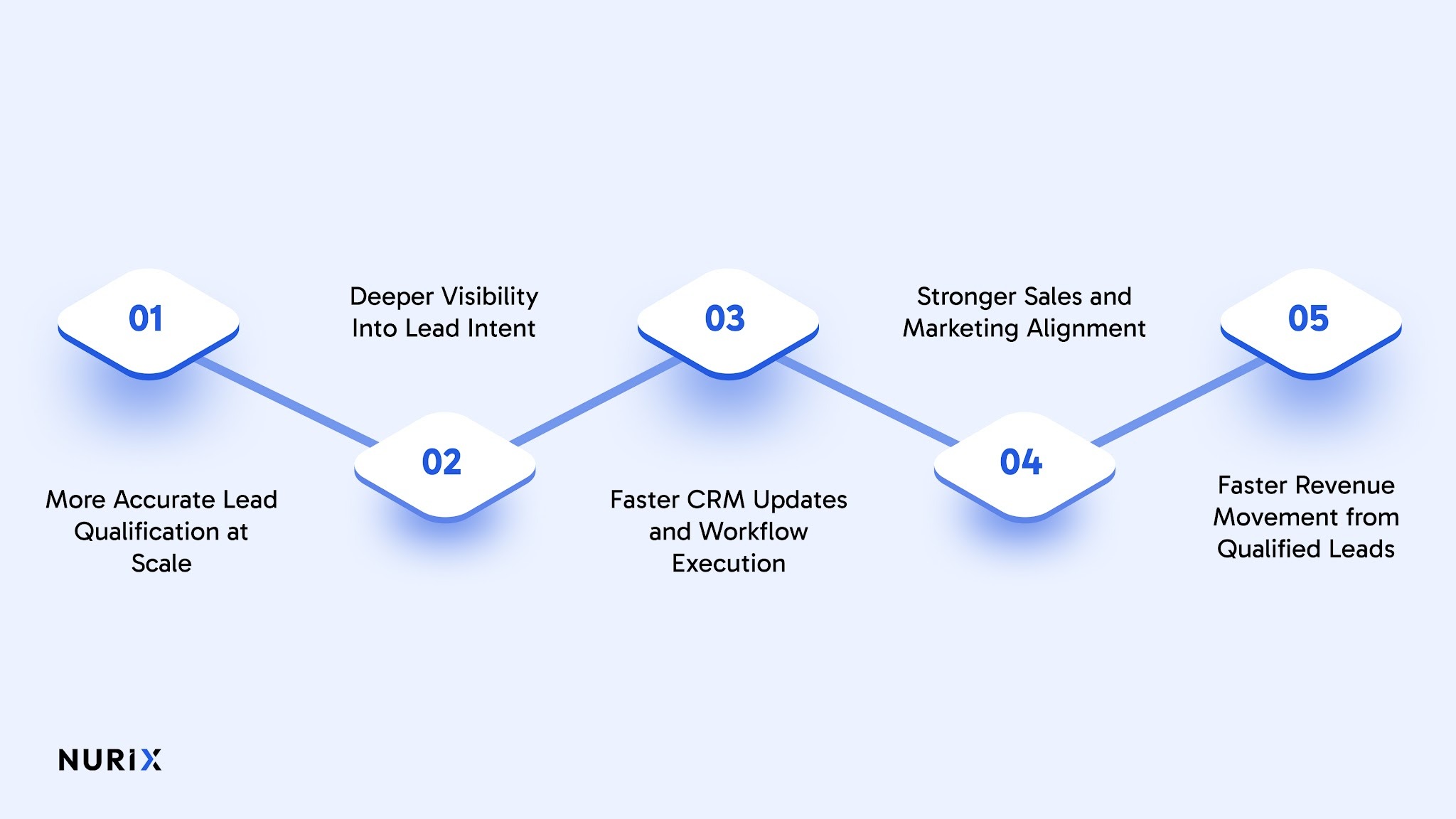
1. More Accurate Lead Qualification at Scale
AI lead scoring analyzes signals to help teams qualify loan, banking, insurance, or investment inquiries more consistently. For CROs and Revenue Ops leaders, it reduces missed high-intent leads and improves pipeline quality.
2. Deeper Visibility Into Lead Intent
AI lead scoring finds patterns across urgency, product interest, behavior, and conversion history.
It helps teams understand which prospects are ready for sales, which need nurturing, and which need support. This gives leaders a clearer view of lead quality across every channel.
3. Faster CRM Updates and Workflow Execution
AI lead scoring can connect with your customer relationship management system to update lead scores and records. It can guide the next best action for each prospect. This reduces delays between qualification, routing, and sales follow-up.
So how do you integrate AI lead scoring with your CRM and other enterprise tools?
NuPlay by Nurix AI connects with 400+ enterprise tools across CRM, call center platforms, calendars, messaging, and collaboration systems. Its AI agents can retrieve live data, update records, schedule callbacks, and close the loop directly within the tools your fintech sales and support teams already use, ensuring faster, more seamless workflow execution.
4. Stronger Sales and Marketing Alignment
AI lead scoring gives sales and marketing teams a shared view of what qualifies a lead.
It combines campaign engagement, CRM history, conversation insights, and sales outcomes into a single model. This helps marketing send stronger leads and helps sales prioritize prospects with real buying intent.
5. Faster Revenue Movement from Qualified Leads
AI lead scoring helps find and prioritize serious buyers, route them to the right team, and reduce time spent on low-fit inquiries. This helps revenue teams focus on opportunities that are more likely to move through the pipeline.
Beyond general benefits, there are specific ways AI can actively support teams in qualifying, prioritizing, and routing leads.
Top Ways AI Helps in Lead Scoring for Teams
AI helps fintech teams turn raw customer inquiries into qualified, prioritized, and actionable sales opportunities. It supports the lead scoring process by capturing missing context, detecting intent, and guiding the next step across sales and support workflows.
Here are the top ways AI helps in lead scoring for financial teams:
1. Captures Missing Qualification Details
AI agents can ask follow-up questions when a lead submits incomplete information. They can confirm product interest, timeline, eligibility needs, and preferred contact method. This helps your team build a fuller lead profile before sales or support gets involved.
But how do you make sure these qualification questions sound clear, professional, and aligned with your fintech brand?
NuRep helps AI agents speak in your brand voice using your website content, help center, playbooks, and past interactions. Your team can define tone, formality level, language preferences, brand terms, and communication rules, so every qualification conversation feels consistent across voice and chat.
2. Classifies Leads by Product Need
AI can identify whether a lead is interested in lending, insurance, banking, investing, or account support. It can then group leads based on product intent and the required next step. This helps teams avoid sending every inquiry through the same qualification path.
3. Prioritizes Time-Sensitive Inquiries
AI can flag leads that show urgency, such as callback requests, eligibility questions, or application issues. These leads can be moved higher in the queue before interest drops. This is useful for CROs, support leaders, and operations teams that manage high daily inquiry volumes.
4. Prepares Better Handoff Context
AI can summarize the customer’s question, intent, reason for the score, and the recommended next action. Sales or support teams can then continue the conversation without asking the same questions again. This creates a smoother handoff and a better customer experience.
5. Improves Scoring with Feedback Loops
AI can learn from outcomes such as booked meetings, closed deals, dropped leads, and support resolutions. These outcomes help refine future scoring and qualification logic. This keeps lead scoring aligned with real fintech sales and support performance over time.
After seeing the impact on teams, the next step is understanding how to deploy AI lead scoring effectively in real workflows.
How to Implement Lead Scoring with AI Agents
Implementing lead scoring with AI agents starts with a clear goal, not just a scoring model. For fintech teams with high query volumes, the focus should be faster qualification, cleaner routing, and better follow-up across sales and support.
Here are the key steps:
1. Define the Business Outcome First
Start by deciding what you want AI lead scoring to improve. Common goals include faster speed-to-lead, more qualified meetings, better lead-to-opportunity conversion, and fewer manual CRM updates. This helps CROs, Revenue Ops leaders, and support leaders measure success from the start.
2. Map the Current Lead Journey
Document where leads enter, how they move through sales and support, and where delays happen. This shows where AI agents can remove friction and speed up qualification.
3. Choose the First High-Volume Use Case
Start with one workflow where lead volume is high, and qualification takes too long.
Examples include inbound loan inquiries, insurance quote requests, banking product inquiries, or advisor callback requests. A focused use case helps your team prove value before expanding across more workflows.
4. Define Scoring Criteria and Qualification Questions
Align the sales, support, operations, and compliance teams on what constitutes a qualified lead. Define signals such as product interest, urgency, eligibility needs, location, timeline, and preferred contact method. This ensures that AI agents ask the right questions and route leads according to agreed-upon logic.
Step 5: Connect AI Agents to CRM and Sales Workflows
AI lead scoring works best when scores trigger action inside your existing systems. Connect agents to CRM, calendars, support tools, and sales workflows so they can update records, assign owners, and trigger follow-ups..
Step 6: Monitor Outcomes and Improve the Model
Track whether AI scoring is improving real outcomes. Use these insights to improve scoring logic, routing rules, and qualification questions over time.
While implementation drives efficiency, ensuring compliance and maintaining trust is essential when managing sensitive financial data.
Compliance and Trust Considerations for AI Lead Scoring in Financial Services
AI lead scoring in financial services must be designed with governance, transparency, and customer data protection from the start. For fintech teams, the goal is to improve qualification and routing without creating compliance gaps or risky decision-making.
Here are the key considerations:
- Keep Human Oversight in Sensitive Decisions: AI lead scoring should support prioritization, qualification, and workflow execution. It should not make unsupported financial recommendations or replace human review in sensitive cases.
- Maintain Audit Trails for Scoring and Routing Decisions: Fintech teams need clear logs that show what happened, when it happened, and why. Audit trails help teams review lead scores, routing actions, escalations, and follow-up decisions.
- Protect Personally Identifiable Information (PII): PII includes sensitive customer details such as names, contact information, account data, and financial information. AI lead scoring workflows should use redaction, access controls, retention policies, and secure integrations.
- Monitor Model Drift and Bias: Buyer behavior, product demand, campaign quality, and market conditions change over time. AI lead-scoring models should be monitored and recalibrated as new outcomes emerge.
Also Read: How Agentic AI Is Boosting Sales Conversions?
Conclusion
AI lead scoring in financial services helps fintech companies handle high volumes of sales and support inquiries efficiently. By analyzing customer signals, intent, and historical outcomes, teams can prioritize high-value leads, route them to the right workflow, and ensure timely follow-up. This not only improves pipeline conversion but also reduces manual effort and enhances the overall customer experience.
While AI scoring identifies which leads are most likely to convert, NuPlay by Nurix AI ensures those scores turn into action. Its AI agents automate lead qualification, route high-intent prospects, update CRM records, and maintain consistent, brand-aligned interactions across voice and chat channels. With multi-agent orchestration and real-time workflow integration, we help fintech sales and support teams generate leads, keeping operations smooth even at high query volumes.
So why wait? Schedule a custom demo to see how AI agents can boost conversions!