
Most teams do not lose qualified pipeline in one obvious place. It slips across small delays: a lead waits too long for a reply, screening happens too late, or a rep spends time sorting weak-fit inquiries instead of speaking to a real buyer. That is why AI for lead qualification is getting serious attention from revenue teams. In Gartner’s 2024 survey of more than 6,000 U.S. consumers, 58% said the companies trying to sell to them do not understand their needs or preferences.
That gap is exactly where qualification starts to matter. In this article, you will get a practical view of what AI for lead qualification is, how it works in real workflows, where it helps, where it falls short, and what to evaluate before adopting it.
Executive Summary 2026: AI for lead qualification is most valuable when teams need faster first response, more consistent screening, and clearer routing before sales steps in. The strongest systems do more than score leads. They qualify intent, capture context, and move leads into the right workflow with less manual friction.
Key Takeaways on AI for Lead Qualification
- Workflow change: AI for lead qualification shifts early screening from delayed manual review to a faster, more structured process, which helps teams act on leads with clearer context and fewer handoff gaps.
- Core bottlenecks: Most qualification issues come from slow follow-up, uneven criteria, missing context, and unclear routing, because those gaps make it harder to identify and act on strong leads quickly.
- Best-fit use cases: AI works best in high-volume, repeatable, digital-first workflows, while human reps still matter most in complex sales conversations that depend on judgment, trust, and deeper discovery.
- Readiness factors: Stronger results depend on clear qualification rules, clean CRM, data, defined routing, and human oversight, because automation cannot fix a workflow that is already unclear.
- System quality: A stronger AI qualification setup does more than trigger replies. It asks follow-up questions, captures context, supports routing, and fits into real enterprise workflows.
What Is AI in Lead Qualification?
AI in lead qualification helps teams respond to new leads faster, ask the right questions, and decide who should move forward in the sales process. Instead of relying only on manual review or basic scoring rules, it uses voice, chat, and workflow automation to capture intent, spot fit, and route leads to the right next step.
That could mean sending a qualified lead to sales, booking a meeting, or placing a lower-intent contact into a nurture flow. In simple terms, it turns lead qualification from a slow manual task into a faster, more consistent workflow.
Where Lead Qualification Breaks Today
Lead qualification often starts to lose momentum before sales can respond with enough speed or context. New leads come in, but follow-up slows, context gets lost, and teams spend time sorting instead of selling. The result is a process that feels busy, yet still leaves gaps in speed, consistency, and decision-making.
- Slow First Response: A strong lead can lose interest while waiting for a reply. When response time slips, sales teams start the conversation later than they should.
- Inconsistent Qualification Criteria: Different reps may judge the same lead differently. That makes qualification harder to trust and creates uneven pipeline quality across the team.
- Low-Value Screening Work: Sales teams often spend time checking basic fit instead of having real buying conversations. That reduces the time available for stronger opportunities.
- Missing or Incomplete Context: Lead details are not always captured clearly at the start. When information is partial, handoffs become weaker, and follow-up becomes less precise.
- Unclear Next-Step Routing: A lead may be qualified, but the next action is not always obvious. Without clear routing, even a good lead can stall inside the workflow.
When qualification breaks, the issue is rarely led by volume alone. The bigger problem is that the process does not help teams respond, assess, and move leads forward with enough clarity.
If slow follow-up is already hurting conversion, see 8 Proven Benefits of AI for Sales Prospecting Teams for a practical look at how AI improves lead quality earlier in the funnel.
What Changes When AI Handles Lead Qualification
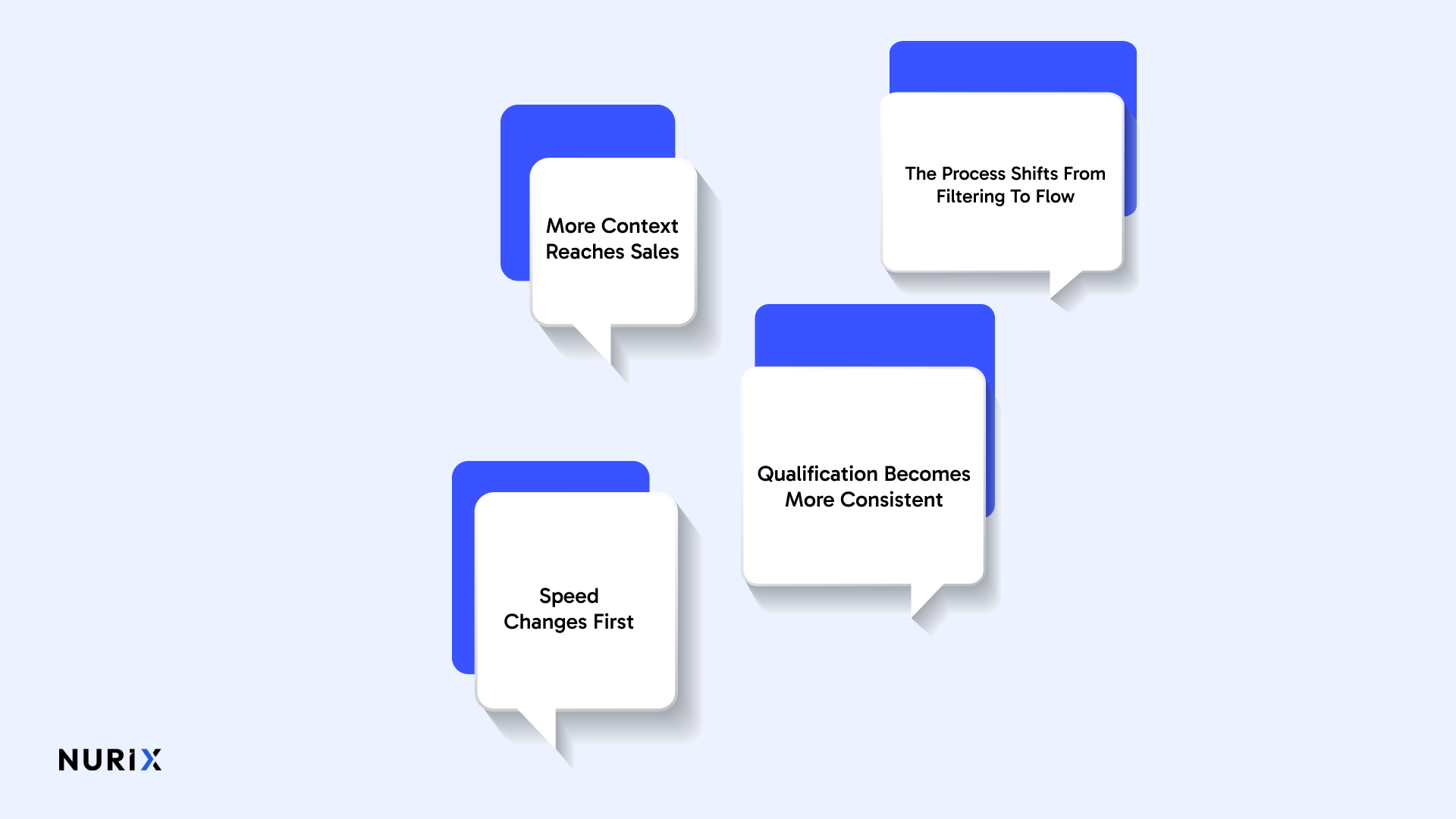
When AI handles lead qualification, the process becomes faster, more structured, and easier to act on. The main shift is that teams no longer rely only on manual review to decide who needs attention first. Early qualification moves from delayed screening to real-time assessment, with clearer signals, cleaner records, and a more consistent path to the next step.
1. Speed Changes First
The first visible change is how quickly qualification begins after a lead enters the funnel.
- Response Starts Earlier: AI can begin the qualification process as soon as a lead comes in. That reduces the delay between interest and first engagement.
- After-Hours Gaps Get Smaller: Qualification does not stop when teams are offline. Leads can still be engaged outside normal working hours.
- Manual Queue Review Drops: Teams spend less time sorting inbound leads one by one before deciding who to respond to first.
2. Qualification Becomes More Consistent
AI changes the qualification from a process shaped by individual judgment to one shaped by defined logic.
- The Same Questions Are Applied More Reliably: AI can follow the same qualification path across leads. That makes early screening more consistent.
- Lead Records Become More Structured: Responses can be captured in a standard format instead of being spread across notes, messages, or incomplete fields.
- The Next Step Gets Clearer: Once qualification details are captured early, routing decisions become easier to apply with less manual back-and-forth.
3. More Context Reaches Sales
Another change is the quality of information available when a lead moves forward.
- Sales Starts With More Than A Name: Reps can receive qualification details, intent signals, and a clearer reason for follow-up before the first live conversation.
- Cold Handoffs Become Less Common: A cold handoff is when a lead is passed forward with little useful context. AI helps reduce that by capturing more upfront.
- Follow-Up Becomes Easier to Prioritize: When early qualification is documented clearly, teams can act on stronger signals instead of scanning raw inbound volume.
4. The Process Shifts From Filtering To Flow
AI changes lead qualification from a stop-and-start task into a more continuous workflow.
- Qualification Happens Inside The Lead Journey: Instead of waiting for manual review later, qualification can begin during the first interaction.
- Leads Move Forward With Less Friction: Fewer steps depend on someone checking, sorting, or rewriting the same information manually.
- The Workflow Becomes Easier To Track: With more of the process captured systematically, teams can see where leads are moving and where they are getting stuck.
What changes with AI is not just automation. It is the quality of the first few steps that decides whether a lead moves forward with speed, context, and a clear owner.
If your team needs that shift to hold up in production, not just in theory, NuPlay by Nurix AI brings together real-time voice and chat qualification, multi-agent orchestration, CRM routing, and NuPulse visibility so leads move forward with cleaner context and fewer manual gaps. Schedule a Custom Demo!
How AI Fits Into Your Current Lead Qualification Workflow
AI works best when it improves the parts of lead qualification that already slow teams down, such as first response, early screening, lead routing, and data capture. In practice, the workflow is simple: AI picks up intent signals, starts the conversation, asks screening questions, prioritizes the lead, and routes the next step.
This matters because sales reps spend only 28% of their week actually selling, while many spend 11 or more hours on research and follow-up.
- Start with First-Touch Engagement: Add AI at the point where new leads first arrive. For example, instead of waiting for rep availability, a lead can get an immediate voice or chat response.
- Use It For Early Screening: Let AI handle the first qualification questions around fit, urgency, or need. For example, an insurance lead can be screened for coverage type before handoff.
- Connect It To Routing Rules: AI fits best when the next action is already defined. For example, qualified enterprise leads can go to one team, while lower-intent leads move to nurture.
- Capture Context Into CRM: CRM records become more useful when AI logs answers in a structured format. For example, reps can see qualification details before the first live call.
- Keep Humans In The Right Moments: AI should support repetitive front-end work, while sales teams stay focused on complex discovery, objections, and high-value conversations that need judgment.
How College Vidya Automates Lead Qualification with AI
College Vidya was dealing with high lead volumes, slow early-stage follow-up, and inconsistent prioritization, which made it harder for counselors to reach high-intent students while interest was still fresh.
Solution:
- Automated early qualification
- Prioritized stronger leads faster
- Logged scores and next steps automatically
Output:
- 38% higher qualified lead throughput
- 45% lower counselor workload
- 3x faster lead routing
- 250+ registrations completed
The best fit is usually not a full workflow redesign. It is a targeted shift where AI takes over the early, repeatable parts of qualification and gives your team clearer signals to act on.
Where AI Lead Qualification Works Well and Where It Fails
AI lead qualification works best when the process is fast, repeatable, and digital-first. It becomes less dependable when qualification depends on subtle context, relationship-building, or multi-person decision-making. The main question is not whether AI works. It is where it fits best.
The practical takeaway is simple. Use AI for speed, structure, and repeatable early screening. Keep humans close to conversations that need judgment, trust, or a deeper commercial context.
If you are weighing where AI adds value before qualification starts, Key Ways to Use AI for Lead Generation helps connect lead generation fit with qualification fit.
What Needs to Be in Place for AI to Qualify Leads Well
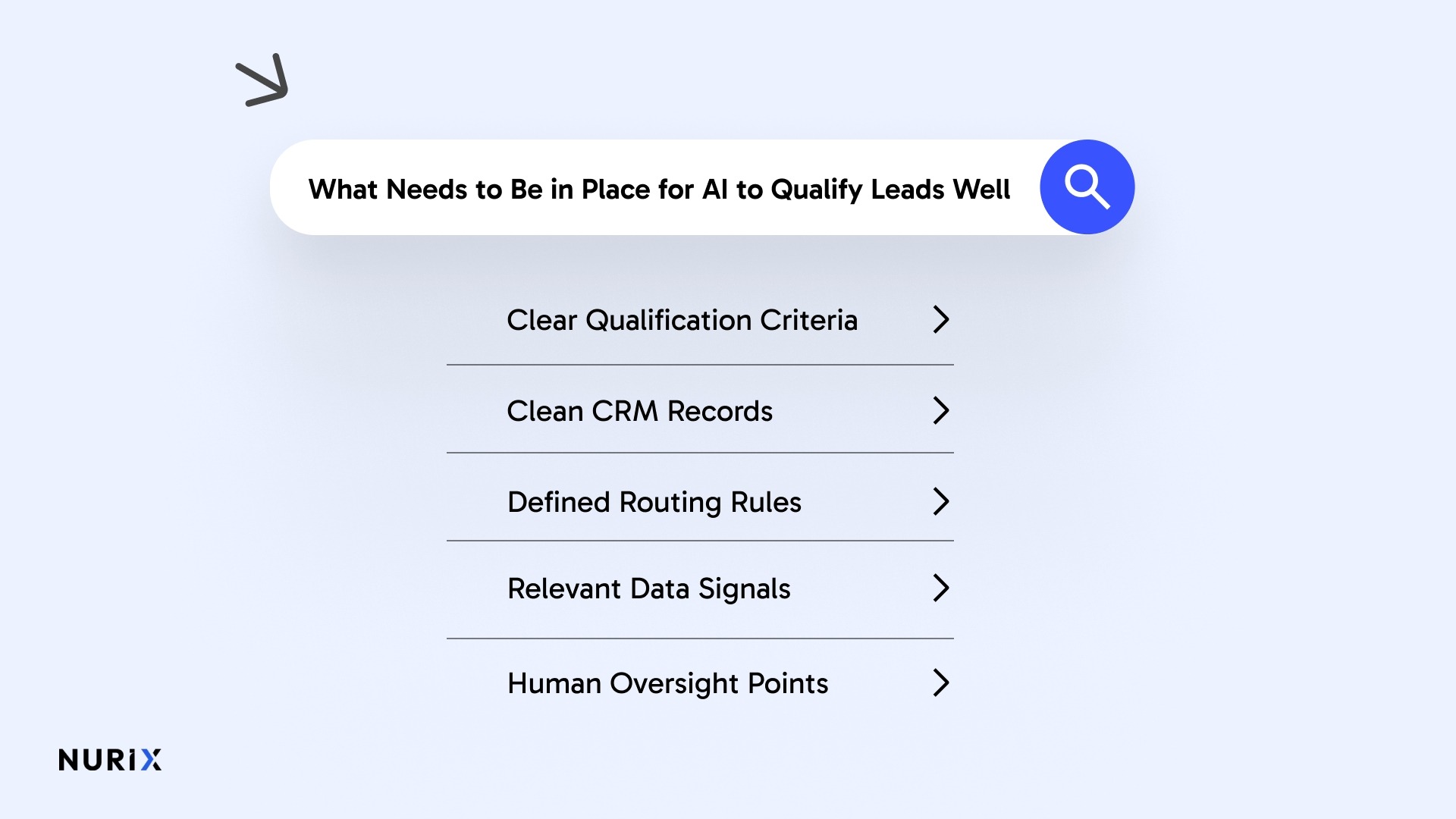
AI lead qualification works better when the workflow around it is clear before automation starts. The system needs clean inputs, defined qualification logic, and a reliable next step. Without that foundation, AI can still collect data, but it will not help your team act on leads with enough consistency or confidence.
- Clear Qualification Criteria: AI needs a clear definition of what makes a lead worth advancing. For example, your team should agree on fit, urgency, and handoff conditions.
- Clean CRM Records: CRM data should be current, structured, and usable. For example, duplicate records or missing fields make qualification output harder to trust.
- Defined Routing Rules: AI performs better when the next step is already mapped. For example, a qualified insurance lead should go straight to the licensed team.
- Relevant Data Signals: The system needs access to the signals your team already uses to judge intent. For example, page visits, form responses, or chat questions can support earlier screening.
- Human Oversight Points: AI needs clear moments where people review, step in, or override. For example, a complex enterprise account may still need manual review before handoff.
The real prerequisite is not more automation. It is a qualification process that your team can already explain clearly, measure consistently, and move forward without confusion.
For a stronger view of readiness, 5 Powerful Ways Automated Lead Qualification AI Works in FSI shows how structured qualification workflows are set up before handoff.
Custom AI Lead Qualification System vs Basic Automation
The difference is not just speed. A custom AI lead qualification system can follow your qualification logic, ask follow-up questions, and route leads based on context. Basic automation usually reacts to fixed triggers, such as a form fill, without understanding fit or urgency.
Basic automation helps teams move faster. A custom AI system helps them decide better, especially when qualification needs to reflect real sales logic rather than fixed triggers.
That difference becomes more practical when a qualification has to work across real systems, not just trigger messages. NuPlay by Nurix AI combines voice and chat qualification, multi-agent orchestration, CRM routing, and NuPulse monitoring to deliver cleaner handoffs, stronger fit checks, and more usable sales context. Get in touch with us!
When AI Lead Qualification Is Worth Adopting
AI lead qualification is worth adopting when manual screening starts slowing response time, creating uneven follow-up, or pulling sales teams into repetitive front-end work. It is usually a better fit when early qualification follows clear rules, and the next step after screening is already defined.
- High Inbound Volume: AI is more useful when lead volume is high enough to slow manual review. For example, demo requests or campaign leads can build quickly.
- Repeatable Early Questions: It fits better when teams ask the same opening questions often. For example, need, timeline, location, or product interest can be screened early.
- Response Speed Matters: AI is easier to justify when delayed follow-up reduces qualification chances. Research has long shown that faster response improves qualification outcomes.
- Sales Time Is Being Lost: It makes sense when reps spend too much time screening or researching instead of selling.
- Routing Is Already Clear: AI adds more value when your team knows what should happen after qualification. For example, qualified leads go to sales, while others move to nurture.
The best time to adopt AI is when your process already has enough volume and repetition for automation to improve speed, consistency, and follow-up quality.
If missed calls and delayed follow-up are the bigger issue, Top Automated Answering Services for Small Business shows how always-on lead capture can support earlier qualification.
How NuPlay By Nurix AI Supports AI Lead Qualification in Real Workflows
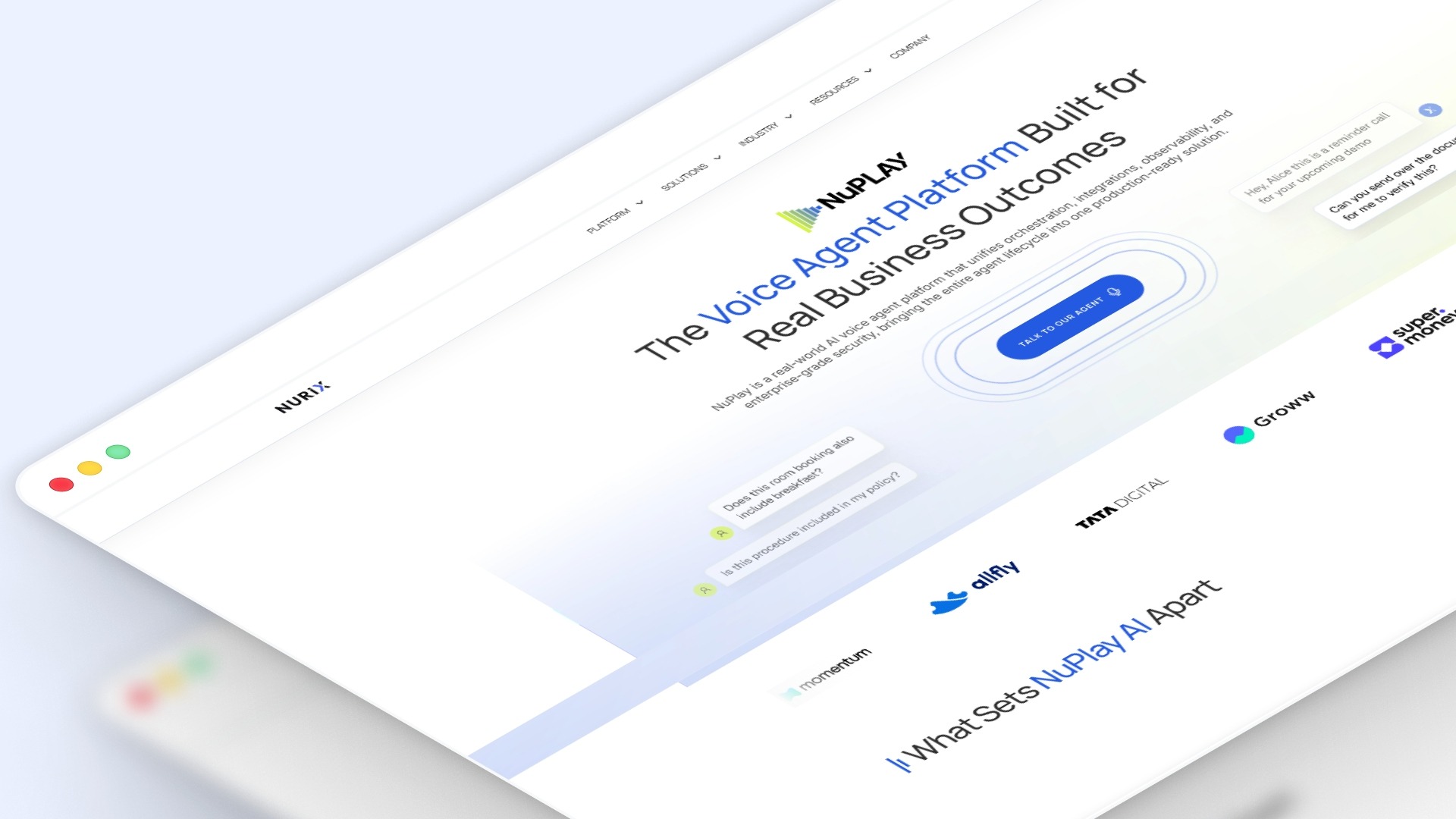
NuPlay by Nurix AI is built for teams that need faster follow-up, clearer routing, and less manual screening without losing control of the workflow. For sales, support, and operations leaders, that means AI can qualify leads inside real conversations, pass context into systems, and give teams visibility into what is working and what needs adjustment.
- Faster First-Touch Response: NuPlay’s voice agents are built for real-time conversations, so leads can be engaged immediately instead of waiting in a queue.
- Cleaner Qualification And Routing: NuPlay captures intent, applies qualification logic, and routes sales-qualified leads into CRM and sales workflows.
- Better Handoffs For Sales Teams: Reps receive conversation summaries and context, not just a name and phone number.
- Operational Visibility Through NuPulse: Teams can track performance, spot issues, and improve agent behavior over time.
- Enterprise Controls That Matter: NuPlay pairs workflow automation with governance, which matters for teams handling sensitive customer data and regulated processes.
What stands out here is not a single feature. It is how NuPlay brings qualification, routing, monitoring, brand control, and governance into one operating model that fits enterprise workflows.
Final Thoughts!
AI for lead qualification is most useful when it improves the parts of your process that create the most drag, usually first response, early screening, routing, and handoff quality. The goal is not more automation for its own sake. It is a cleaner workflow that helps your team act faster and spend less time on low-value screening.
That is where NuPlay by Nurix AI fits naturally. NuPlay is an enterprise voice and chat AI platform that helps teams qualify leads inside real conversations, route them with context, and keep performance visible through monitoring and controls.
If you want to see how NuPlay supports AI lead qualification in real workflows, schedule a custom demo.
Author: Sakshi Batavia, Marketing Manager
Sakshi Batavia is a marketing manager focused on AI and automation. She writes about conversational AI, voice agents, and enterprise technologies that help businesses improve customer engagement and operational efficiency.