AI Personalization in Sales: Strategies, Use Cases, and Enterprise Benefits in 2026

Don’t miss what’s next in AI.
Subscribe for product updates, experiments, & success stories from the Nurix team.
Personalization has become a baseline expectation in modern sales, yet delivering it consistently remains challenging. Sales reps are expected to understand each buyer’s goals, tailor outreach to their context, and follow up with the right message at the right time, all while managing crowded pipelines and repetitive administrative work.
The pressure to personalize is increasing. Salesforce reports that 86% of business buyers are more likely to purchase when their goals are understood, yet 59% say most sales reps do not take the time to understand those goals.
This is where AI-driven personalization becomes valuable. It enables teams to leverage buyer data, engagement signals, and past interactions to make outreach more relevant at scale. Instead of relying on generic templates or guesswork, sales teams can tailor messaging, timing, and next steps more consistently across the funnel.
In this guide, we’ll explain what AI personalization in sales is, how it works, where it delivers value, and what teams need to address before scaling it.
Key Takeaways
- AI personalization in sales is most valuable when tied to execution, not just messaging. The real gains come from better lead prioritization, follow-up timing, and next-best-action guidance, not simply generating “personalized” copy.
- Data quality is the hidden constraint. If CRM records, intent signals, and interaction history are incomplete or messy, AI personalization becomes shallow or inaccurate.
- The best use cases are narrow and high-impact first. Start with prospecting, qualification, and follow-up workflows before trying to personalize every stage of the funnel.
- Over-automation hurts trust. Strong teams use AI to improve relevance and consistency, while keeping human review for tone, judgment, and deal context.
- For enterprise teams, personalization only works if it connects to live systems. AI has more value when it is integrated with CRM, routing, call workflows, and sales operations rather than sitting outside the process.
What is AI Personalization in Sales?
AI personalization in sales works by combining customer data, behavioral signals, and machine learning models to determine the most relevant message and timing for each buyer. It analyzes browsing history, purchase patterns, and social media activity to recommend the right product. It's like having a sales assistant who knows your taste inside out.
How AI Personalization in Sales Works:
- Data Collection: AI collects customer data from website interactions, email clicks, and social media engagement.
- Analysis: This data is then analyzed to find patterns, trends, and preferences that will inform future interactions.
- Personalized Engagement: Based on this analysis, AI delivers customized recommendations, tailored offers, and specific content suggestions to each user.
Food for thought: Have you ever received an email with a product recommendation that was bang on? That's AI personalization in sales at work behind the scenes, creating a tailored experience to increase your chances of buying.
You might find this one equally interesting: Using AI in Customer Support Software
Critical Components Of AI Personalization in Sales
AI personalization in sales isn't a one-size-fits-all solution. It involves several technologies working together to create a smooth, personalized customer journey:
- Natural Language Processing (NLP): AI uses NLP to read customer queries and preferences in real-time and provide highly relevant responses and recommendations.
- Machine Learning (ML): ML algorithms learn from customer behavior and adjust personalization accordingly. The more data they collect, the better they know what the customer will want next.
- Predictive Analytics: Predictive AI uses past behavior and interactions to predict future behavior and offer timely and relevant product recommendations.
By combining these technologies, businesses can offer a seamless customer experience and drive engagement and loyalty.
With AI personalization in sales, brands can now deliver super-relevant experiences that connect with customers on a deeper level. But how do businesses benefit from that personalization in sales?
The Benefits Of AI Personalization In Sales
The benefits of integrating AI personalization in sales into your sales strategy are immense, impacting both the customer journey and your bottom line. Let’s see how:
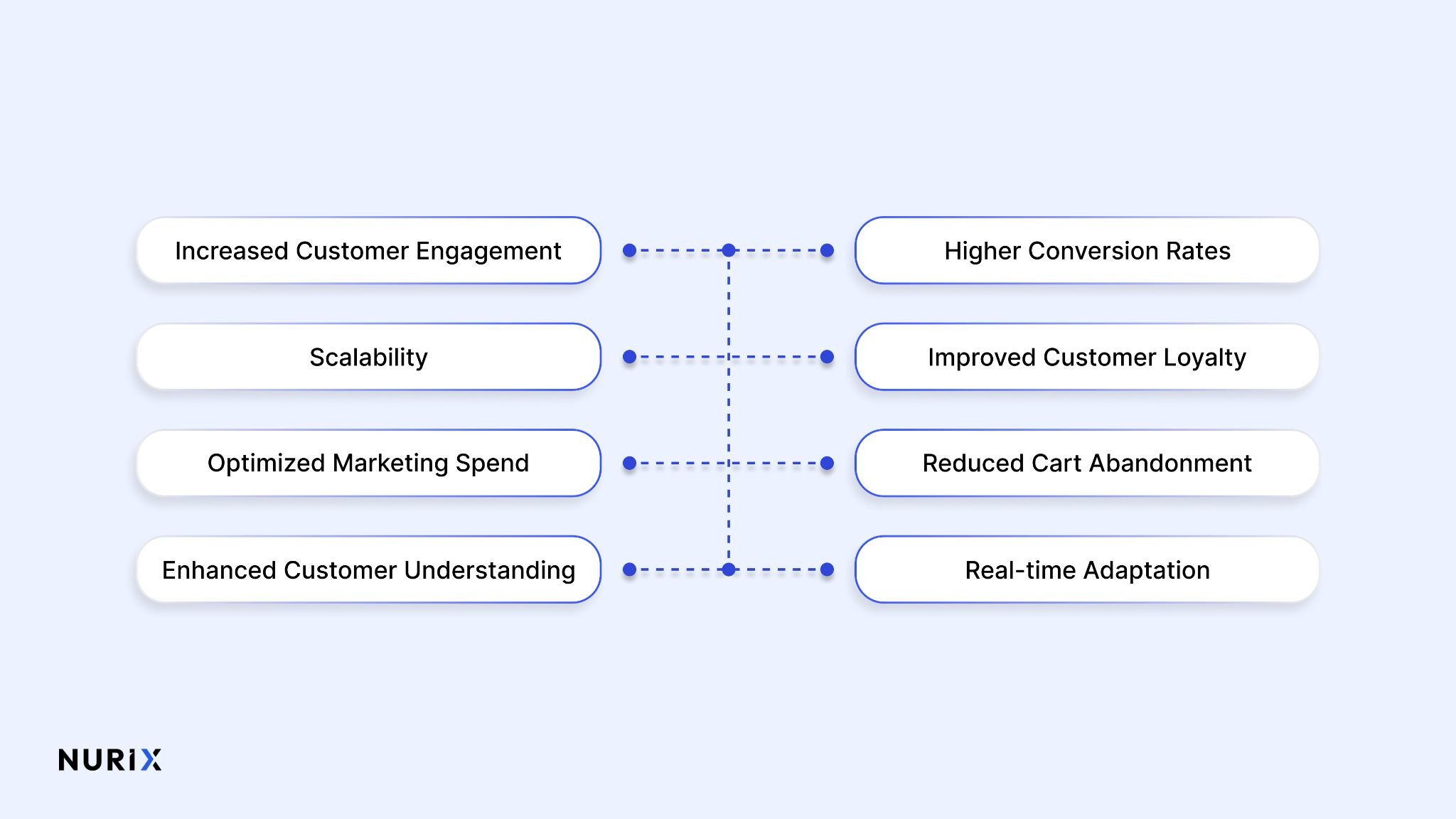
- Increased Customer Engagement: Personalized experiences lead to more engagement. When content, offers, and recommendations match customer needs, customers will engage.
- Higher Conversion Rates: Personalized product recommendations and content significantly enhance conversions. When you put the right offer in front of the right customer at the right time, conversions go through the roof.
- Scalability: Unlike human-driven personalization, AI can scale without extra resources. Whether you have hundreds or millions of customers, AI can personalize at scale.
- Improved Customer Loyalty: Salesforce says 88% of customers are more likely to purchase again when companies meet their expectations, which reinforces why relevance and timing matter in AI-driven sales engagement.
- Optimized Marketing Spend: With AI, you can focus on your high-value customers, reduce wasted marketing spend, and improve overall ROI.
- Reduced Cart Abandonment: By analyzing customer behavior, AI can identify when customers abandon their carts and send tailored reminders or incentives, encouraging them to complete their purchases.
- Enhanced Customer Understanding: AI provides deep insights into customer behavior and preferences through data analysis. This understanding allows sales teams to tailor their approaches effectively, improving customer satisfaction and engagement.
- Real-time Adaptation: AI systems can adapt marketing messages in real time based on changes in customer behavior, ensuring that communications remain relevant and timely.
The benefits of AI personalization in sales go beyond increasing sales. They also foster customer loyalty and optimize marketing efficiency. Next, let's look at how businesses use AI personalization in sales to their advantage.
While you’re at it, this is worth a read: Generative AI in Customer Service: Use Cases and Benefits
Core Use Cases of AI Personalization in Sales
AI personalization in sales isn't just theory, it's already happening at some of the biggest companies in the world. Here are the top ways AI is being used to change sales:
1. Personalized Product Recommendations
Amazon harnesses cutting-edge AI to analyze user behavior, delivering hyper-relevant product suggestions that dramatically boost engagement and drive impressive sales conversion rates.
The case for AI personalization is operational as much as strategic. Salesforce’s 2026 State of Sales reports that reps spend more than half of their time on nonselling work, which makes consistent personalization difficult without automation.
2. Dynamic Content Creation
AI empowers brands to create tailored content in real-time, customizing email subject lines and website recommendations to individual preferences, significantly enhancing user engagement and satisfaction.
3. AI-Driven Chatbots
AI chatbots are becoming a must-have for online customer engagement. These bots don't just answer questions—they can recommend products, guide customers through checkout, and offer personalized discounts, just like a human sales assistant.
4. Omnichannel Personalization
AI seamlessly integrates customer interactions across platforms, crafting a cohesive and personalized experience that fosters loyalty and elevates customer satisfaction throughout the buying process.
5. Next Best Action Suggestions
By analyzing customer interactions, AI equips sales reps with actionable insights on optimal next steps, dramatically enhancing efficiency and skyrocketing conversion rates.
6. AI-Powered Demand Forecasting
Retail giants like Walmart leverage AI to scrutinize vast historical data, enabling precise sales forecasts that optimize inventory management and align supply with evolving consumer demand.
These applications show that AI personalization in sales is already transforming how businesses engage customers across multiple touchpoints. Let's focus on some real-life examples.
Challenges and Risks of AI Personalization in Sales
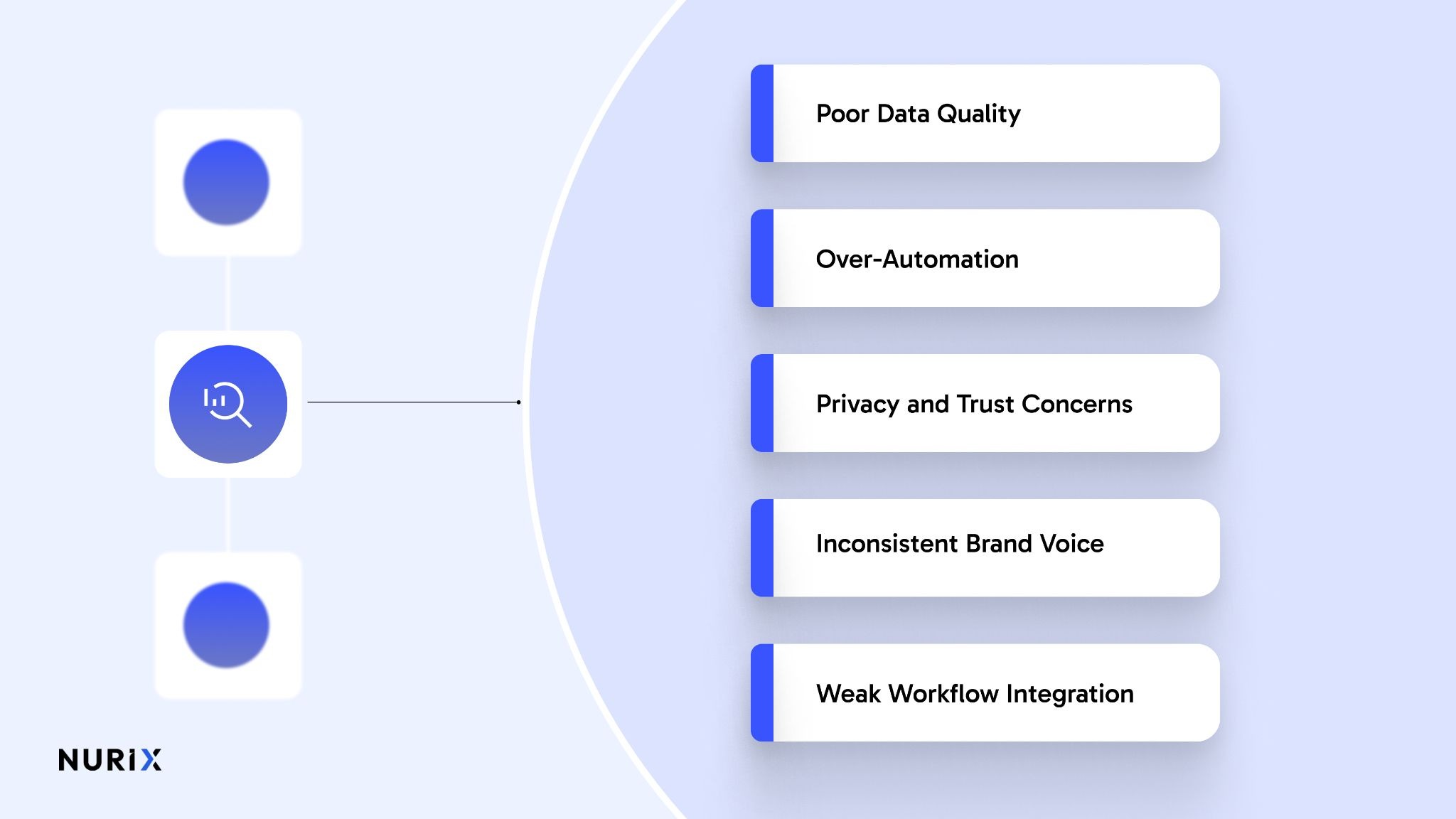
AI personalization is useful, but it is not automatically effective. Teams that treat it as a shortcut often create more noise, not better sales outcomes.
1. Poor Data Quality
If the underlying data is inaccurate, incomplete, or outdated, personalization will be weak. The output may sound polished, but it will still miss the mark.
This is one of the most common failure points. Personalization quality depends on signal quality.
2. Over-Automation
There is a difference between scaling relevance and automating too much. If every email, call opener, or follow-up sounds machine-generated, buyers notice.
AI should support sales execution, not remove judgment from it. Teams still need review standards, escalation rules, and clear boundaries for where human input matters most.
3. Privacy and Trust Concerns
Personalization can backfire if it feels invasive. Buyers are more likely to respond to relevant outreach than to messaging that seems overly familiar or based on unclear data collection.
Sales teams need to be thoughtful about what data they use, how they use it, and whether the resulting outreach feels credible rather than unsettling.
4. Inconsistent Brand Voice
If AI-generated messaging is not aligned to the company’s positioning, tone, and approved claims, personalization can create inconsistency across the funnel.
That becomes a bigger risk in enterprise sales, where trust, precision, and compliance matter.
5. Weak Workflow Integration
AI personalization is most useful when it connects to actual sales processes. If it sits outside the CRM, email workflows, call tools, or routing logic, teams may use it occasionally but not operationally.
The result is fragmented adoption instead of measurable impact.
This might just be the next thing you’re looking for: The Future of Work: Integrating Human Intelligence with AI
Key Trends in AI Personalization in Sales
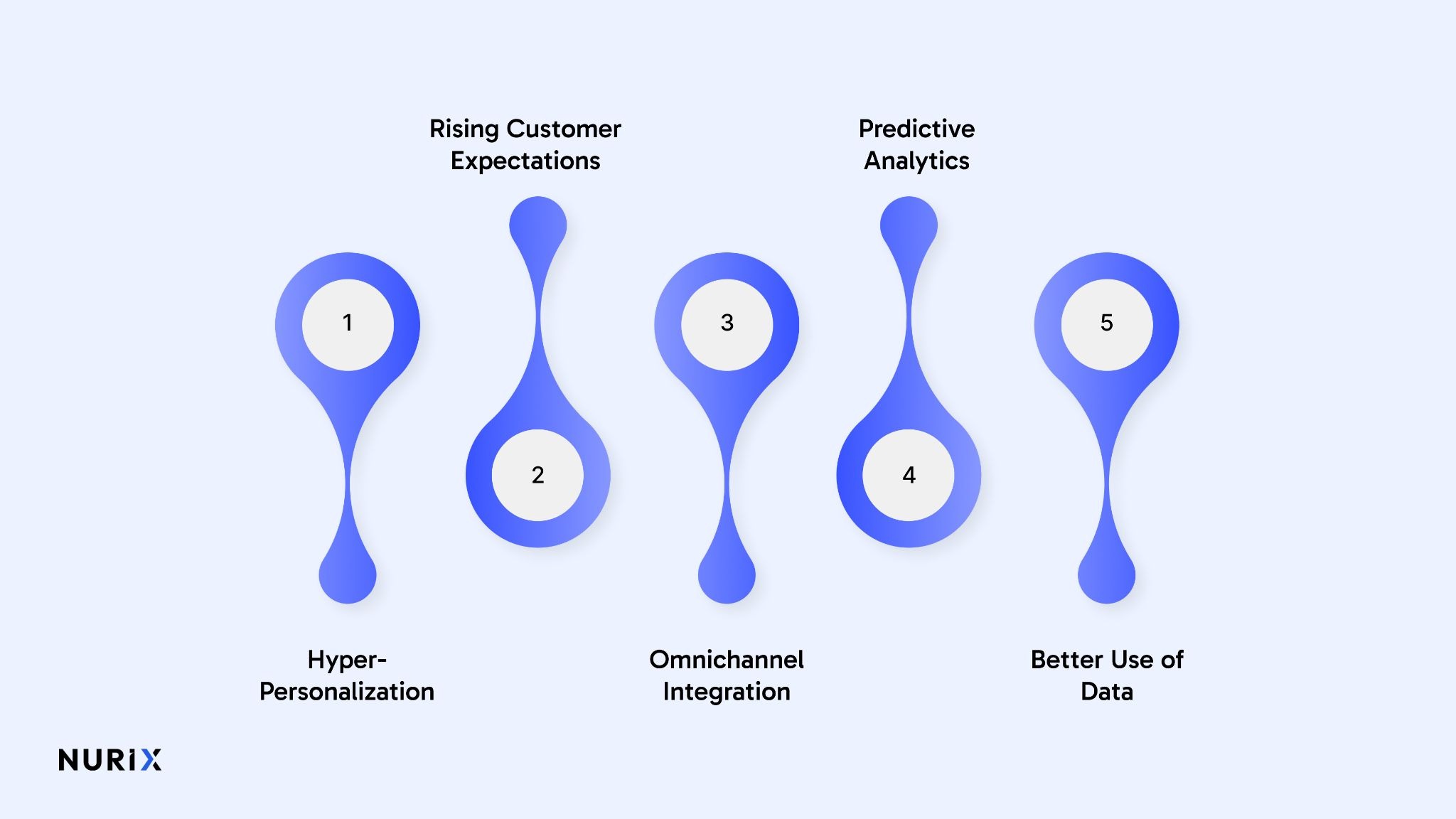
AI personalization in sales is evolving fast, and several fundamental trends are making waves. Let's dive into some of the most exciting developments:
- Hyper-Personalization: Imagine being able to give each customer a unique experience in real time. With advanced AI, that’s now possible, making connections more personal than ever! Brands can now adjust their interactions based on real-time data, responding to customer preferences and behavior as they happen.
- Rising Customer Expectations: It's not nice to have customers expect personalization. 71% of consumers expect tailored content from brands, and 76% get frustrated when they don't feel like their interactions are personalized enough. That's a big wake-up call for businesses who want to keep their customers happy and loyal!
- Omnichannel Integration: AI is helping businesses deliver seamless, personalized experiences across all channels in-store, online, or mobile apps. This omnichannel integration means that no matter where customers engage, they get a consistent, personalized experience that drives engagement and satisfaction.
- Predictive Analytics: AI can predict what customers want before they ask, and it's improving. With enhanced predictive analytics, companies can anticipate customer needs, behavior, product recommendations, and marketing strategies.
- Better Use of Data: As AI tech improves, it's better at analyzing massive amounts of data from multiple sources. This means businesses can gain deeper insights into what customers really want, and their personalization efforts will be more accurate and effective.
These trends are game changers, and businesses that anticipate them will have a significant advantage in delivering personalized experiences that drive engagement and sales.
Looking for more insights? Here’s a good one: The Power of AI in Sales and Marketing Strategy
How NuPlay By Nurix AI Supports AI Personalization in Sales
NuPlay is an enterprise-grade voice and chat AI platform by Nurix AI that helps organizations operationalize personalization across sales workflows instead of limiting it to message generation alone.
For sales teams, personalization becomes more valuable when it is connected to qualification, routing, follow-up, and live customer interaction. That is where NuPlay adds the most value.
- Personalization Connected to Qualification and Routing
NuPlay’s Sales AI Agents can help capture buyer intent, qualify inbound interest, and route opportunities based on real account context rather than generic lead handling. - Real-Time Context Across Systems
Because enterprise sales personalization depends on accurate data, NuPlay connects with CRM systems, knowledge sources, and operational tools so customer interactions can reflect live business context rather than disconnected snapshots. - Follow-Up and Workflow Execution
NuPlay helps teams move from personalized engagement to the next action, whether that means routing a qualified lead, updating records, triggering reminders, or supporting downstream sales workflows. - Consistent Brand and Conversation Quality
Enterprise teams need personalization that sounds credible and controlled. NuPlay supports brand-aligned behavior and governed interaction design so teams can scale personalization without losing consistency across customer touchpoints. - Visibility Through NuPulse
NuPulse gives teams insight into conversation outcomes, drop-off points, and workflow performance so personalization can be improved over time based on real operational signals.
Together, these capabilities help sales teams move from isolated personalization tactics to more connected and measurable execution across the funnel.
Conclusion
AI personalization in sales gives teams a way to make outreach, qualification, and follow-up more relevant without slowing execution.
The strongest results usually come from a focused approach. Start with the workflows where personalization directly affects engagement and conversion. Improve data quality. Set clear messaging guardrails. Then connect personalization to the systems and processes sales teams already rely on.
Done well, AI personalization does not make sales feel more automated. It makes the sales process more informed, timely, and consistent.
If your team is looking to make sales engagement more relevant across voice, chat, qualification, and follow-up workflows, NuPlay by Nurix AI can help operationalize that at enterprise scale while maintaining visibility and control. Schedule a custom demo today!
AI helps when it uses real buyer context, such as CRM history, engagement signals, industry cues, and stage-based intent. The goal is not to automate every line blindly, but to give reps a stronger starting point that still reflects the account and buying situation.
The most useful data usually includes CRM activity, website engagement, previous conversations, lead source, account history, qualification signals, and content interaction patterns. Weak or outdated data usually leads to shallow personalization.
Yes. It can help prioritize leads, surface intent signals, recommend next steps, and improve how quickly teams identify which accounts deserve immediate attention.
The safest approach is to use AI for drafting, prioritization, and workflow guidance while keeping human review for tone, deal context, and sensitive communication. Personalization should feel informed, not manufactured.
Useful metrics include response rate, qualified meeting rate, conversion quality, pipeline progression, follow-up speed, and the amount of rep time saved from manual prospecting or admin work.
Don’t miss what’s next in AI.
Subscribe for product updates, experiments, & success stories from the Nurix team.