
AI agents for B2B lead qualification are automated systems that engage, qualify, and route leads across voice, chat, and email in real time without human intervention.
If you handle high inbound volume, slow responses, and inconsistent qualification can cost deals and waste team capacity. AI agents address this by responding instantly, capturing key details, and routing leads based on defined criteria while keeping records clean and structured.
With generative AI projected to deliver $0.8–$1.2 trillion in productivity across sales and marketing (McKinsey), adoption is accelerating as platforms improve in reliability, control, and auditability.
In this guide, you will see how to evaluate the right solution, compare leading tools, and run a focused pilot that proves measurable impact quickly.
Executive summary 2026: AI agents for B2B lead qualification automate lead engagement, scoring, and routing across voice, chat, and email in real time. They improve speed, data accuracy, and cost efficiency through structured workflows and CRM integration. Leading tools like NuPlay enable real-time qualification, while others support inbound conversion or workflow automation based on use case.
Benefits of AI Agents for B2B Lead Qualification
AI agents for B2B lead qualification improve pipeline speed, data accuracy, and operational control by automating first-touch engagement, structured data capture, and routing decisions. They reduce response latency, enforce consistent qualification logic, and create audit-ready records, enabling sales teams to focus only on validated, high-intent opportunities.
The points below highlight the specific operational benefits teams see post-deployment:
- Instant Lead Response (Reduced Latency): Responds within seconds, cutting time-to-first-contact and minimizing lead decay, which directly impacts conversion probability in high-intent inbound scenarios.
- Structured Data Capture (CRM-Ready Records): Converts conversations into clean, standardized Customer Relationship Management (CRM) fields, eliminating manual entry errors and improving downstream reporting accuracy.
- Consistent Qualification Logic (Rule-Based Scoring): Applies predefined scoring models uniformly across all interactions, removing rep-level variability and improving lead prioritization reliability.
- Operational Cost Reduction (Lower CPL): Reduces cost per lead (CPL) by automating repetitive screening tasks, allowing teams to scale qualification volume without increasing headcount.
- Auditability and Compliance (PII Controls): Logs every interaction, captures Personally Identifiable Information (PII) events, and maintains traceable decision paths for compliance audits and governance reviews.
AI agents shift qualification from manual, inconsistent workflows to a controlled, data-driven process that improves speed, accuracy, and accountability across the entire inbound pipeline.
See how scoring models connect with qualification workflows in regulated environments in Intelligent AI Lead Scoring in FSI: What It Means and How It Works
Best AI Agents for B2B Lead Qualification (Top Tools in 2026)
AI agents for B2B lead qualification differ by execution capability; some handle outbound engagement, others automate workflows, while a smaller set supports real-time qualification across voice and chat. With 78% of organizations already using AI in at least one business function (McKinsey, 2025), choosing the right tool depends on whether your priority is conversation depth, workflow control, or pipeline generation.
Comparison of Top AI Lead Qualification Tools 2026
The table below compares how each platform performs across qualification depth, channels, and operational control so you can quickly identify the right fit for your use case.
Decision Insight: If your goal is structured, real-time lead qualification with routing and compliance, prioritize platforms built for execution like NuPlay. If your focus is inbound conversion, website engagement tools like Qualified are a better fit. For signal-driven outreach or workflow automation, Jazon and Relevance AI offer flexibility but require more configuration.
1. NuPlay
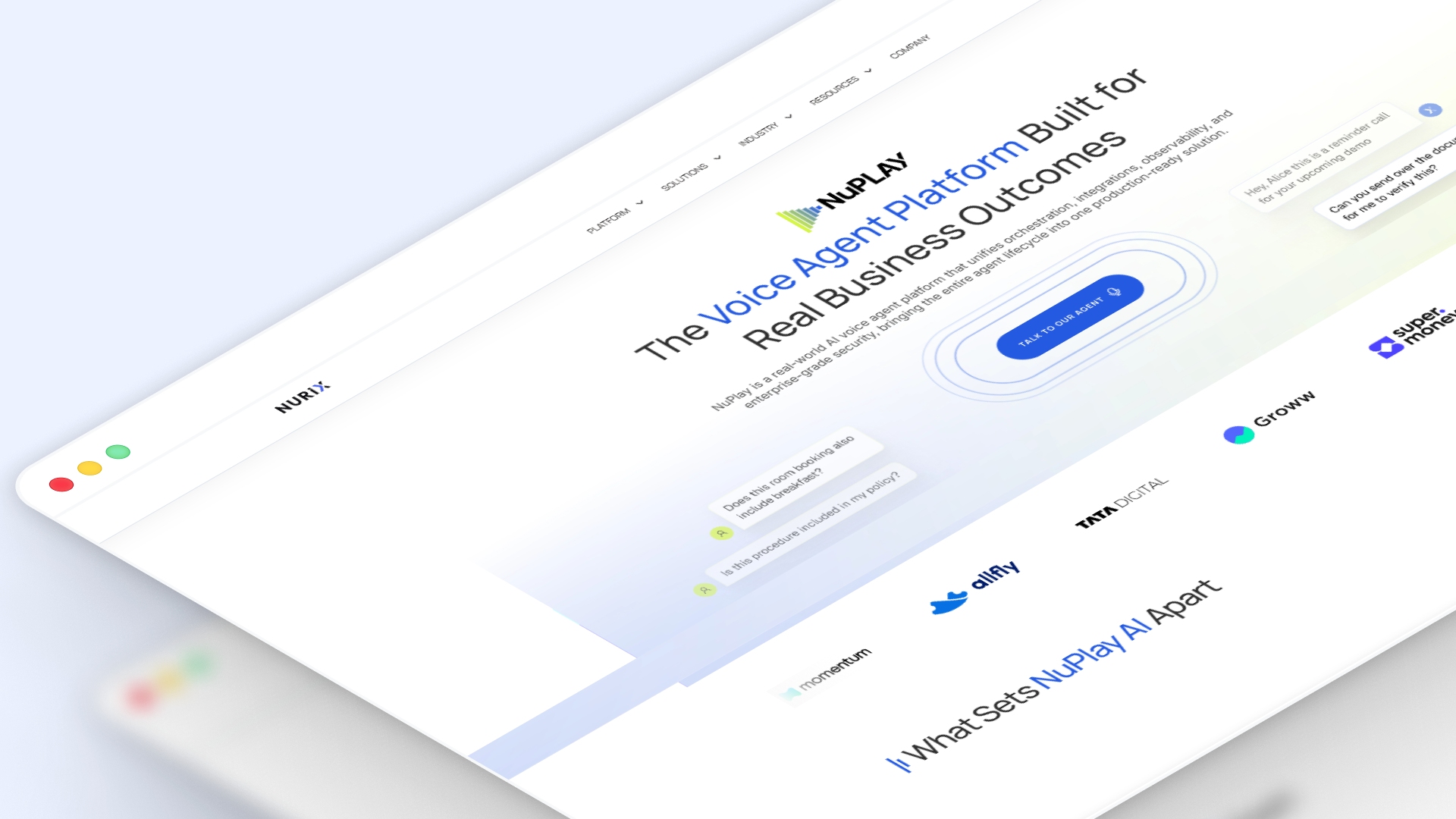
NuPlay is an enterprise AI voice agent platform that unifies orchestration, integrations, observability, and security into a single production-ready system. It supports the full agent lifecycle from build to deployment and continuous optimization, enabling teams to run real-time, multi-step lead qualification workflows at scale with full control and visibility.
Key features:
- Model-Agnostic Execution: selects and switches between language models based on latency, accuracy, or cost without vendor lock-in
- Multi-Agent Orchestration: manages branching workflows, multi-turn conversations, and agent-to-agent task execution
- 400+ System Integrations: connects with CRM, telephony, and enterprise tools via APIs (Application Programming Interfaces)
- Observability (NuPulse): tracks conversion rates, drop-offs, CSAT (Customer Satisfaction), and maps them to agent decisions
- Enterprise Governance: includes audit logs, access controls, and compliance-ready workflows for regulated environments
- Brand-Aligned Voice + RAG: uses Retrieval-Augmented Generation (RAG) to deliver context-aware, accurate responses aligned with business data
Best For: Enterprises that need full lifecycle control of voice-based AI agents, from deployment to optimization, with strong orchestration, integration, and governance capabilities.
Pros:
- Covers build, deploy, and optimization in one platform
- High flexibility with model-agnostic architecture
- Strong visibility into performance and decision flows
Pricing: Custom enterprise pricing based on deployment scale and workflow complexity.
Zolve used a NuPlay, a Voice AI agent, to automate outbound lead qualification, handling multilingual conversations, filtering high-intent prospects, and routing them to experts. This enabled 25–35% connectivity, 12% qualified leads, and sub-4-minute qualification cycles, without increasing headcount, improving speed, and focusing on high-value opportunities.
2. Qualified (Piper AI SDR Agent)

Qualified Piper is an AI SDR (Sales Development Representative) agent designed for inbound pipeline generation through agentic marketing workflows. It engages website visitors across chat, voice, video, and email, guiding buyers through the funnel and converting interest into qualified meetings at scale.
Key features:
- Multichannel Engagement: Interacts via website chat, voice, video, and email to guide buyers across touchpoints
- Agentic Funnel Execution: Manages the full inbound journey from first interaction to meeting booking
- Buyer Intent Signals: Identifies and prioritizes high-intent visitors using behavioral and firmographic data
- Smooth Handoff: Transitions conversations across channels (chat to email) without losing context
Best For: Marketing and revenue teams focused on converting inbound website traffic into a pipeline through continuous engagement and automated meeting booking.
Pros:
- Strong inbound pipeline generation capabilities
- Works across multiple engagement channels
Cons:
- Primarily focused on inbound and website-driven qualification
- Limited control over complex, multi-system orchestration workflows
Pricing: Custom pricing based on platform usage and deployment scope.
3. Jazon by Lyzr.ai

Jazon - World's 1st truly agentic AI SDR
Jazon is a custom AI SDR (Sales Development Representative) designed to connect marketing signals with sales execution. It analyzes buyer behavior, prioritizes accounts, and runs multi-channel conversations across email, LinkedIn, and messaging platforms to drive qualified engagement and meeting conversion.
Key features:
- Account Mapping Engine: Builds prioritized target lists using buyer intent signals and behavioral data
- Hyper-Personalized Messaging: Adapts outreach based on content engagement, source, and interaction history
- Multi-Channel Conversations: Manages replies and follow-ups across email, LinkedIn, and messaging platforms
- Smart Scheduling Integration: Syncs with calendars and CRM systems for meeting booking
Best For: Teams that want to align marketing signals with outbound and inbound engagement using a customizable AI SDR workflow.
Pros:
- Strong signal-driven personalization capabilities
- Supports multi-channel engagement beyond email
Cons:
- Primarily optimized for outreach and engagement, not real-time voice qualification
- Requires setup to align marketing data sources and workflows
Pricing: Custom pricing with pilot-based access for eligible customers.
4. Relevance AI

Relevance AI | AI Agents for Sales & GTM Teams
Relevance AI provides an AI workforce platform that enables teams to build and deploy agent-driven go-to-market (GTM) workflows. It supports assisted, copilot, and autonomous execution models, allowing businesses to automate lead qualification, routing, and engagement based on real-time pipeline signals.
Key features:
- AI Workforce System: Builds multi-agent workflows that automate inbound, outbound, and pipeline operations
- Supergtm Engine: Acts as an AI teammate that executes research, follow-ups, and CRM updates across workflows
- Inbound Qualification Agent: Qualifies leads in real time and routes them to the appropriate sales owner
- Event-Driven Automation: Triggers workflows based on pipeline signals, behavior, and account activity
Best For: Teams looking to build customizable, agent-driven GTM workflows that automate qualification, research, and pipeline management across multiple systems.
Pros:
- Highly flexible with configurable agent workflows
- Strong integration ecosystem across sales and data tools
Cons:
- Requires setup and workflow design before delivering value
- Not a plug-and-play qualification agent for immediate deployment
Pricing: Tiered pricing with free trial and enterprise plans based on usage and scale.
5. Conversica

Conversica provides AI agents designed to run persistent, two-way conversations across the customer lifecycle. It focuses on engaging inbound leads, re-engaging dormant prospects, and driving outcomes through automated conversations across email, SMS, and messaging channels, operating continuously without manual intervention.
Key features:
- Persistent Conversation Engine: Runs ongoing, two-way conversations across email, SMS, and messaging platforms.
- Lead Qualification Workflows: Engages inbound inquiries and progresses leads based on responses and intent signals.
- Campaign Activation Layer: Converts ads, events, and content interactions into active conversations.
- Meeting & Workflow Automation: Schedules meetings, sends assets, and triggers actions within connected systems.
Best For: Organizations that need continuous lead engagement and re-engagement across campaigns, especially where follow-up speed and persistence impact conversion.
Pros:
- Strong at re-engaging inactive or delayed leads
- Supports always-on, multi-channel conversations
Cons:
- Focused on messaging channels, not real-time voice-based qualification
- Less suited for complex, multi-step decision workflows
Pricing: Custom enterprise pricing based on usage, channels, and deployment scope.
The right AI agent depends on where you need control; at the conversation layer, workflow layer, or engagement layer. Align the tool with how your team qualifies and routes leads, not just how it generates pipeline.
Extend AI beyond lead qualification into customer support and operations with How to Implement AI in Call Centers: A Step-by-Step Guide for 2025
Use Cases of AI Agents in B2B Lead Qualification
AI agents for B2B lead qualification are applied across inbound capture, outbound engagement, and pipeline management workflows. They automate interaction handling, extract structured data, and trigger routing decisions based on predefined rules, enabling faster qualification, reduced manual effort, and consistent lead evaluation across channels.
The use cases below show where AI agents directly impact qualification accuracy and pipeline movement:
- Inbound Lead Screening: Qualifies web forms, chat, and call inquiries in real time, capturing firmographic data and routing leads using predefined CRM rules.
- Event And Campaign Follow-Up: Engages event attendees or campaign responders automatically, validates intent signals, and schedules meetings based on engagement behavior and responses.
- Outbound Lead Qualification: Initiates conversations via email or messaging, filters responses using qualification criteria, and prioritizes high-intent accounts for sales outreach.
- Account-Based Qualification (ABM): Supports Account-Based Marketing (ABM) by engaging target accounts with personalized questions, identifying decision-makers, and mapping buying groups.
- Re-Engagement And Pipeline Recovery: Reconnects with dormant leads, reassesses intent, and re-qualifies opportunities based on updated activity and interaction history.
AI agents extend qualification beyond first touch, embedding structured decision logic across inbound, outbound, and re-engagement workflows to improve pipeline quality and conversion consistency.
AI Agents vs Chatbots for Lead Qualification
AI agents for lead qualification execute multi-step conversations, apply decision logic, and integrate with business systems to route leads in real time. Chatbots rely on predefined scripts, handle limited queries, and lack the ability to perform dynamic qualification, scoring, or workflow execution across channels.
The comparison below highlights how both differ across qualification depth, system integration, and execution capability:
AI agents replace static interaction models with decision-driven qualification systems, enabling real-time routing, structured data capture, and scalable execution across channels that chatbots cannot support.
See how automated qualification workflows operate in financial services in 5 Powerful Ways Automated Lead Qualification AI Works in FSI
How to Implement AI Agents for B2B Lead Qualification
Implementing AI agents for B2B lead qualification requires aligning data, workflows, and system integrations before deployment. Teams must define qualification logic, connect core systems, and set monitoring controls so agents can capture structured data, score leads, and trigger routing actions reliably in live environments.
.jpg)
The steps below outline how to deploy agents into production-ready qualification workflows:
- Define Qualification Criteria: Map Ideal Customer Profile (ICP), scoring rules, and required data fields so agents can evaluate leads consistently across interactions.
- Integrate Core Systems: Connect CRM, telephony, and marketing tools using APIs (Application Programming Interfaces) for real-time data exchange and workflow execution.
- Design Conversation Flows: Build multi-step interaction logic with fallback paths, ensuring agents ask relevant questions and handle edge cases without breaking flow.
- Set Routing And Escalation Rules: Configure automated routing, meeting booking, and Human-in-the-Loop (HITL) escalation when confidence scores fall below thresholds.
- Monitor And Optimize Performance: Track conversion rates, drop-offs, and response accuracy using dashboards, then refine models and rules based on observed outcomes.
AI agent implementation succeeds when qualification logic, system connectivity, and monitoring work together, allowing teams to deploy controlled automation that improves lead quality and pipeline efficiency.
How to Choose the Right AI Agent for B2B Lead Qualification
Picking the right agent is less about flashy features and more about match: how the product fits your systems, data needs, compliance rules, and scale. Use this practical checklist and scoring approach to evaluate vendors.
- Does it natively connect to your CRM, telephony, and calendar systems? You want read/write capability, not just one-way sync. Prebuilt connectors speed deployment.
- Is the agent multimodal? It should handle voice, chat, email, and documents with consistent logic.
- Can it extract B2B entities reliably? Look for demos that extract firmographic fields and buying signals, not just generic intent.
- Does it provide human-in-the-loop controls and clear handoffs? Escalation must be simple and context-rich.
- Are governance and security enterprise-grade? Require SOC 2 / ISO 27001, configurable data retention, PII masking, and audit logs.
- Is monitoring and model explainability included? You need dashboards for drift, confidence, and correction histories.
- Does the vendor support domain tuning and custom rules? Vertical language and company-specific logic are musts.
- What's the SLA and enterprise support model? Look for uptime guarantees, escalation paths, and an enterprise onboarding team.
With the right selection approach in place, you’re ready to bring everything together and think about what this means for your teams moving forward.
Explore how AI agents handle critical workflows and real-time response systems in Best AI Agents for Incident Response Automation in 2026
Challenges of AI Agents in Lead Qualification
AI agents for B2B lead qualification introduce operational and technical challenges across data readiness, workflow alignment, and system governance. Performance depends on clean inputs, defined logic, and reliable integrations, while gaps in configuration, monitoring, or compliance controls can impact accuracy, routing decisions, and overall pipeline trust.
The table below outlines common challenges and how they affect qualification workflows:
AI agents require structured data, defined workflows, and continuous monitoring to perform reliably. Without these, qualification accuracy and operational trust can degrade over time.
Conclusion
AI agents for b2b lead qualification are now a choice between testing and falling behind. Pick a narrow pilot, measure a clear outcome, and validate with real traffic so you see faster contact, cleaner data, and lower qualification cost in weeks, not months. Move from evaluation to a short live test to prove value quickly and reduce risk before scaling.
NuPlay is an enterprise-grade voice and chat platform built for low-latency, long conversations and direct CRM and workflow integration. Schedule a custom demo to see NuPlay handle real qualification calls and show measurable results in your systems.
Author: Sakshi Batavia, Marketing Manager
Sakshi Batavia is a marketing manager focused on AI and automation. She writes about conversational AI, voice agents, and enterprise technologies that help businesses improve customer engagement and operational efficiency.