Enhancing Customer Service in Banking with AI in 2026


Don’t miss what’s next in AI.
Subscribe for product updates, experiments, & success stories from the Nurix team.
Customer service in banking is under pressure from rising query volumes, higher expectations for instant support, and the need to maintain trust in every interaction. Banks are being asked to respond faster, personalize service better, and reduce costs without compromising security or compliance.
This is where Artificial Intelligence (AI) is changing the service model. AI systems can automate routine inquiries, support fraud detection, personalize interactions, and help banks provide 24/7 assistance across digital and voice channels. Citi estimated that AI could add roughly $170 billion to banking profits by 2028, helping push the industry’s profit pool toward $2 trillion.
In this guide, we explain how AI improves banking customer service, the technologies behind it, the most valuable use cases, the risks banks must manage, and what good implementation looks like in practice.
Executive Summary: AI in banking enhances customer service by automating routine tasks, reducing costs, and offering personalized experiences. It provides 24/7 support, improved fraud detection, and proactive service. By leveraging technologies like NLP, ML, and RPA, banks can streamline operations, boost customer satisfaction, and stay competitive. Embracing AI allows seamless integration, delivering a smarter, faster banking experience.
Key Takeaways
- AI in Banking: AI automates routine tasks, reduces operational costs, and improves efficiency, enabling banks to offer personalized customer support.
- Key Benefits: AI-powered customer service offers faster response times, personalized banking experiences, proactive fraud detection, and compliance automation.
- AI Technologies: Technologies like NLP, ML, RPA, and speech recognition enhance banking services by providing more intuitive and responsive customer interactions.
- Key Applications: AI-driven chatbots, virtual assistants, personalized financial advice, and document processing optimize workflows, reducing wait times and enhancing customer experience.
- Future of AI: The future promises even deeper personalization, faster service delivery, and seamless integration of AI with existing banking technologies, transforming the customer experience.
What Is AI Customer Support Automation in Banking?
AI customer support automation in banking refers to the use of artificial intelligence to handle customer service tasks more quickly, accurately, and consistently. It helps your bank manage routine queries, support requests, and service workflows across channels like voice, chat, email, and mobile banking.
In simple terms, it allows you to automate repetitive customer interactions while still delivering fast and personalized support. Instead of relying only on human agents for every request, AI can assist with tasks like answering balance inquiries, tracking transactions, routing complex cases, detecting fraud signals, and helping customers get support anytime they need it.
Also Read: Generative AI Use Cases in Banking and Financial Services
Benefits of AI Customer Service Automation in Banking
AI customer service automation in banking can significantly improve operational efficiency, enhance customer experience, and reduce costs. By automating routine tasks and providing 24/7 support, AI helps banks deliver faster, more personalized, and cost-effective services.
Here are the key benefits of AI in banking customer service:
- Increased Efficiency: AI systems handle routine inquiries and transactions, allowing banks to process more customer requests in less time. This leads to faster response times, improved operational efficiency, and higher levels of customer satisfaction.
- 24/7 Availability: AI-powered systems offer always-on support, ensuring customers can access banking services and resolve issues at any time. This level of availability enhances convenience and ensures customers never have to wait for business hours to manage their finances.
- Personalized Banking Experiences: AI analyzes customer data to provide tailored recommendations and personalized experiences. By offering relevant suggestions based on customer preferences, AI helps banks boost customer retention, loyalty, and overall satisfaction.
- Cost Savings: By automating routine tasks, banks can reduce reliance on large customer service teams. AI-driven systems provide scalable customer support, ensuring high-quality service without escalating expenses.
- Improved Fraud Detection: AI helps banks detect and prevent fraud by analyzing transaction patterns and customer behavior in real time. This enhanced fraud detection reduces financial risk and protects customer accounts from unauthorized activities.
- Regulatory Compliance: AI automates processes for anti-money laundering (AML) and Know Your Customer (KYC) compliance. By ensuring accurate, traceable data, AI reduces the risk of non-compliance, helping banks avoid costly penalties and safeguard their reputations.
- Proactive Support: AI-powered systems use predictive analytics to anticipate customer needs, such as reminding customers about upcoming payments or suggesting loan refinancing options. This proactive approach improves customer satisfaction by addressing their needs before they arise.
To deliver these benefits consistently, it’s important to understand the technologies that enable them.
Key AI Technologies in Banking Customer Support Automation
AI technologies are transforming banking customer support by enhancing the way systems interact with customers, predict their needs, and automate routine tasks. These technologies help banks provide faster, more efficient, and personalized service.
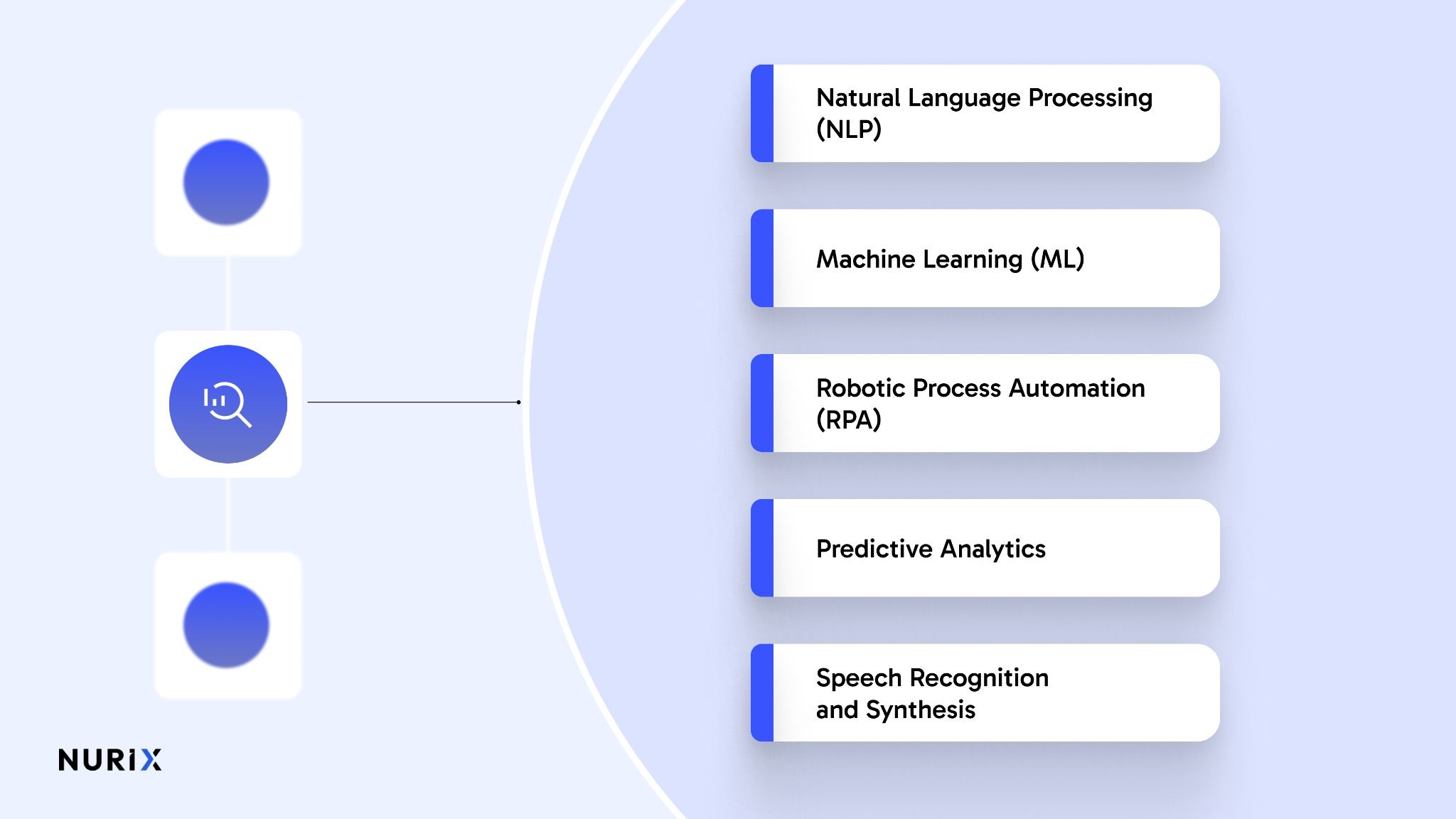
Here are the key AI technologies enabling customer support automation in banking:
- Natural Language Processing (NLP): NLP allows AI systems to understand and interpret human language, whether written or spoken. This enables systems to interact with customers in a natural, intuitive way, improving customer service communication.
- Machine Learning (ML): ML empowers AI systems to learn from data and adapt over time. By analyzing customer behavior and past interactions, machine learning allows AI to improve its decision-making and tailor responses to individual needs.
- Robotic Process Automation (RPA): RPA automates repetitive, rule-based tasks within banking systems. This technology enables AI to perform tasks such as updating records and processing payments without human intervention, making operations more efficient and reducing the risk of errors.
- Predictive Analytics: Predictive analytics uses historical data to forecast future trends. By analyzing customer data, AI can anticipate needs, such as when a customer might need financial advice or a service upgrade, enabling proactive support.
- Speech Recognition and Synthesis: This technology enables AI systems to understand spoken language and respond verbally. It’s a key component in voice-based banking, allowing customers to manage their accounts or request information through voice commands.
- Fraud Detection: AI-powered fraud detection technologies analyze transaction patterns, account activity, and customer behavior in real time to identify unusual or suspicious actions. This helps banks prevent fraud faster, reduce false alerts, and protect customer trust during service interactions.
These core AI technologies form the backbone of modern customer support systems in banking, helping improve efficiency, accuracy, and personalization in service delivery.
Now, the next step is to see how these capabilities translate into real-world customer service improvements.
How to Enhance Customer Service in Banking with AI
AI enhances banking customer service by enabling 24/7 support through intelligent chatbots, personalized financial advice, and proactive fraud detection. Applications such as AI-driven virtual assistants, automated document processing for loan approvals, and sentiment analysis improve customer experience. By leveraging AI, banks can streamline operations, reduce costs, and improve customer satisfaction.
Here are the key applications of AI in banking customer service:
1. AI Chatbots & Virtual Assistants
These AI-powered systems provide support for routine customer inquiries such as account balances, transaction alerts, and basic banking tasks. By handling high volumes of interactions, AI chatbots and virtual assistants free up human agents to focus on more complex issues.
This ultimately reduces wait times and improves customer satisfaction. With AI, customers get instant responses at any time of day, improving overall service efficiency.
2. Personalized Financial Advice
AI-based solutions analyze spending patterns and transactional data to provide customers with customized financial advice. Whether offering wealth management insights or suggesting specific banking products tailored to a customer’s financial goals, AI helps banks deliver highly personalized experiences.
This not only improves customer satisfaction but also boosts customer loyalty by offering valuable financial guidance that meets individual needs.
3. Proactive Fraud Detection & Security
Fraud detection has advanced with the integration of Generative AI into banking, enabling real-time identification and prevention of fraud. AI can analyze user behavior in real time to detect fraudulent activity.
By identifying unusual patterns such as unauthorized transactions or irregular account activity, AI systems can instantly flag potential fraud, significantly reducing false positives by up to 80%. This not only enhances security but also improves customer trust by reducing false alarms and providing more accurate fraud alerts.
4. Streamlined Loan and Document Processing
AI algorithms accelerate loan applications by automating critical tasks like document verification and risk assessment. What traditionally took days to process can now be completed in minutes, improving loan approval efficiency and reducing customer wait times.
This application ensures that customers receive faster, more responsive service, ultimately improving their overall banking experience.
5. Intelligent Document Processing (IDP)
AI-driven Intelligent Document Processing is transforming how banks handle loan servicing and onboarding. By extracting and analyzing data from unstructured documents like contracts, applications, and forms, AI enhances operational efficiency.
This reduces manual intervention, speeds up document review, and ensures more accurate data processing, resulting in faster, more accurate service for customers.
These AI applications not only optimize banking operations but also help banks provide faster, more personalized, and secure customer service.
6. Voice AI Agents & Sentiment Analysis
With Voice AI, customers can interact with banking systems using natural language, whether to request account information or complete transactions via voice commands.
Additionally, sentiment analysis technology helps detect customer emotions, allowing agents to respond more effectively to complaints and proactively engage with customers. By understanding customer sentiment, AI helps deliver more empathetic, personalized, and responsive service.
While these AI-driven improvements deliver clear benefits, implementing them in banking environments also comes with its own set of challenges that need careful consideration.
How AI in Banking Evolved
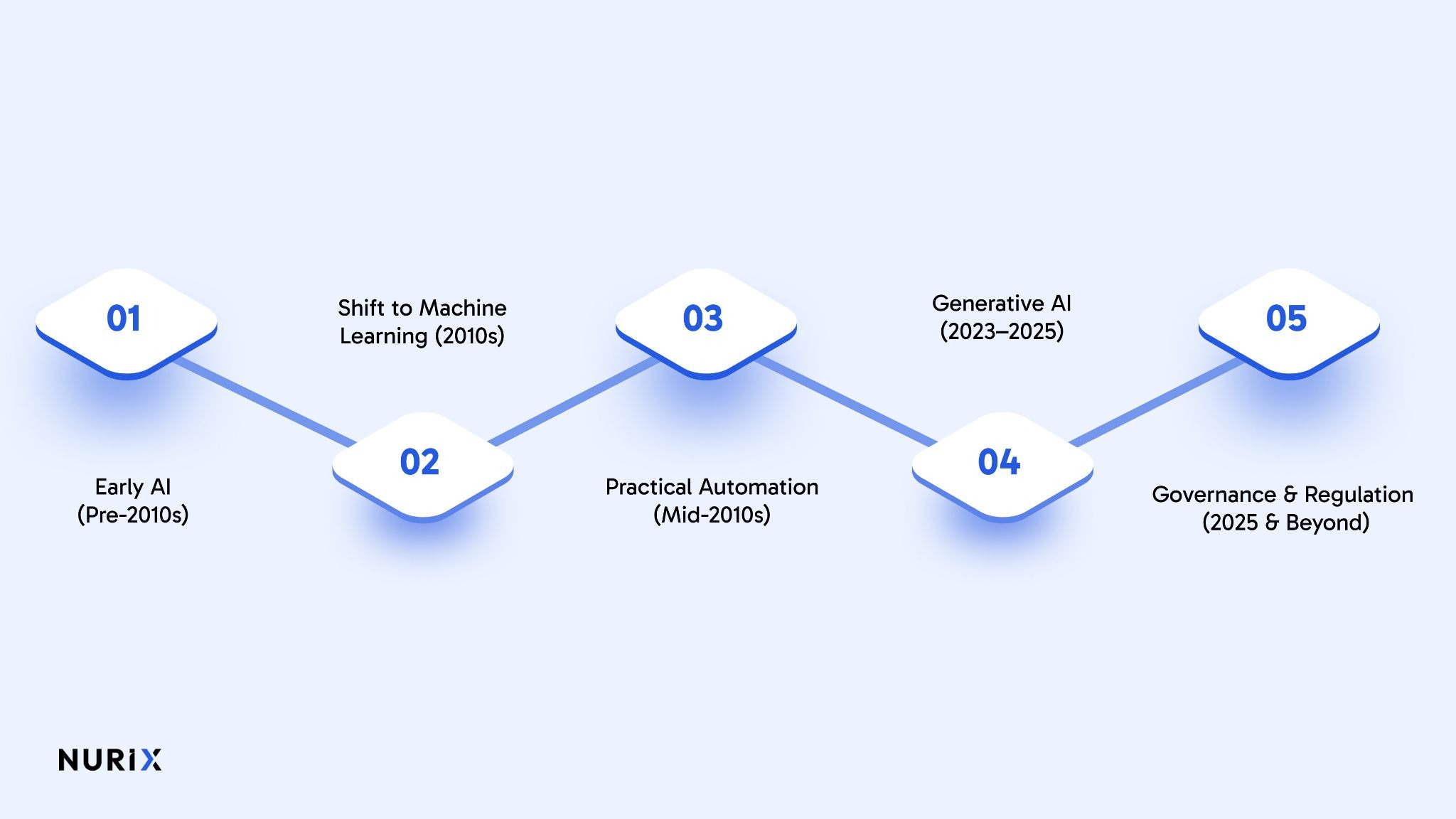
AI in banking has moved from simple rule-based automation to more advanced systems that can learn, respond, and support customer service at scale. What started with basic decision engines now includes machine learning, chatbots, document automation, and Generative AI tools that help banks improve speed, accuracy, and customer experience.
Here is a quick look at how AI in banking has evolved:
- Rule-based systems: Early banking automation followed fixed rules for simple decisions and repetitive tasks.
- Machine learning models: Banks then started using AI to detect fraud, spot anomalies, and improve risk analysis in real time.
- Customer service automation: Tools like chatbots, Natural Language Processing (NLP), and workflow automation helped banks manage growing service volumes more efficiently.
- Generative AI: More recently, AI has started generating summaries, drafts, explanations, and insights, making it useful across support and operations.
- Governance focus: As AI use has expanded, banks have also placed more focus on security, compliance, explainability, and oversight.
This shift shows why AI is now seen as a practical tool for improving banking customer service, not just automating back-office tasks.
Challenges of AI in Banking
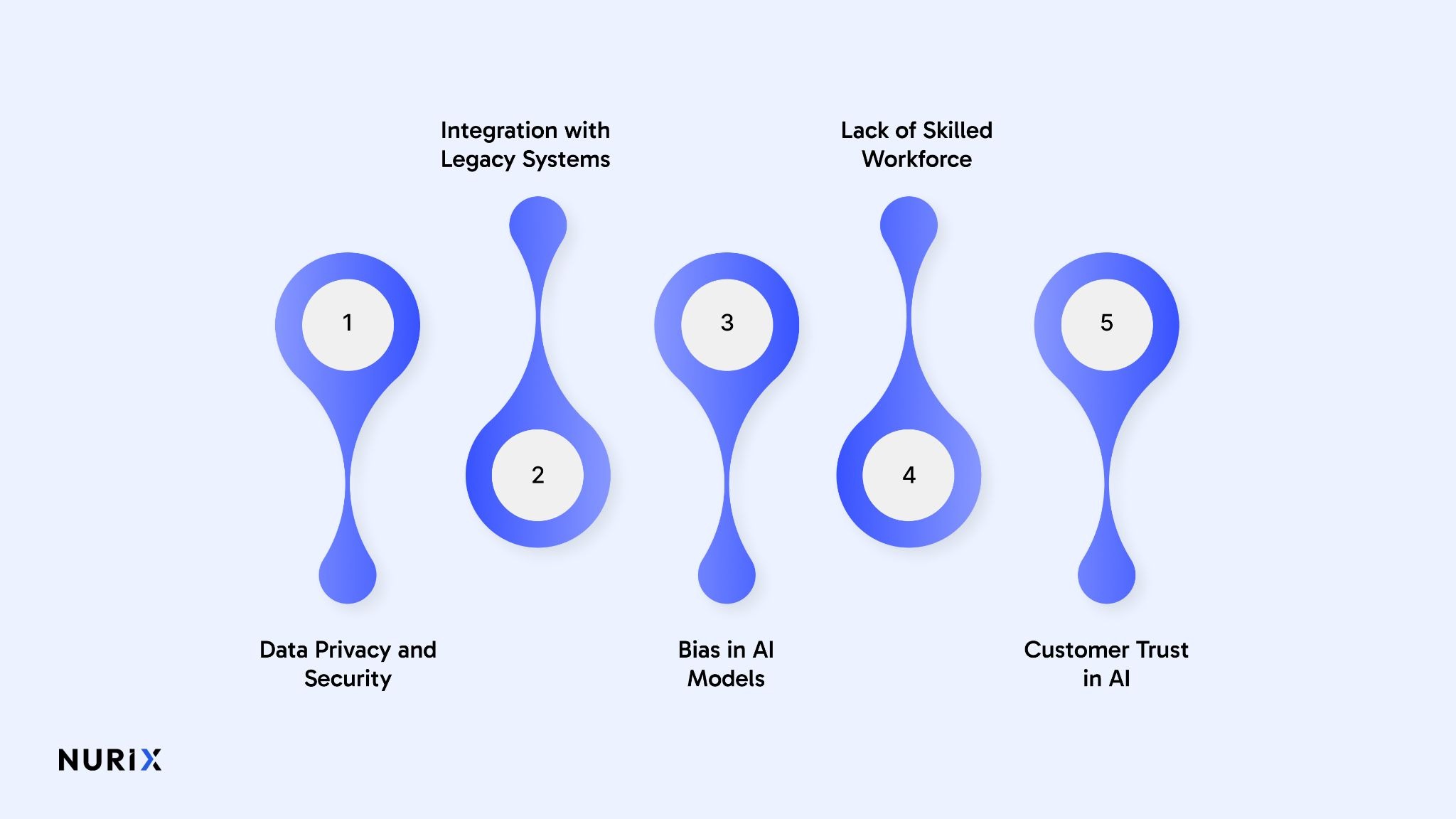
While AI offers numerous benefits for customer service in banking, several challenges must be addressed. These challenges can affect the efficiency and effectiveness of AI-driven solutions, especially in a highly regulated, customer-focused industry like banking.
Here are five key challenges of AI in banking and how to overcome them:
- Data Privacy and Security: AI systems in banking handle sensitive customer information, making data security critical.
- Integration with Legacy Systems: Many banks still rely on legacy systems that may not be compatible with modern AI solutions. Adopt hybrid AI solutions that can integrate seamlessly with existing systems to ensure a smooth transition to more advanced AI technologies.
- Bias in AI Models: AI models can inadvertently perpetuate bias if trained on incomplete or unrepresentative data. Regularly audit and update AI models to ensure fairness and prevent bias.
- Lack of Skilled Workforce: Implementing AI requires skilled talent, and the shortage of AI professionals in banking is a challenge. Invest in training programs and collaborate with third-party AI providers to bridge the gap.
- Customer Trust in AI: Many customers remain hesitant to fully embrace AI-driven customer service, fearing the loss of human touch. Combine AI with human agents to create a hybrid system that provides both efficient automation and empathetic human support, building customer trust in the technology.
By understanding these challenges and addressing them proactively, banks can harness the full potential of AI to enhance customer service while ensuring a secure, fair, and effective customer experience.
Next, let’s take a look at future AI trends in banking.
Also Read: Generative AI Use Cases and Challenges in Banking
The Future of AI Customer Support Automation in Banking
The future of AI customer support in banking will be shaped by faster decisions, more flexible service models, and connected experiences across every customer touchpoint. Instead of only improving basic support tasks, AI will help banks deliver real-time service, support branchless banking, and maintain context across voice, chat, mobile, and web.
Here are the key aspects of the future of AI customer support automation in banking:
- Real-Time Decisioning: AI will help banks make faster service decisions during live interactions. This includes instant fraud checks, faster issue resolution, smarter routing, and real-time recommendations based on customer behavior and account context.
- Branchless Service: As more customers prefer digital-first banking, AI will support branchless service models by handling routine requests, onboarding tasks, account queries, and support journeys without requiring in-person assistance.
- Voice and Conversational Banking: Voice AI will play a bigger role in how customers interact with banks. Instead of navigating long menus or waiting for agents, customers will be able to speak naturally, complete tasks faster, and get support through more human-like conversations.
- Cross-Channel Continuity: Future AI systems will help banks deliver connected experiences across channels. A customer who starts a conversation on chat should be able to continue it on voice or mobile without repeating the issue, creating a smoother and more consistent service journey.
- Deeper Personalization at Scale: AI will move beyond basic personalization to deliver more relevant support based on customer history, preferences, and intent. This will help banks offer service that feels timely, helpful, and tailored to each individual.
In the coming years, enhancing customer service in banking with AI will deliver unprecedented levels of convenience and personalization, transforming the customer experience.
How NuPlay by Nurix AI Supports AI Customer Service Workflows in Banking
Banks face growing pressure to deliver faster support, reduce wait times, improve fraud response, and maintain service quality across every customer interaction. At the same time, your teams must manage high query volumes, legacy systems, strict compliance requirements, and rising expectations for seamless service across voice, chat, and digital channels.
This is where NuPlay by Nurix AI comes in. NuPlay by Nurix AI is an enterprise-grade voice and chat AI platform that unifies orchestration, integrations, observability, and security to automate sales, support, and knowledge-work workflows. The platform brings the entire agent lifecycle into a single production-ready solution, enabling organizations to design, deploy, monitor, and optimize AI agents to handle complex tasks across channels, languages, and systems.
Here are the key NuPlay by Nurix AI capabilities that support banking customer service workflows:
- NuRep: NuRep helps you shape how AI agents speak by learning from your website, help center, playbooks, and past interactions. It also gives you control over tone, personality traits, formality, and language preferences, so customer conversations stay consistent and natural.
- NuPulse: With NuPulse, we provide Conversational Analytics that dive deeper into sentiment patterns, interaction quality, and customer escalation reasons. This enables your team to instantly uncover key topics, customer friction points, and feedback to improve customer service.
- Agent Monitoring: With our agent monitoring & observability, you can stay on top of every interaction with live metrics like response time, containment, resolution rate, intent accuracy, and escalation frequency. That makes it easier for banking teams to measure service quality and spot issues before they grow.
- Security and Compliance: NuPlay by Nurix AI security and compliance automatically detect and mask sensitive information, including names, credit card numbers, email addresses, and phone numbers, across transcripts, analytics, and logs.
- Multi-Agent Orchestration: Instead of forcing one agent to manage every task, NuPlay by Nurix AI uses specialized agents coordinated by a central orchestrator. This setup supports branching logic, multi-turn flows, handoffs, and real-time actions across systems, which is especially useful for complex banking workflows.
Together, these capabilities help banks move from disconnected AI tools to more secure, observable, and scalable customer service workflows.
Conclusion
Enhancing customer service in banking with AI is no longer just about faster replies. It is about building support experiences that are more responsive, more personalized, and easier to scale across growing customer demand. From chatbots and voice AI to fraud detection and document automation, AI helps banks reduce wait times, improve efficiency, and deliver better service across the customer journey.
The real value comes when these systems are implemented with the right structure behind them. Banks need strong integration with existing systems, clear governance, secure data handling, and visibility into how AI performs in real interactions. This is where NuPlay by Nurix AI supports banking teams. As an enterprise-grade voice and chat AI platform, NuPlay by Nurix AI helps organizations design, deploy, monitor, and optimize AI agents across channels, while supporting orchestration, observability, security, and compliance in one production-ready system.
Schedule a custom demo with NuPlay by Nurix AI to see how AI customer service workflows can be built for speed, control, and long-term banking performance.
Common AI applications in banking customer service include chatbots, virtual assistants, voice AI, fraud detection, personalized financial recommendations, and document automation. These tools help banks answer routine queries, speed up service, and provide 24/7 support.
AI improves customer service at bank branches by supporting self-service kiosks, voice-assisted help, automated check-ins, and faster query handling. It can also reduce wait times and help staff focus on more complex customer needs.
AI helps connect customer service with online banking systems by enabling real-time support inside digital channels. Customers can check balances, track transactions, get product guidance, and resolve issues through chat or voice without leaving the banking platform.
AI improves agility by helping banks respond faster, automate repetitive work, and adapt quickly to changing customer needs. It allows teams to handle higher volumes, route issues faster, and deliver support more efficiently across channels.
Banks often face challenges with data privacy, regulatory compliance, legacy system integration, AI bias, workforce readiness, and customer trust. To implement AI successfully, banks need secure data controls, strong governance, smooth integration with existing systems, and a balanced approach that combines automation with human oversight.
Don’t miss what’s next in AI.
Subscribe for product updates, experiments, & success stories from the Nurix team.