
In high-volume call centers across industries, every missed signal can mean longer wait times, frustrated customers, lost revenue, and overloaded agents. When call data stays trapped in recordings, notes, and dashboards, your team reacts too late. And when agents repeat the same manual steps across thousands of conversations, support costs rise while customer trust falls.
According to McKinsey’s State of Customer Care survey, 57% of customer care leaders expect call volumes to increase by up to 20% over the next one to two years. At the same time, Gartner predicts conversational AI will reduce contact center agent labor costs by $80 billion by 2026, creating both urgency and opportunity for teams that use call center intelligence effectively.
This blog explains what call center intelligence means, how AI voice and chat agents support enterprise call centers, and how teams can use them to automate routine workflows, reduce manual effort, and deliver faster, more consistent support.
Executive Summary: Call center intelligence helps high-volume teams turn customer conversations into action. AI voice and chat agents detect intent, route issues, automate routine workflows, support agents, and surface real-time insights. For enterprise call centers, this means faster resolutions, lower manual effort, better visibility, stronger governance, and more consistent customer experiences at scale.
TL;DR
- Rising Pressure: High-volume call centers cannot rely on manual routing, delayed reports, and after-call notes as call volumes grow. You need call center intelligence to detect signals early and act faster.
- Actionable Intelligence: Call center intelligence does more than measure performance. It helps your team understand intent, urgency, sentiment, and next steps during customer conversations.
- AI Execution: AI voice and chat agents can resolve routine requests, route complex cases, summarize calls, update systems, and support human agents in real time.
- Operational Gains: Enterprises can use call center intelligence to improve response times, reduce manual work, lower cost per interaction, and deliver more consistent customer experiences.
- Enterprise Readiness: The right platform should combine natural voice AI, deep integrations, workflow orchestration, real-time monitoring, and strong security controls.
What Is Call Center Intelligence?
Call center intelligence uses artificial intelligence, conversation data, analytics, and workflow automation to understand customer calls and take the right next action. It helps your team detect intent, analyze sentiment, summarize calls, route issues, and trigger workflows across systems like CRM, helpdesk, and order management tools. The global call center AI market is valued at $2.98 billion in 2026 and projected to reach $13.52 billion by 2034 at a 20.8% CAGR, according to Fortune Business Insights, showing the shift from reporting-only analytics to AI that can take action during live calls.
For enterprise teams, it helps you see why customers are calling, which issues need urgent attention, where agents need support, and which repetitive queries can be automated without hurting customer experience.
To understand why call center intelligence matters today, it helps to see how call centers have evolved from manual support systems to AI-driven operations.
Also read: Call Center Automation Technologies and Best Practices in 2026
The Evolution of AI Intelligence in Call Centers
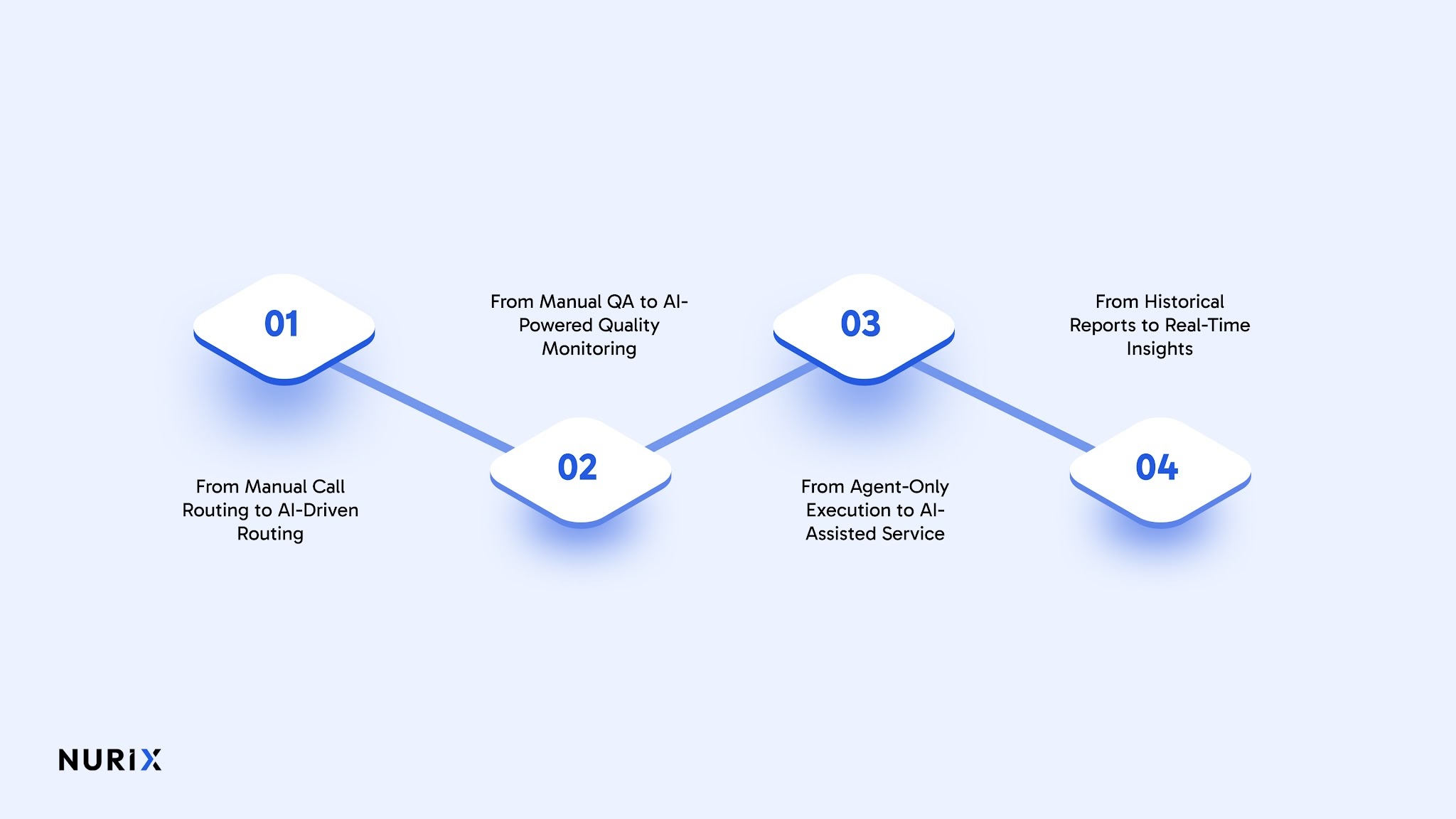
AI intelligence in call centers has evolved from basic automation to systems that can understand calls, guide agents, and trigger actions in real time. For high-volume enterprises, this means your call center can move from reactive support to faster, smarter, and more scalable service.
Here are the key shifts shaping modern call centers:
From Manual Call Routing to AI-Driven Routing
Traditional call routing often depends on fixed rules, agent availability, or rigid Interactive Voice Response menus. This can lead to long wait times, repeated transfers, and customers explaining the same issue multiple times.
AI-driven routing uses customer intent, sentiment, history, and context to send each call to the right agent, team, or automated workflow. For your support team, this means fewer transfers, faster resolutions, and better use of agent expertise.
From Manual QA to AI-Powered Quality Monitoring
Manual quality assurance reviews only a small sample of calls after they happen. This leaves visibility gaps and makes it harder for CX leaders to quickly spot compliance risks or coaching needs.
AI-powered quality monitoring can review interactions at scale and surface patterns across calls. It helps your managers identify service gaps, agent training needs, and customer friction faster.
From Agent-Only Execution to AI-Assisted Service
In traditional call centers, agents often search for customer details, take notes, update systems, and manage the conversation simultaneously. This increases pressure on agents and slows down the customer experience.
AI-assisted service supports your agents by summarizing calls, surfacing customer context, suggesting next steps, and reducing after-call work. This allows human agents to focus on complex, emotional, or high-value conversations.
From Historical Reports to Real-Time Insights
Traditional reports usually show what happened in the past week or month. By then, customer issues may have already affected satisfaction, renewals, or revenue.
With AI analyzing conversations in real time, your team can spot rising call drivers, changes in sentiment, churn risks, and process gaps earlier. This turns your call center from a reporting function into a real-time intelligence engine.
This evolution shows AI is no longer just for reporting or basic automation. It now supports practical call center use cases.
10 Ways to Use AI Agents in Call Centers
AI agents help call centers move beyond manually answering calls. They use call center intelligence to understand customer needs, guide the next step, and take action across support, sales, and operations workflows.
Here are 10 practical ways to use AI agents in call centers:
1. Resolve Routine and Multi-Step Customer Requests
AI agents can handle common customer requests without making every caller wait for a human agent. This is useful for high-volume queries like order status, refund updates, appointment changes, account questions, and policy information.
AI voice agents can handle these structured, repeatable workflows while human agents manage exceptions. They can also complete multi-step tasks by checking customer details, pulling data from systems, updating records, and confirming the outcome. This improves response times and frees agents to handle complex customer conversations.
2. Route Calls to the Right Agent or Team
Traditional routing often depends on fixed rules or agent availability. AI agents can route calls based on customer intent, urgency, sentiment, language, history, and account type.
For your team, this reduces unnecessary transfers and improves first-call resolution. For example, a frustrated insurance customer can be routed differently from someone asking a routine policy question.
But how do you manage routing when different issues require different expertise and workflows?
This is where multi-agent orchestration helps. Instead of relying on a single general-purpose agent, specialized AI agents can handle specific tasks, while a central orchestrator manages routing, handoffs, and escalations in real time. This helps your call center improve accuracy, reduce friction, and keep conversations moving smoothly.
3. Improve Call Quality Monitoring
Manual quality assurance usually reviews only a small sample of calls. AI can analyze more interactions and help managers identify service gaps, compliance risks, and coaching opportunities faster.
This gives support leaders a clearer view of what is happening across the call center. You can track whether agents follow scripts, resolve issues correctly, and handle sensitive conversations properly.
4. Reduce After-Call Work
After-call work slows agents down and increases average handle time. AI agents can create call summaries, generate transcripts, tag outcomes, and automatically update customer records.
This helps your agents move to the next customer faster. It also gives managers and future agents a cleaner record of what happened during each interaction.
5. Understand Customer Intent and Sentiment
AI agents can detect why a customer is calling and how they feel during the conversation. They can identify signals such as frustration, urgency, confusion, churn risk, or buying intent.
This helps agents adjust their tone and next steps. For example, a BPO team can prioritize calls from angry customers, while a sales team can flag high-intent leads for faster follow-up.
6. Assist Human Agents During Live Calls
AI agents can work as real-time copilots for your human teams. They can surface customer history, suggest answers, recommend next steps, and pull approved knowledge during the call.
This reduces the need for agents to switch between multiple systems. It also helps new or overloaded agents respond with more confidence and consistency.
7. Track Performance and Interaction Quality
AI agents can help managers monitor key call center metrics more consistently. These may include average handle time, containment rate, escalation rate, first-call resolution, and customer sentiment.
Instead of waiting for weekly reports, leaders can spot issues earlier. This helps you improve staffing, training, workflows, and customer experience before problems grow.
But how do you track all of this without relying on disconnected dashboards or delayed reports?
NuPulse helps your team monitor live agent performance, detect conversation anomalies through smart alerts, and turn customer interaction patterns into actionable business insights.
8. Analyze Call Data for Better Decisions
Every call contains useful business signals. AI agents can help identify repeated complaints, common blockers, product issues, process gaps, and demand trends across thousands of conversations.
For enterprise leaders, this turns call data into operational insight. You can use it to improve policies, reduce recurring tickets, forecast demand, and make better decisions across support, sales, and operations.
The greater value arises when these use cases translate into measurable gains for customers, agents, and enterprise leaders.
Benefits of Using Call Center Intelligence
Call center intelligence helps your team improve speed, consistency, and visibility across high-volume customer conversations. It turns call data into actions that reduce manual work and improve customer experience.
Here are five key benefits of using call center intelligence:
- More consistent customer satisfaction: Call center intelligence improves routing accuracy, reduces repeat transfers, and helps customers get faster answers. It also supports 24/7 handling for routine requests during peak hours or seasonal demand.
- Higher agent productivity: AI agents can handle repetitive tasks, create call summaries, and surface customer context during live calls. This helps your agents spend less time on admin work and more time resolving complex customer issues.
- Faster issue resolution: Call center intelligence helps your team detect customer intent, pull the right context, and guide the next best action during the call. This reduces delays, repeated explanations, and unnecessary handoffs.
- Lower operating costs: By automating routine queries and improving first-call resolution, call center intelligence can reduce cost per interaction. This is especially valuable for BPOs, retail support teams, insurance service centers, and other high-volume operations.
- Deeper operational insights: Call center intelligence helps you identify patterns in customer intent, sentiment, demand, and churn risk. You can use these insights to improve staffing, forecast call volume, fix process gaps, and make better support decisions.
The benefits become clearer when you look at how call center intelligence works in practice.
How Call Center Intelligence Turns Conversations Into Action
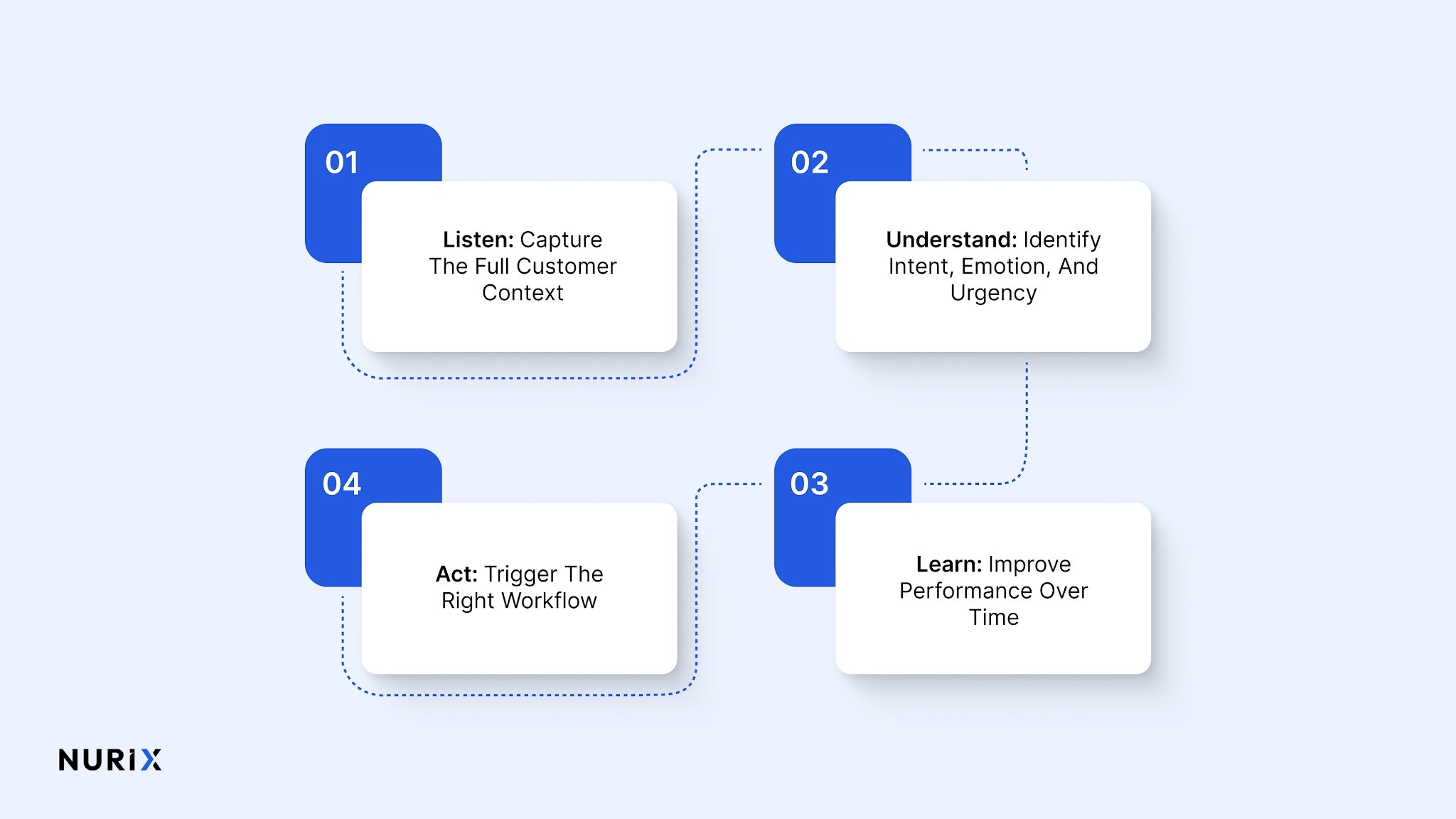
AI agents improve calls by turning each conversation into a clear sequence of understanding, decision-making, and action. For enterprise teams, this means calls do not just get answered; they get routed, resolved, escalated, or documented with the right context.
Here are the four steps in the intelligence-to-action loop:
Step 1: Listen: Capture the Full Customer Context
The AI agent first captures what the customer is saying. It not only records the words. It also collects useful context such as customer history, account details, previous tickets, language preference, and the channel used.
Step 2: Understand: Identify Intent, Emotion, and Urgency
Next, the AI agent identifies the customer's wants and the seriousness of the issue. It can detect intent, sentiment, repeated complaints, urgency, and possible escalation risk.
For example, a customer saying, “This is the third time I’ve called about my refund,” should not be treated like a routine status request. Call center intelligence helps your team identify that frustration early and decide whether the case needs priority handling.
Step 3: Act: Trigger the Right Workflow
Once the AI agent understands the request, it can take the next best action. This may include answering the question, updating a record, creating a ticket, booking an appointment, checking claim status, or routing the call to the right specialist.
This is where call center intelligence becomes more than analysis. In a BPO or insurance support center, for example, the AI agent can collect required details, validate the information, and hand off only complex cases to human agents, providing a full summary.
Step 4: Learn: Improve Performance Over Time
After the interaction, the AI agent helps your team learn from the conversation. It can create summaries, tag outcomes, track recurring issues, and highlight patterns across thousands of calls.
For leaders, this creates a feedback loop. You can see which call types are increasing, where customers get stuck, which workflows need improvement, and where agents need more support. Over time, your call center becomes faster, more consistent, and easier to scale.
Once you understand how call center intelligence turns conversations into action, the next step is to determine which capabilities your platform should have to support that at enterprise scale.
What Enterprise Teams Should Look for in Call Center Intelligence Software
The right call center intelligence software should help your team understand calls, take action, and improve performance across every interaction. It should also connect with your existing systems and protect sensitive customer data.
Here are the key factors to look for:
- Natural voice AI: The software should understand natural conversations, interruptions, accents, and customer intent. This helps customers avoid rigid menus and get faster, more human-like support.
- Deep system integrations: It should connect with your CRM, helpdesk, order systems, schedulers, and internal tools. This allows AI agents to check records, update tickets, and complete tasks during the call.
- Workflow orchestration: The platform should do more than show insights. It should trigger the right workflow, route tasks, escalate complex cases, and coordinate actions across teams and systems.
- Real-time monitoring: Your leaders should be able to track response time, resolution rate, escalation rate, and customer sentiment as conversations happen. This helps you spot issues early and improve operations faster.
- Security and governance: The software should support Personally Identifiable Information redaction, audit logs, role-based access control, single sign-on, and data retention controls. This is critical for regulated industries and enterprise-scale operations.
After identifying the right software capabilities, the next question is how an enterprise platform brings them together in real call center workflows.
Also Read: 10 Best AI Call Center Solutions in 2026 (Ranked & Tested)
How NuPlay by Nurix AI Helps Call Centers Act Faster
NuPlay by Nurix AI is an enterprise-grade voice and chat AI platform that unifies orchestration, integrations, observability, and security to automate sales, support, and knowledge-work workflows.
NuPlay by Nurix AI powers voice AI agents that deliver human-like conversations and automate support, sales, and operations without sacrificing trust or quality. This helps your customers speak naturally instead of struggling through rigid call flows.
For call centers, this means AI agents do more than answer questions. They can understand customer intent, pull the right context, trigger workflows, update systems, and escalate complex cases with full conversation history.
Key NuPlay Features That Help Call Centers Act Faster
- Multi-agent orchestration: We use a structured system of specialized agents, with a central orchestrator that assigns tasks, manages handoffs, and decides on escalations. This helps complex call center workflows stay accurate, fast, and coherent.
- Deep enterprise integrations: We integrate with CRMs, ticketing tools, and internal APIs, enabling voice agents to create tickets, update records, and trigger workflows. This is what turns call center intelligence from insight into action.
- NuPulse monitoring and insights: NuPulse gives your team visibility into agent performance, response time, containment, resolution rate, intent accuracy, and escalation frequency. It also flags performance dips and conversation anomalies before they become larger issues.
- NuRep brand voice intelligence: NuRep helps AI agents speak in your brand voice by learning from your website, help center, playbooks, and past interactions. It also lets teams adjust tone, formality, personality, and brand guidelines.
- Enterprise-grade security and compliance: We support security controls, including Personally Identifiable Information redaction, configurable data retention, audit trails, role-based access control, single sign-on, and regional data residency options. This is critical in regulated, high-volume enterprise environments.
With these capabilities, we help your call center move from fragmented call data to connected action. Your team can reduce manual work, improve routing, speed up resolutions, and deliver more consistent support at scale.
Conclusion
Call center intelligence helps enterprise teams move beyond call recordings, static dashboards, and manual follow-ups. It gives your team a better way to understand customer intent, detect urgency, route issues, support agents, and trigger the right workflows.
As global enterprises scale support across voice, chat, email, and languages, they need AI agents that can do more than just answer basic questions. NuPlay by Nurix AI helps teams build, deploy, monitor, and optimize human-like voice and chat agents for support, sales, and operations workflows, with integrations, analytics, security, and enterprise-grade orchestration built in.
Ready to turn customer conversations into action?
Schedule a custom demo to see how enterprise AI agents can help your call center act faster, scale smarter, and support customers with more consistency!