
How many customers are you losing because your support team cannot respond fast enough in their language?
As query volumes grow across regions, every delayed response can lead to frustration, missed revenue, or poor reviews. For retail, insurance, real estate, and BPO teams, language gaps increase escalations, stretch bilingual agents, and create inconsistent service quality.
This matters because CSA Research found that 76% of online shoppers prefer to buy products with information in their native language, while 40% will not buy from websites in other languages.
This blog explains how to create multilingual AI agents for customer service that understand intent, respond in the right language, connect with support systems, and resolve routine queries.
Executive Summary: Creating multilingual AI agents for customer service enhances customer experience by bridging language gaps. These agents can detect language, understand intent, and seamlessly interact in multiple languages, providing faster support and reducing operational costs. They integrate with backend systems to improve efficiency, enhance customer satisfaction, and maintain consistent service quality across regions, boosting brand trust and revenue.
TL;DR
- Language Gaps: High-volume support teams lose speed, consistency, and customer trust when they cannot respond in the customer’s preferred language.
- Beyond Translation: Multilingual AI agents do more than translate. They detect language, understand intent, keep context, and complete support tasks across voice, chat, and messaging channels.
- Enterprise Resolution: The best agents integrate with Customer Relationship Management (CRM), helpdesk, order, policy, and scheduling systems to resolve routine issues, not just answer questions.
- Controlled Rollout: Start with your top two or three high-volume languages, test with native speakers, localize the experience, and expand only when quality is stable.
- Continuous Improvement: Track performance by language, not just overall. Use metrics like containment, escalation rate, Customer Satisfaction Score (CSAT), failed queries, and handoff quality to improve over time.
What Is a Multilingual Customer Support AI Agent?
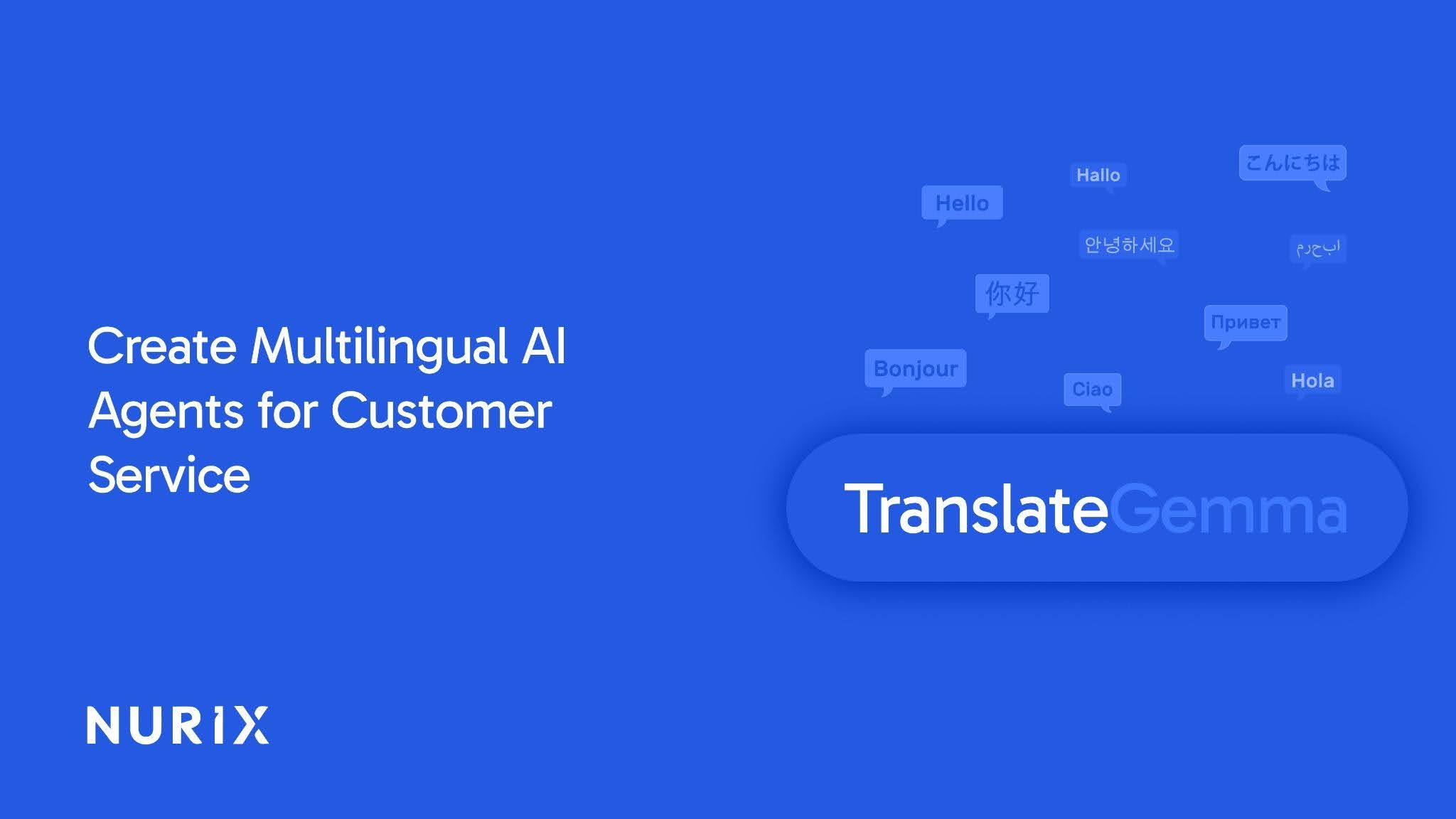
A multilingual customer support AI agent is an AI-powered service agent that can understand, respond, and take action in multiple languages. It helps your customers get support in the language they prefer, whether they contact you through voice, chat, or messaging channels.
For example, if your customer speaks Spanish, Arabic, Hindi, French, or German, the AI agent can adapt in real time. It helps you deliver support that feels faster, clearer, and more personal without depending only on limited bilingual agents.
To fully understand the impact of multilingual AI agents, it's important to recognize the key advantages they bring to customer service operations.
Also Read: The Magic Of Multilingual Models
What are the Benefits of Multilingual AI Agents for Customer Service?
Multilingual AI agents matter because they help you serve customers in the language they are most comfortable using. For high-volume enterprises, this means faster responses, fewer handoffs, lower support pressure, and a more consistent customer experience across regions.
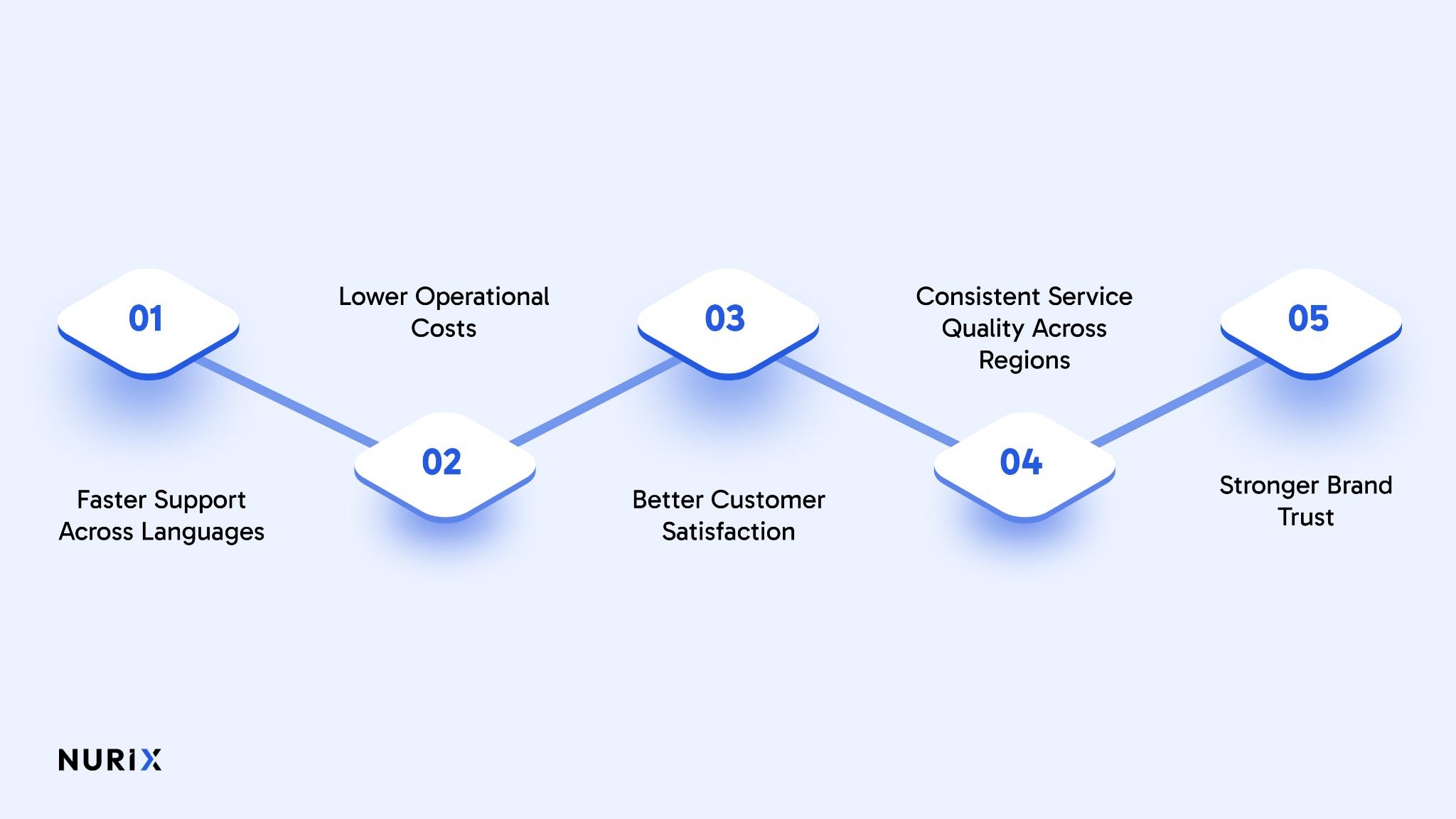
Here are the key benefits of using multilingual AI agents for customer service:
1. Faster Support Across Languages
When customers ask for help in Spanish, French, Hindi, Arabic, or any other language, they do not want to wait for the right agent to become available. A multilingual AI agent can respond instantly, understand the issue, and guide the customer to the next step.
For retail, insurance, real estate, and BPO teams, this helps reduce long queues, repeat calls, and delayed resolutions.
2. Lower Operational Costs
Hiring and managing separate language-specific support teams can become expensive as query volume grows. Multilingual AI agents help automate routine requests across languages, such as order tracking, claim updates, appointment booking, document status, and account changes.
This allows your human agents to focus on complex or high-value cases instead of repetitive questions.
3. Better Customer Satisfaction
Customers feel more confident when they can explain their issue in their preferred language. A multilingual AI agent can make support feel easier, clearer, and more personal.
This can improve Customer Satisfaction Score (CSAT), reduce frustration, and make customers more likely to stay with your brand.
4. Consistent Service Quality Across Regions
Without AI support, service quality may vary by language, location, or agent availability. One customer may get fast support in English, while another waits longer in Spanish or French.
Multilingual AI agents help you give consistent answers using approved company knowledge, policies, and workflows.
5. Stronger Brand Trust
Your customers judge your brand by how easy it is to get help. When you support them in their language, you show that your business is accessible, prepared, and customer-focused.
For enterprises expanding into new markets, multilingual AI agents can help build trust while keeping support operations scalable.
To fully understand how multilingual AI agents can enhance customer service, it's important to look at how these systems operate.
How Multilingual AI Agents Work
Multilingual AI agents work by detecting the customer’s language, understanding their intent, and responding naturally through voice, chat, or messaging channels. For high-volume enterprises, they also connect with CRM, ticketing, and knowledge systems to resolve issues, not just answer questions.
Here are the key steps behind how multilingual AI agents work:
1. Real-Time Language Detection
The agent detects the customer’s language from the first few words, without asking them to choose manually. It can also identify regional cues and mixed-language inputs such as Hinglish or Spanglish, making the support experience smoother.
2. Natural Language Understanding and Translation
After detecting the language, the agent uses Natural Language Understanding (NLU) to understand the customer’s intent, tone, and urgency. It avoids word-for-word translation and responds based on what the customer actually needs.
3. Response Generation in Text or Voice
The agent creates a clear response in the same language and delivers it through the right channel, such as live chat, voice calls, WhatsApp, email, or Interactive Voice Response (IVR). This helps customers get support in the channel they already prefer.
4. Context and Memory Retention
A multilingual AI agent remembers previous messages, actions taken, and unresolved issues during the conversation. So even if a customer switches languages or topics, the agent can continue without making them repeat everything.
5. CRM and Backend Integration
The agent connects with systems such as Customer Relationship Management (CRM), help desks, order management, policy databases, and scheduling tools. This allows it to check customer history, update records, create tickets, book appointments, or route cases in real time.
To ensure your multilingual AI agents deliver seamless and high-quality service, it’s essential to focus on key steps.
How to Build Effective Multilingual AI Agents for Better Customer Service
To build effective multilingual AI agents, you need more than a translation layer. You need the right platform, clear language rules, localized workflows, strong integrations, native-language testing, and ongoing monitoring by language.
For high-volume enterprises, the goal is not just to “reply in many languages.” The goal is to resolve customer issues faster, reduce manual handoffs, and deliver consistent support across every region.
Here are the key steps to build multilingual AI agents for better customer service:
Step 1: Choose a Platform Built for Multilingual Support
Not every chatbot or virtual assistant platform is ready for enterprise multilingual support. You need a platform that can manage language, intent, workflows, and integrations at scale.
Look for a platform that supports:
- Multiple languages for both input and output.
- Real-time language switching.
- Voice and chat support.
- Localized conversation flows.
- Natural Language Understanding (NLU).
- Integration with web, mobile, WhatsApp, Interactive Voice Response (IVR), and support tools.
- Security, audit logs, and Personally Identifiable Information (PII) controls.
For enterprise teams, this is where NuPlay by Nurix AI becomes valuable. NuPlay by Nurix AI is built for voice and chat AI agents that can support real customer service workflows, connect with business systems, monitor performance, and maintain enterprise-grade security. Instead of using a basic chatbot layer, you can build multilingual AI agents that are ready for high-volume, regulated, and customer-facing support operations.
Tip: Start with your top two or three customer languages. Prove quality, resolution rate, and customer satisfaction before expanding.
Step 2: Name Your AI Agent Carefully
Your AI agent’s name appears early in the customer experience. It affects trust, brand perception, and how natural the conversation feels.
Choose a name that is:
- Easy to pronounce across languages.
- Short and simple to spell.
- Culturally safe in your target markets.
- Easy to use in voice and chat.
- Aligned with your brand personality.
Avoid names like “Bot,” “Chatbot,” or “Assistant” if they feel generic or robotic in your markets. A simple name, such as “Alfred” or a purpose-based name like “Loan Advisor,” can feel more useful and human.
Before launch, check the name for slang, negative meanings, or pronunciation issues in every target language.
Step 3: Set Clear Language Instructions
Your AI agent needs clear instructions for handling multilingual conversations. These rules should define how the agent detects language, responds, switches language, and asks for clarification.
Your system instructions should explain:
- Customers may speak in their preferred language.
- The agent should reply in the same language.
- The agent should stay polite, clear, and brand-aligned.
- The agent should ask for language confirmation when unsure.
- The agent should handle mid-conversation language changes.
Example instruction:
“Customers may speak in English, Spanish, French, or German. Always respond in the customer’s language. If the language is unclear or changes during the conversation, politely confirm the preferred language before continuing.”
Test these instructions with real conversations before launch.
Step 4: Make Language Selection Easy
Even if your AI agent can detect language automatically, customers should still have an easy way to choose their preferred language.
Add quick-select options such as:
- EN
- ES
- FR
- DE
- PT
- AR
Once the customer selects a language, the agent should confirm the choice. For returning customers, the agent should remember the preferred language, subject to your privacy and data policies.
Step 5: Go Beyond Translation and Localize the Experience
Translation changes words. Localization adapts the full support experience to the customer’s region.
For enterprise customer service, localization should include:
- Local date formats.
- Currency formats.
- Address formats.
- Regional product names.
- Local policy wording.
- Formal or informal tone.
- Cultural expressions.
- Right-to-left text for languages like Arabic or Hebrew.
This is important for industries such as insurance, real estate, and financial services, where a minor wording issue can create confusion or compliance risk.
A good multilingual AI agent should not sound like a translated English script. It should sound natural for that market.
Step 6: Support Mid-Conversation Language Switching
Many customers switch languages during a conversation. This is common in multilingual regions and among customers who mix languages such as Hinglish, Spanglish, or Franglais.
Your AI agent should detect language per message, not just once at the start of the session.
Best practices include:
- Detecting language changes in real time.
- Confirming the preferred language when needed.
- Keeping the conversation context intact.
- Allowing the customer to switch back anytime.
This makes the experience smoother and prevents customers from repeating information.
Step 7: Train and Test With Native Speakers
AI models can understand many languages, but they can still miss slang, regional phrasing, tone, and cultural nuance.
Before launch, test your agent with native speakers from your target markets.
Ask testers to check:
- Common support questions.
- Local slang and idioms.
- Misspellings.
- Mixed-language inputs.
- Angry or urgent messages.
- Voice pronunciation.
- Accent handling.
- Policy-sensitive questions.
For high-volume support teams, this testing is critical. It helps you prevent poor responses before customers experience them.
Step 8: Support Accessibility and Regional Variants
A multilingual AI agent should work for different language variants, not just broad language labels.
For example:
- Portuguese in Brazil is different from Portuguese in Portugal.
- Spanish in Mexico may differ from Spanish in Spain.
- French in Canada may differ from French in France.
- Arabic may vary across regions.
Let customers choose regional variants when needed. This improves clarity, tone, and trust.
Also test accessibility across channels, including screen readers, voice interfaces, mobile chat, and messaging apps.
Step 9: Monitor, Measure, and Improve by Language
After launch, do not evaluate your multilingual AI agent with a single global performance score. Track each language separately.
Monitor:
- Language detection accuracy.
- Intent recognition accuracy.
- Containment rate.
- Escalation rate.
- Average handle time.
- Customer Satisfaction Score (CSAT).
- Failed queries.
- Low-confidence responses.
- Voice latency.
- Human handoff quality.
For example, your English agent may perform well, while your French or Arabic agent may need better coverage of knowledge. Language-level reporting helps you quickly find these gaps.
With tools like NuPulse, enterprise teams can monitor agent performance, review conversation quality, identify friction points, and continuously improve multilingual customer service.
While building multilingual AI agents, it's important to avoid certain common mistakes that can undermine their effectiveness.
Common Mistakes to Avoid When Building Multilingual AI Agents
Multilingual AI agents fail when treated as translation tools rather than as full customer service systems. For high-volume enterprises, poor language handling can increase escalations, delays, and support costs.
Here are the common mistakes to avoid when building multilingual AI agents:
- Launching Too Many Languages at Once: Do not launch all languages at once. Start with your top two or three high-volume languages, test performance, and then expand.
- Ignoring Regional Differences: Spanish in Mexico may differ from Spanish in Spain. Portuguese in Brazil may differ from Portuguese in Portugal. Your agent should support local tone, terms, and policies.
- Measuring All Languages Together: A global score can hide weak performance in one language. Track resolution rate, escalation rate, failed queries, and CSAT by language.
- Overlooking Security and Compliance: Your agent must handle Personally Identifiable Information (PII), consent, audit trails, and data retention rules correctly, especially in regulated industries.
To avoid these common pitfalls, it's essential to have the right platform and tools in place.
Also Read: Multilingual Sales Strategies to Boost Your Business
How NuPlay by Nurix AI Helps You Build Multilingual AI Agents for Customer Service
Building multilingual AI agents is not just about adding more languages to your support flow. You need agents that can understand customer intent, respond naturally, connect with your systems, resolve routine issues, and escalate complex cases with full context.
NuPlay by Nurix AI helps enterprises build voice and chat AI agents that support real customer service workflows. For high-volume teams in retail, insurance, real estate, and BPO, this means faster support, fewer handoffs, and more consistent service across regions.
Here is how NUplay helps high-volume support teams:
1. NuRep: Brand-Aligned Conversations Across Languages
NuRep helps your AI agents sound like your brand, not like a generic chatbot. It learns from your website, help center, playbooks, and past interactions to create an agent that matches your tone, style, and personality.
For multilingual customer service, this is important because whether a customer speaks English, Spanish, Arabic, Hindi, or French, the agent should stay polite, helpful, and aligned with your brand voice.
2. NuPulse: Monitor Performance by Language and Workflow
NuPulse gives your team visibility into how AI agents perform after launch. It tracks live metrics, including response time, containment, resolution rate, intent accuracy, and escalation frequency.
For enterprise support teams, this helps you avoid managing multilingual AI blindly. You can see which languages perform well, where customers get stuck, and which workflows need improvement.
3. Multi-Agent Orchestration: Handle Complex Support Workflows
Multi-Agent Orchestration enables multiple specialized AI agents to work together as a single system. NUplay uses a central orchestrator to assign tasks, manage handoffs, and keep the conversation coherent.
This is useful for multilingual customer service because one customer query can involve many steps. For example, one agent may detect the language, another may verify identity, another may check order status, and another may process a refund or escalate the case.
4. Security and Compliance: Protect Customer Data at Scale
Security and Compliance are critical when multilingual AI agents handle customer data across regions. NUplay’s enterprise security suite includes data protection, audit-ready governance, and granular control for voice AI operations.
For industries such as insurance, real estate, financial services, and BPO, this matters because customer conversations may include names, phone numbers, emails, account details, or payment information.
In short, NuPlay by Nurix AI helps you build multilingual AI agents that do more than answer in different languages. They can speak in your brand voice, complete complex workflows, monitor performance by language, and protect customer data across high-volume support operations.
Conclusion
Creating multilingual AI agents for customer service is not just about translating support conversations. It is about helping customers get faster, clearer, and more consistent support in the language they prefer. For high-volume enterprises, the right AI agent can detect language, understand intent, keep context, connect with business systems, and escalate complex cases when needed. When built well, multilingual AI agents reduce delays, lower support pressure, and improve customer experience across regions.
But how do you ensure your multilingual AI agents are accurate, brand-aligned, integrated with your systems, and ready for real enterprise support volumes?
NuPlay by Nurix AI is an enterprise-grade voice and chat AI platform built for support, sales, and workflow automation, with capabilities such as orchestration, integrations, observability, security, and brand-aligned voice intelligence. For multilingual customer service, this means you can move beyond basic translation and build AI agents that respond naturally, follow your workflows, monitor performance, and protect customer data at scale.
So, are you ready to support customers across languages without adding more complexity? Schedule a custom demo to see how AI agents can improve your customer service operations!