How many high-intent leads are slipping away before your sales team can respond?
In high-volume industries like retail, insurance, real estate, and BPO, every delayed reply can turn buyer interest into a lost pipeline. Research found that companies contacting leads within one hour were nearly 7x more likely to qualify them than those that waited even one hour longer. Teams that waited 24 hours or more were far less likely to qualify those leads, which makes slow follow-up a direct revenue risk.
This blog explains how conversational AI for lead capture helps enterprise teams engage prospects in real time, understand buyer intent, qualify leads, update customer relationship management systems, and route high-value opportunities to the right sales team faster.
Executive summary: Conversational AI for lead capture helps enterprise teams engage high-intent prospects faster, qualify them with better context, and route them to the right sales path. Instead of relying on static forms and delayed follow-ups, teams can use voice and chat AI agents to capture demand, update systems, book meetings, and reduce manual sales effort.
TL;DR
- Speed Matters: High-intent leads lose value when your team responds too late. Conversational AI helps you engage prospects when interest is active, not hours later.
- Forms Fail: Static forms collect basic details but often miss intent, urgency, and fit. Conversational AI turns lead capture into a guided conversation.
- Better Qualification: AI agents can ask adaptive questions, score leads, and separate serious buyers from low-fit inquiries before they reach sales.
- Workflow Connection: Lead capture should not stop at collecting information. The best systems update your CRM, route leads, book meetings, and automatically trigger follow-ups.
- Enterprise Control: For high-volume teams, conversational AI must support voice, chat, brand consistency, monitoring, security, and compliance at scale.
What Is Conversational AI?
Conversational AI is technology that lets people interact with software through natural voice or text conversations. It uses artificial intelligence to understand questions, detect intent, respond in context, and complete actions such as capturing lead details, qualifying interest, booking meetings, or updating a customer relationship management system.
For high-volume enterprise teams, conversational AI is more than a chatbot. It can help you manage thousands of inquiries, qualify leads faster, route them to the right team, and reduce manual follow-up across sales, support, and operations workflows.
That capability matters most when traditional lead capture systems start to fail.
Also Read: Top 10 Strategies Using AI for Insurance Lead Management
Why Traditional Lead Capture Breaks at Enterprise Scale
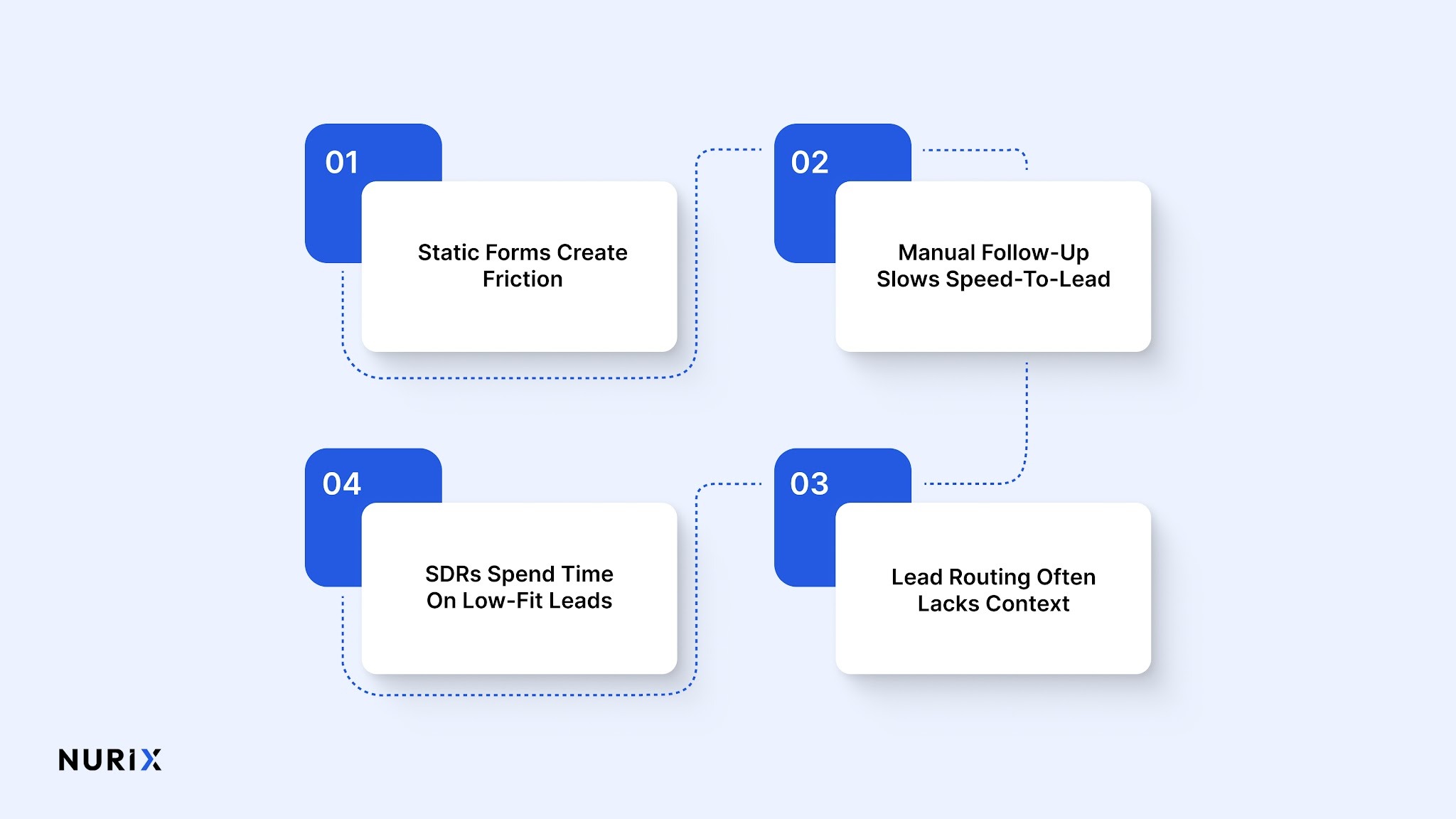
Traditional lead capture breaks when your inquiry volume grows faster than your team’s ability to respond, qualify, and route leads. At enterprise scale, slow forms, manual follow-ups, and disconnected systems can turn strong buyer intent into missed revenue.
Here are the reasons why traditional lead capture often fails for high-volume enterprise teams:
- Static Forms Create Friction: Long forms can make prospects drop off before they share details. Short forms may capture contact information, but they often miss intent, urgency, budget, and use case.
- Manual Follow-Up Slows Speed-to-Lead: Manual follow-up slows response times because sales reps spend nearly 60% of their time on non-selling tasks like data entry and lead research, according to Salesforce’s State of Sales report. That delay matters: InsideSales and MIT found leads contacted within 5 minutes are 21x more likely to qualify than those reached after 30 minutes. At scale, manual workflows make that speed hard to achieve.
- Lead Routing Often Lacks Context: A lead may enter your customer relationship management system, but without enough detail for the next action. This can send prospects to the wrong team, region, or sales queue.
- SDRs Spend Time on Low-Fit Leads: Sales development representatives often waste hours sorting through incomplete or low-intent inquiries. This leaves less time for qualified prospects who are ready for a real sales conversation.
Next, let’s look at how conversational AI helps enterprise teams capture, qualify, and convert leads more efficiently at scale.
Benefits of Conversational AI for Lead Capture
Conversational AI is important because it helps you engage leads the moment they show interest, instead of waiting for a manual follow-up. It also helps your team qualify, route, and act on leads faster across high-volume channels.
Here are the benefits of conversational AI for your lead-generation strategy:
1. It helps you respond to leads faster
In high-volume industries, your best leads may not wait for a callback or email. Conversational AI can engage them instantly when they visit your website, fill out a form, call your team, or respond to a campaign.
This helps you reduce missed opportunities and move interested buyers to the next step faster.
2. It captures better lead information
Collecting basic details is not enough for enterprise sales teams. Conversational AI can ask relevant follow-up questions about budget, urgency, company size, location, use case, and buying intent.
This gives your sales team better context before they make contact.
3. It qualifies leads before they reach sales
Not every inquiry is ready for a sales conversation. Some leads need education, some need support, and some are ready to buy.
Conversational AI can identify high-intent leads, separate them from low-fit inquiries, and send only qualified opportunities to your sales team. This helps sales representatives spend more time on prospects that are more likely to convert. In fact, automated chat qualification workflows can reduce lead qualification time by 61%, while 64% of businesses using AI chatbots report an increase in qualified leads—meaning sales teams get not just more leads, but better-fit opportunities.
4. It routes leads to the right team
In retail, insurance, real estate, and BPO, one wrong handoff can delay the entire sales process. A lead may need a sales rep, a support agent, a regional team, or a specialist.
Conversational AI can use the prospect’s answers to route them to the right team, location, product line, or workflow. This reduces manual sorting and improves the buyer experience.
How do you route complex leads without losing context?
This is where multi-agent orchestration can help. Instead of relying on one general AI agent to handle everything, we use specialized agents with a central orchestrator to assign tasks, manage handoffs, and keep the conversation coherent.
5. It keeps lead capture running 24/7
High-volume enterprises cannot depend only on business-hour follow-up. Leads may come in after hours, during peak seasons, or across different time zones.
Conversational AI provides an always-on lead-capture layer. It can answer initial questions, collect details, qualify interest, and trigger follow-up even when your sales team is offline.
Once the benefits are clear, the next step is understanding how conversational AI moves a prospect from the first interaction to a qualified sales opportunity.
How Conversational AI Turns Interest Into Qualified Lead
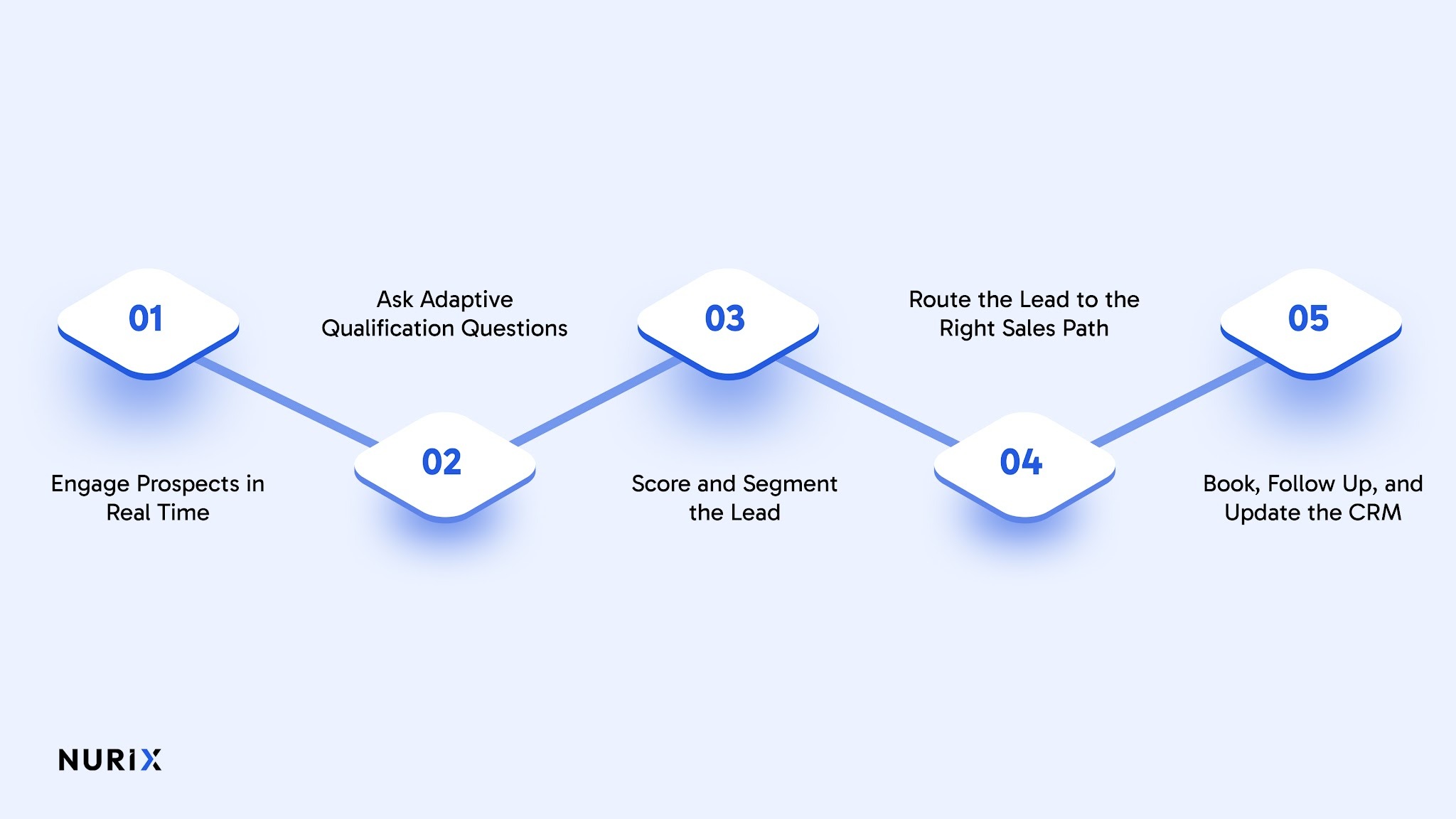
Conversational AI turns buyer interest into a qualified lead by moving prospects through a clear, automated sales workflow. It captures intent, checks fit, assigns priority, and sends the lead to the right next step.
Here is how conversational AI for lead capture works in enterprise sales teams:
Step 1: Engage Prospects in Real Time
The AI agent starts the conversation when a prospect visits a key page, calls your business, responds to a campaign, or requests information. This helps your team act while the buyer is still interested.
Step 2: Ask Adaptive Qualification Questions
The AI asks questions based on the prospect’s answers, not a fixed script. It can check use case, company size, location, timeline, buying role, and service need without making the conversation feel like a long form.
Step 3: Score and Segment the Lead
The AI uses the captured details to rank the lead by fit, urgency, and buying intent. This helps your team separate high-value opportunities from general inquiries.
Step 4: Route the Lead to the Right Sales Path
The AI sends each lead to the correct workflow, sales queue, region, product team, or nurture path. This reduces delays and helps enterprise teams handle large inquiry volumes with more control.
Step 5: Book, Follow Up, and Update the CRM
The AI can schedule meetings, send confirmations, trigger follow-up tasks, and update the customer relationship management system. This gives your sales team a cleaner record and better context before the first conversation.
To make that workflow reliable at scale, your team needs the right best practices.
Best Practices to Optimize Conversational AI for Lead Capture
Conversational AI works best when it is designed as a full lead-capture workflow, not just a chat box on your website. For high-volume enterprise teams, this means your AI should engage prospects across chat and voice, qualify them in real time, connect with your systems, and hand off high-value leads with full context.
Here are the best practices to make conversational AI for lead capture:
1. Train the AI on Your Business, Products, and Sales Rules
Your conversational AI should understand your products, services, pricing logic, service locations, buyer personas, and qualification criteria. If you work in insurance, real estate, retail, or BPO, the AI should know the common questions prospects ask before they convert.
For example, an insurance lead may ask about policy options, while a real estate lead may ask about location, budget, or availability. A trained AI agent can respond with relevant answers and collect the right details without needing a human agent for every first-touch conversation.
This also helps your AI stay aligned with your brand voice. The responses should feel helpful, clear, and professional, not robotic or generic.
2. Use AI Voice Agents for High-Intent Phone Leads
Many enterprise leads still come through phone calls. If those calls go unanswered, stay on hold too long, or reach the wrong department, you may lose a high-intent prospect.
AI voice agents can answer inbound calls, greet prospects naturally, understand why they are calling, and capture key details such as name, location, need, budget, timeline, and preferred callback time.
This is especially useful during peak hours, after-hours inquiries, campaign spikes, or seasonal demand. Instead of letting calls go to voicemail, you can keep lead capture active even when your human team is busy.
3. Design Conversations Around Buyer Intent, Not Scripts
A strong conversational AI flow should not feel like a fixed script. It should adapt based on what the prospect says.
For example, if a prospect says they are comparing vendors, the AI can ask about their current challenge and timeline. If they say they need pricing, the AI can collect company size, use case, and buying role before routing them to sales.
This makes the experience feel more natural for the buyer and more useful for your sales team. You get better lead data without making the conversation feel long or difficult.
4. Keep Questions Short and Progressive
Do not ask everything at once. Long forms already create friction, and long AI conversations can create the same problem.
A better approach is to collect information step by step. Start with the prospect’s need, then ask for details that help your team qualify and route the lead.
For example:
- What are you looking for help with?
- Which location or region are you interested in?
- How soon do you need a solution?
- Are you exploring this for yourself or your company?
- Would you like to speak with a specialist?
This keeps the conversation simple while still collecting useful information.
5. Personalize Responses by Industry and Use Case
Your enterprise prospects may come from different industries. Conversational AI should adjust its responses based on the prospect’s industry, use case, and intent. This helps the buyer feel understood and helps your team capture more accurate context.
Personalization should not be limited to using the prospect’s name. It should mean guiding them toward the most relevant next step based on their needs.
6. Connect Conversational AI With Your CRM and Sales Workflows
Lead capture is incomplete if the information stays inside a chat or call transcript. Your AI should push structured data into your customer relationship management system, sales engagement tool, calendar, or routing workflow.
For example, after a conversation, the AI can update fields such as:
- Lead source
- Industry
- Region
- Company size
- Product interest
- Urgency
- Budget range
- Qualification status
- Preferred follow-up channel
This gives your sales team a cleaner record and reduces manual data entry. It also helps Revenue Operations teams track lead quality, routing accuracy, and campaign performance.
7. Build Smooth Human Handoffs
Conversational AI should not block prospects from reaching a human when needed. In enterprise sales, complex questions often require a sales representative, a product expert, a regional manager, or a support specialist.
A smooth handoff should include the full conversation history, qualification answers, lead score, and recommended next step. This prevents the prospect from repeating the same information and helps your team continue the conversation with context.
8. Use AI to Book Meetings and Trigger Follow-Ups
Once a lead is qualified, the next step should happen immediately. Conversational AI can help by checking calendar availability, booking meetings, sending confirmations, and triggering follow-up emails or tasks.
This reduces the gap between interest and action. It also helps sales development representatives avoid repetitive scheduling work, so they can focus on serious buyer conversations.
9. Monitor Conversation Quality and Drop-Off Points
You should not launch conversational AI and leave it untouched. Enterprise teams need ongoing visibility into how conversations perform.
Track metrics such as:
- Engagement rate.
- Lead capture rate.
- Qualified lead rate.
- Drop-off points.
- Meeting booking rate.
- Response time.
These insights help you see where prospects lose interest, which questions create friction, and which flows produce the best leads.
But how do you identify where leads drop off or which conversations actually drive a qualified pipeline?
This is where NuPulse helps. NuPulse gives enterprise teams visibility into AI agent performance through dashboards, conversational analytics, smart alerts, and conversation logs. You can monitor metrics such as response time, escalation frequency, intent accuracy, lead quality, and operational efficiency to identify friction points and continuously improve lead-capture performance.
10. Keep Security, Privacy, and Compliance Built In
High-volume enterprises often handle sensitive customer and prospect data. Your conversational AI should support secure data handling from the start.
This means your system should be able to protect Personally Identifiable Information, control who can access conversation data, maintain audit trails, and follow your data retention policies.
Even with strong best practices, a few setup mistakes can reduce lead quality.
Common Mistakes to Avoid With Conversational AI
Conversational AI can improve lead capture only when it supports real sales decisions, not just surface-level conversations. If the setup is too generic, your team may capture more inquiries but still miss the leads that matter.
Here are the common mistakes to avoid when using conversational AI for lead capture:
- Measuring Volume Instead of Lead Quality: More captured leads do not always mean a better pipeline. Track how many leads become sales-qualified leads, booked meetings, and accepted opportunities.
- Treating Every Inquiry the Same: A pricing-page visitor, a policy inquiry, a property buyer, and a BPO prospect may need different paths. If every lead gets the same flow, your team may miss urgency, fit, or buying intent.
- Letting the AI Give Unverified Answers: In enterprise sales, wrong answers can damage trust. Keep responses grounded in approved product, pricing, service, and policy information.
- Making Escalation Too Late: Some prospects should reach a human quickly, especially high-value accounts or complex enterprise buyers. If escalation happens too late, strong leads may drop off.
- Ignoring Compliance and Data Controls: High-volume teams often collect sensitive information through forms, calls, and chats. Make sure the AI follows clear rules for Personally Identifiable Information, consent, access, and data retention.
Avoiding these mistakes is easier when your conversational AI platform is built for enterprise workflows.
Also Read: 5 Powerful Ways Automated Lead Qualification AI Works in FSI
How NuPlay by Nurix AI Supports Conversational AI for Lead Capture
NuPlay by Nurix AI builds voice and chat AI agents that can manage real conversations, not just scripted responses. Our agents are designed for real-time speech, long conversations, interruptions, retries, and multi-step interactions, which makes us useful for capturing leads.
Key features that support conversational AI for lead capture include:
1. Brand-Aligned Conversations With NuRep
Lead capture is also a brand experience. If the AI sounds generic or robotic, prospects may lose trust before they reach sales.
NuRep helps AI agents speak in your brand voice by learning from your website, help center, playbooks, and past interactions. Your team can also define tone, formality, personality, language preferences, and brand guidelines.
2. CRM and Workflow Integrations
NuPlay by Nurix AI connects conversations with your customer relationship management system, ticketing tools, calendars, and internal workflows. This helps agents update records, create tasks, trigger follow-ups, and route leads without manual data entry.
For sales teams, this means cleaner lead records and stronger handoffs with the context already captured.
3. Multi-Agent Orchestration for Complex Lead Journeys
Enterprise lead capture often involves several steps, such as answering pricing questions, checking location, qualifying intent, and routing to a specialist.
Our multi-agent orchestration uses specialized agents and a central orchestrator to manage these tasks. This keeps conversations coherent while improving qualification, routing, and handling of complex inquiries.
4. NuPulse for Monitoring and Optimization
NuPulse gives your team visibility into how AI agents perform across conversations. You can track response time, containment, resolution rate, intent accuracy, escalation frequency, drop-offs, and conversation patterns.
For CROs, Revenue Operations, and enterprise leaders, this helps identify which conversations turn into qualified opportunities and where the lead-capture flow needs improvement.
5. Secure Handling of Enterprise Data
High-volume enterprises often collect sensitive prospect data across calls, chats, and forms. We support enterprise-grade security and compliance features such as Personally Identifiable Information redaction, configurable data retention, audit trails, role-based access control, single sign-on, and data residency options.
This helps industries like insurance, financial services, real estate, and BPO keep lead capture fast, controlled, and audit-ready.
Conclusion
Conversational AI for lead capture helps enterprise teams move faster when buyer intent is highest. Instead of relying on static forms, delayed callbacks, or manual qualification, you can engage prospects in real time, understand their needs, and route them to the right next step. For high-volume industries, this means fewer missed leads, cleaner sales handoffs, and better visibility into what drives qualified pipeline.
NuPlay by Nurix AI helps enterprises build voice and chat AI agents that support real lead-capture workflows, not just scripted conversations. Our platform is designed for human-like conversations across sales, support, and operations, with capabilities including low-latency voice, long-conversation handling, CRM integrations, workflow automation, analytics, and enterprise-grade security.
So, why wait? Schedule a custom demo to see how we can help your team capture, qualify, and route leads faster!