Why are some revenue teams closing deals faster while others struggle with stalled pipelines and slow prospect response times? The shift toward AI sales is one major reason. The market is projected to reach USD 10.75 billion by 2032 as enterprises adopt intelligent automation across revenue operations.
Platforms like NuPlay, the enterprise conversational AI platform, are helping sales teams operationalize AI through conversational voice agents that automate prospect engagement and qualification. Today, AI sales systems interpret engagement activity, automate outreach, and guide sellers with real-time insights that improve pipeline velocity.
In this blog, you will learn how AI sales works, key use cases driving adoption, and how organizations implement it to improve revenue performance.
What Is AI in Sales?
AI in sales refers to the use of Artificial Intelligence technologies such as Machine Learning (ML), Natural Language Processing (NLP), and Large Language Models (LLMs) to automate prospecting, analyze buyer signals, and guide revenue teams across the pipeline.
Top AI Sales Use Cases (Quick Overview)
These use cases show where AI delivers immediate impact across the sales cycle.
- Predictive lead scoring
- Automated account research
- AI-powered outreach
- Conversation intelligence
- Revenue forecasting
Key Takeaways
- Data-Driven Revenue Execution: AI sales replaces manual pipeline management with Machine Learning (ML), Natural Language Processing (NLP), and Large Language Models (LLMs) that surface prospect behavior patterns and guide decisions.
- Core AI Sales Capabilities: Predictive lead scoring, conversation intelligence, generative outreach, agentic automation, and AI-driven forecasting help revenue teams identify high-value opportunities.
- Operational Productivity Gains: Automation updates Customer Relationship Management (CRM) records, schedules follow-ups, and captures call insights, reducing administrative workload for sellers.
- Conversational Sales Intelligence: Voice AI agents and real-time assistants analyze conversations, detect sentiment, recommend responses, and document interactions.
- Autonomous Revenue Infrastructure: Agentic AI systems increasingly coordinate prospect research, outreach, forecasting, and workflow execution across enterprise sales platforms.
Why AI Is Transforming Modern Sales Operations
AI is transforming sales operations by shifting teams from manual pipeline management to data-driven execution. Using ML, NLP, and GenAI, systems analyze CRM data and buyer signals to automate administrative tasks, prioritize leads, and increase seller capacity for revenue-generating interactions.
- Administrative Workflow Automation: AI engines automatically capture call notes, update CRM records, and schedule follow-ups, eliminating manual data entry from seller workflows.
- Predictive Opportunity Prioritization: ML models evaluate engagement signals, account attributes, and deal history to identify prospects most likely to progress through the revenue pipeline.
- AI-Driven Account Intelligence: NLP systems analyze earnings calls, press releases, and industry reports to generate structured insights before sales meetings.
- Real-Time Conversation Guidance: Conversational AI analyzes live call transcripts and surfaces objection-handling prompts, competitive positioning, and next-best-action recommendations.
- Adaptive Revenue Forecasting: Predictive analytics continuously update pipeline forecasts by combining historical conversion patterns with real-time engagement activity across accounts.
AI transforms sales operations into intelligence-driven revenue systems, where algorithms continuously detect buyer intent, automate operational work, and guide sellers toward faster deal progression and stronger pipeline outcomes.
5 Key AI Sales Use Cases Driving Modern Revenue Teams
.jpg)
AI sales tools support multiple stages of the revenue lifecycle, from prospect discovery to pipeline forecasting. By combining ML, NLP, and GenAI, these systems automate prospect research, personalize outreach, analyze sales conversations, and improve forecasting accuracy across enterprise CRM environments.
1. Predictive Lead Scoring
ML models analyze CRM records, digital engagement signals, and historical opportunity data to rank prospects by conversion probability before sellers initiate outreach.
Predictive lead scoring systems deliver operational advantages across pipeline prioritization and account targeting.
- Conversion Probability Modeling: ML models evaluate engagement frequency, website activity, and historical pipeline behavior to calculate probability-to-purchase scores for each account record.
- Sales Pipeline Prioritization: AI scoring engines rank opportunities within CRM platforms so sellers focus on prospects demonstrating verified intent signals.
- Dynamic Lead Qualification: Predictive models automatically adjust prospect rankings when engagement signals change, allowing revenue teams to respond immediately to shifting buying behavior.
2. Automated Account Research
AI research agents aggregate and summarize account intelligence from earnings reports, industry databases, and web sources to prepare sellers with structured insights before prospect conversations.
Automated account research capabilities improve sales preparation and contextual engagement with enterprise buyers.
- Automated Account Profiling: NLP systems analyze corporate filings, press releases, and social signals to generate structured summaries of company priorities and market positioning.
- Stakeholder Intelligence Extraction: AI identifies decision-makers, reporting structures, and recent organizational changes from public data sources and CRM records.
- Meeting Preparation Automation: AI systems generate account briefings highlighting industry trends, technology adoption signals, and competitive context before seller interactions.
3. AI-Powered Sales Outreach
GenAI systems produce personalized outreach sequences across email, messaging platforms, and social channels using account-level context and prospect engagement signals.
AI-powered outreach platforms improve prospect engagement through contextual messaging and automated communication workflows.
- Personalized Outreach Generation: LLMs produce targeted prospecting emails referencing company initiatives, technology investments, and competitive positioning.
- Proposal Draft Automation: GenAI systems assemble customized proposals combining product capabilities, pricing frameworks, and relevant case studies.
- Sales Messaging Optimization: AI analyzes historical conversion patterns to recommend language variations that improve response rates across outbound communications.
4. Real-Time Sales Conversation Intelligence
Conversation intelligence platforms use NLP to analyze live or recorded sales calls, extracting insights that help sellers improve communication effectiveness.
Conversation intelligence capabilities improve seller performance during customer interactions and post-call analysis.
- Call Transcript Analysis: NLP models convert recorded conversations into searchable transcripts while identifying buying signals, objections, and product interest.
- Customer Sentiment Detection: AI analyzes language patterns, tone indicators, and conversational cues to determine prospect sentiment during sales discussions.
- Deal Risk Identification: Conversation intelligence systems flag stalled opportunities by detecting hesitation signals or unresolved objections within call transcripts.
5. AI-Driven Revenue Forecasting
Predictive analytics tools combine pipeline activity, engagement metrics, and past conversion patterns to generate more reliable revenue forecasts for sales leadership.
Revenue forecasting systems improve strategic planning and pipeline visibility across sales organizations.
- Pipeline Health Modeling: ML algorithms analyze deal stage progression, engagement frequency, and account activity to estimate pipeline reliability.
- Revenue Projection Automation: AI forecasting engines generate rolling revenue estimates by combining historical deal closure patterns with current pipeline activity.
- Deal Velocity Analysis: Predictive models measure average progression time between sales stages to identify bottlenecks slowing revenue conversion.
AI is reshaping sales execution by embedding predictive insights, automation, and conversational intelligence into daily revenue workflows, so teams can scale selling capacity and pipeline performance at the same time.
Discover how NuPlay powers over 799,000 monthly conversations, enabling enterprises to reduce cost per interaction by up to 50% with integrated orchestration and monitoring.
How Do AI Voice Agents Automate AI Sales?
AI voice agents combine conversational AI and Agentic AI (autonomous decision systems) to execute sales conversations, qualify prospects, and update CRM records through natural voice interaction.
Operational capabilities allowing AI voice automation across enterprise sales environments include the following technical functions.
- Speech-To-Intent Recognition: Automatic Speech Recognition (ASR) converts spoken customer input into structured text while NLP extracts intent signals for sales workflow execution.
- Autonomous Sales Task Execution: Agentic AI systems trigger actions such as meeting scheduling, opportunity creation, and CRM record updates after detecting buyer intent.
- Conversational Workflow Orchestration: Voice agents coordinate actions across CRM platforms, calendars, and messaging systems to complete multi-step sales workflows.
- Real-Time Conversation Synthesis: GenAI models generate natural spoken responses aligned with conversation context instead of relying on rigid decision-tree scripts.
- Multi-System Data Synchronization: AI integrations synchronize call insights, qualification data, and meeting outcomes across enterprise sales infrastructure without manual data entry.
AI voice agents transform sales automation by allowing spoken interaction with enterprise revenue systems. Teams can qualify leads, schedule meetings, and update workflows directly through conversational AI.
If you want to explore the platforms shaping modern revenue workflows, read our detailed guide on 7 Best AI Tools for Sales Enablement in 2026
How Real-Time AI Assistants Improve AI Sales Conversations
Real-time AI assistants monitor live conversations, analyze spoken buyer signals, and generate contextual recommendations using GenAI and LLMs to improve deal progression.
Operational capabilities allowing real-time guidance during enterprise AI sales conversations include the following functions.
- Live Objection Intelligence: NLP analyzes spoken objections and generates recommended responses using LLMs aligned with predefined sales playbooks.
- Dynamic Next-Action Guidance: AI systems evaluate CRM deal history and engagement signals to suggest next-best-action recommendations during active sales conversations.
- Real-Time Sentiment Detection: Speech analytics engines monitor tone, pacing, and keyword signals through Automatic Speech Recognition (ASR) to detect buyer hesitation or dissatisfaction instantly.
- Contextual Knowledge Retrieval: GenAI retrieves product specifications, pricing frameworks, and competitive positioning from internal knowledge bases during live discussions.
- Automated Conversation Documentation: AI assistants convert conversation transcripts into structured summaries and update CRM records with action items and deal insights.
Real-time AI assistants improve AI sales conversations by delivering live guidance, extracting buyer signals, and automating conversation documentation, allowing revenue teams to execute higher-quality interactions and accelerate deal progression.
AI Sales Agents vs Traditional Sales Tools
AI sales agents transform revenue systems from passive data repositories into autonomous execution layers powered by ML, LLMs, and Agentic AI. Unlike traditional CRM tools that store pipeline data, AI agents analyze signals, recommend actions, and execute revenue tasks automatically.
.png)
AI sales agents combine predictive intelligence, workflow automation, and conversational interfaces to execute revenue tasks autonomously, allowing sales teams to scale prospect engagement beyond the limitations of traditional tools.
For a deeper look at how automation platforms are evolving across revenue teams, explore Understanding AI in Sales Automation: Tools and Future Perspective
Measuring the ROI of AI in Sales Operations
AI in sales delivers measurable returns through improved conversion rates, forecasting accuracy, productivity, and cost control when predictive analytics, automation, and generative AI are applied across revenue operations.
AI in sales delivers consistent, measurable ROI by aligning revenue growth, operational productivity, and cost control into a unified, data-driven sales execution model.
How to Implement AI in Sales Workflows
AI adoption in sales requires structured deployment across data infrastructure, workflow orchestration, and governance. Successful implementations integrate ML and LLMs with CRM and revenue systems while redesigning workflows for automation readiness and scalable sales execution.
- Executive Alignment And Governance: Establish leadership ownership while defining data governance policies for AI systems accessing CRM, call transcripts, and prospect engagement datasets.
- Sales Workflow Decomposition: Map every pipeline action from lead creation to opportunity closure to identify manual handoffs, duplicate data entry points, and process latency within sales operations.
- Unified Revenue Data Layer: Consolidate fragmented sales datasets across CRM, marketing automation platforms, and communication tools to create structured training inputs for ML models.
- High-Impact Use Case Prioritization: Deploy AI first in revenue stages generating the largest operational drag, such as lead qualification, account intelligence research, and pipeline forecasting.
- Pilot Deployment And Iteration: Launch controlled pilots integrating GenAI assistants and predictive models, then refine performance using pipeline metrics such as deal velocity and conversion progression.
Successful AI deployment in sales workflows requires executive sponsorship, structured data architecture, targeted pilot programs, and continuous optimization of Machine Learning models embedded within revenue systems.
To see how AI improves prospect discovery, outreach precision, and pipeline development, check out 8 Proven Benefits of AI for Sales Prospecting Teams
Future Trends in AI Sales
AI in sales is growing from basic automation to autonomous revenue orchestration powered by ML, LLMs, and Agentic AI. These systems analyze engagement signals, automate workflows, and coordinate revenue operations across CRM and marketing platforms to improve pipeline execution and decision accuracy.
- Agentic Revenue Systems: Agentic AI platforms autonomously plan and execute prospecting, outreach, and qualification workflows using goal-driven reasoning instead of static automation rules.
- Multi-Agent Sales Orchestration: Coordinated AI agents handle specialized functions such as prospect research, conversation analysis, and revenue forecasting within integrated multi-agent decision systems.
- Conversational Revenue Interfaces: Conversational AI powered by LLMs allows sellers to control revenue systems using natural language voice or text commands.
- Predictive Revenue Intelligence: ML models continuously analyze engagement patterns across CRM activity streams to identify emerging pipeline opportunities.
- AI-Native Revenue Operations: Revenue Operations (RevOps) teams deploy AI to coordinate forecasting models, automation workflows, and data governance across sales infrastructure.
Future AI sales systems will function as autonomous revenue infrastructure, coordinating prospect engagement, forecasting intelligence, and workflow execution across enterprise platforms without requiring continuous human supervision.
Why NuPlay Powers Enterprise AI Sales
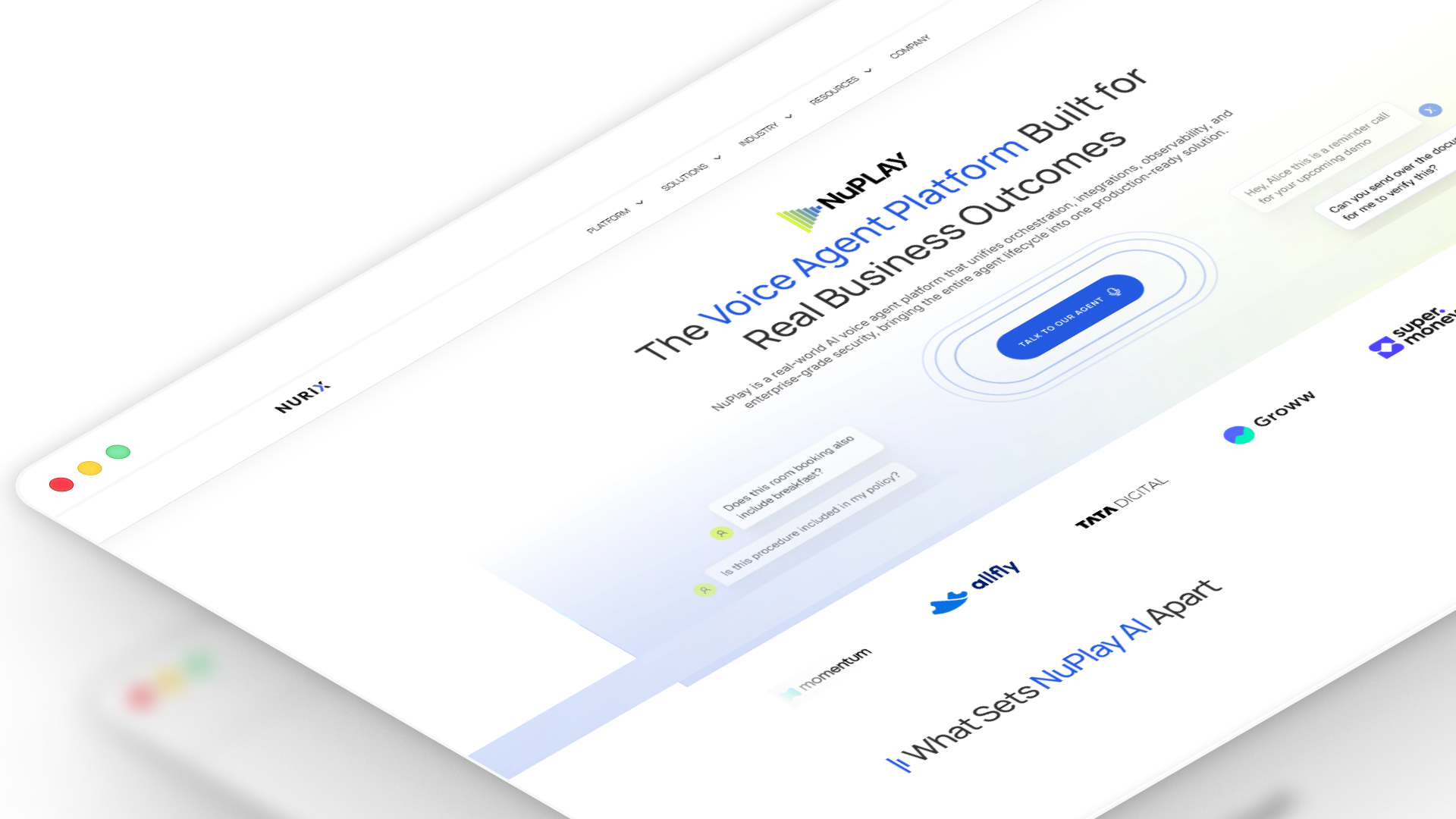
NuPlay, the enterprise conversational AI platform, enables sub-800ms latency voice agents, combines conversational AI, ASR, and LLMs to execute high-volume sales interactions, capture buyer intent, and synchronize insights directly with CRM platforms.
Enterprise sales teams deploy NuPlay voice agents across multiple pipeline stages to improve lead qualification accuracy, accelerate prospect engagement, and scale pipeline coverage without expanding sales headcount.
- Conversational Lead Qualification: AI voice agents capture prospect intent through natural dialogue and apply qualification frameworks before routing Sales Qualified Leads (SQLs) into CRM workflows.
- AI Sales Concierge: Conversational Artificial Intelligence agents assist buyers during product discovery, answer complex queries, and recommend relevant solutions using contextual knowledge base retrieval.
- Autonomous SDR Outreach: AI agents initiate outbound prospecting calls, collect prospect intelligence through conversational data capture, and automatically update CRM records.
- Dynamic Pipeline Engagement: Voice agents maintain continuous engagement with prospects through follow-ups, meeting scheduling, and qualification workflows integrated with sales automation systems.
- Enterprise Sales Infrastructure Integration: NuPlay connects with CRM, calendar systems, and product databases to synchronize sales conversations with revenue operations platforms.
In Short, AI sales platforms use ML, NLP, and LLMs to automate prospecting, lead qualification, and revenue forecasting. Systems like NuPlay allow real-time conversational sales workflows that increase pipeline velocity and reduce manual operational work.
Conclusion
AI helps revenue teams turn raw sales data into clear actions that move deals forward. Organizations adopting AI sales gain clearer pipeline visibility and improved execution across revenue workflows. As adoption grows, AI sales will increasingly support faster decisions, smarter engagement strategies, and more predictable revenue performance across enterprise sales operations.
Ready to turn strategy into execution? Platforms like NuPlay help revenue teams operationalize conversational automation through voice and chat systems designed for enterprise-scale interactions. If you are planning the next phase of AI-driven revenue operations, start by exploring how conversational automation can support your sales workflows.
Discover how NuPlay powers the next generation of AI sales systems. Schedule a demo!
Author: Sakshi Batavia — Marketing Manager
Sakshi Batavia is a marketing manager focused on AI and automation. She writes about conversational AI, voice agents, and enterprise technologies that help businesses improve customer engagement and operational efficiency.