
“Will this arrive before Friday?” “Can I return it if the size is wrong?” “Do my loyalty points apply here?” A shopper can be ready to buy and still leave if those questions are not answered in time. The National Retail Federation found that 71% of consumers are less likely to shop with a retailer again after a poor returns experience.
In this blog, you will learn how conversational AI in retail helps reduce that friction across discovery, checkout, post-purchase support, and cross-channel journeys, what makes it different from standard chatbots, and how enterprise teams should evaluate platforms for real retail workflows.
Executive Summary 2026: Retail teams are using conversational AI to reduce friction where customers hesitate, switch channels, or create repeat service demand, especially across product comparison, checkout, order support, returns, and loyalty workflows.
Stronger platforms stand out by handling live retail data, preserving context across channels, supporting measurable rollout, and giving enterprise teams the control to monitor performance, manage escalation, and scale automation safely.
Key Takeaways
- Live Retail Context: Conversational AI in retail works when Automatic Speech Recognition (ASR) and Natural Language Understanding (NLU) are tied to live retail data, not static question-and-answer scripts.
- High-Impact Starting Points: The best early use cases sit at measurable friction points, such as product comparison, checkout hesitation, returns screening, and order-status queries, where impact is easier to prove.
- Beyond Basic Chatbots: Retail teams outgrow basic chatbots when they need orchestration across channels, persistent context, and task execution inside Customer Relationship Management, order, inventory, and support systems.
- Stronger Platform Evaluation: Platform evaluation should focus on integration depth, workflow control, context retention, analytics, and escalation design, because demo quality rarely predicts production performance.
- Operational Retail Infrastructure: NuPlay positions retail conversational AI as operational infrastructure, combining multi-agent orchestration, NuPulse monitoring, and enterprise controls to automate workflows with measurable visibility after launch.
What Is Conversational AI for Retail?
Conversational AI for retail is a customer and employee interaction layer that uses Natural Language Processing, machine learning, and voice recognition to understand intent, retrieve live business data, and complete tasks through chat or speech across shopping, service, and store operations.
Why Retail Teams Are Investing in Conversational AI
Retail teams are investing in conversational AI because digital retail volume keeps rising, returns create heavy service pressure, and customer experience now affects repeat purchase risk. In the United States, this investment is tied to practical retail workloads such as order support, returns handling, and always-on customer interaction across digital channels.
Retail adoption is rising because operating pressure is increasing across commerce, service, and post-purchase workflows.
- Digital Sales Scale: U.S. e-commerce sales reached $1,233.7 billion in 2025, increasing the volume of digital customer interactions retailers must manage.
- Online Share Growth: E-commerce accounted for 16.4% of total U.S. retail sales in 2025, making digital service quality more central to retail performance.
- Returns Workload: Retailers estimate that 15.8% of annual sales will be returned in 2025, totaling $849.9 billion.
- Online Returns Pressure: NRF estimates that 19.3% of online sales will be returned in 2025, increasing the load on refund, exchange, and order-resolution teams.
Retail teams are investing because conversational AI helps manage rising digital demand and returns-related service pressure with more consistent response quality and lower manual effort.
As retail teams weigh where AI can create the clearest business impact, it is also worth seeing how enterprise buying is shifting around AI agents in How AI Agents are changing Sales Forever
Top Use Cases of Conversational AI for Retail
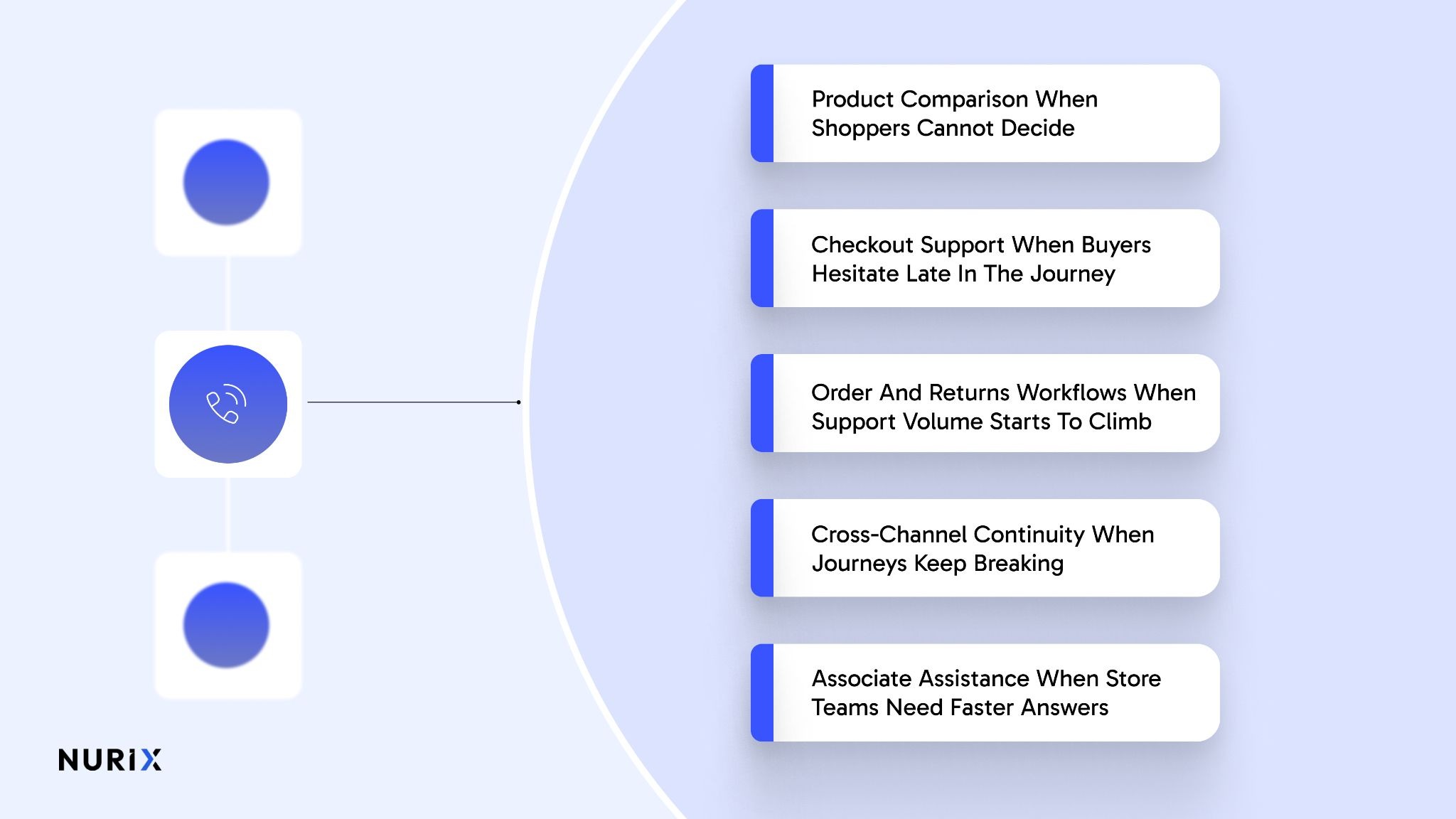
Conversational AI creates the most value in retail when it is applied to moments where shoppers slow down, ask for help, switch channels, or create repeat service work after purchase.
The real opportunity is not broad automation. It is choosing the workflows where better guidance, faster answers, or cleaner execution can directly improve conversion, service efficiency, or store performance.
Retail teams usually get the clearest early wins when they match conversational AI to one measurable friction point at a time.
1. Product Comparison When Shoppers Cannot Decide
This is one of the most useful retail applications because many shoppers arrive with intent, but not with a clear product choice. They know the problem they want to solve, yet still need help narrowing options, understanding trade-offs, or feeling confident enough to move forward.
The strongest deployment signals in this area usually look like this:
- Intent Translation: Converts broad requests into buying criteria such as budget, size, compatibility, or material preference.
- Option Narrowing: Reduces choice overload by surfacing the most relevant products instead of forcing deeper catalog browsing.
- Decision Support: Explains trade-offs in plain language, which helps in higher-consideration categories like electronics, furniture, and beauty.
What retail teams should do with this: Use this workflow when shoppers spend time on product pages but do not progress to the cart. It is often one of the clearest places to improve mid-funnel conversion.
2. Checkout Support When Buyers Hesitate Late In The Journey
This is where conversational AI becomes commercially important very quickly. By the time a shopper reaches checkout, the problem is rarely product discovery. It is usually a last-minute doubt around shipping, returns, payment, or fit that interrupts a purchase already close to completion.
The operational pressure points are usually easy to spot:
- Question Resolution: Handles delivery timing, return windows, warranty coverage, or fit concerns without forcing a support detour.
- Friction Detection: Responds when the shopper pauses, edits the basket repeatedly, or stalls at payment or shipping selection.
- Reorder Acceleration: Rebuilds previous baskets with current stock data, which is useful for replenishment-heavy categories.
What retail teams should do with this: Prioritize this use case when cart creation is strong but checkout completion is weak. It is especially useful when abandonment is driven by unanswered operational questions.
3. Order And Returns Workflows When Support Volume Starts To Climb
For many retail teams, this is where conversational AI moves from interesting to necessary. Order tracking, exchanges, refunds, and damaged-item claims create a large share of repetitive service demand, and most of that work follows structured rules rather than requiring complex judgment.
That makes this area a practical automation candidate:
- Order Retrieval: Pulls shipment, payment, and fulfillment updates from the Order Management System, which tracks post-purchase order status.
- Return Screening: Checks eligibility, exchange routes, and refund rules before passing only exception cases to human teams.
- Claims Collection: Gathers issue details, images, and purchase records in one conversation for damaged-item or replacement requests.
What retail teams should do with this: Use this when service teams are overloaded with repetitive post-purchase contacts. It is often one of the easiest places to reduce handling time without changing the buying journey.
4. Cross-Channel Continuity When Journeys Keep Breaking
Retail journeys rarely stay in one channel. A shopper may start on web chat, return through messaging, and finish through a phone call. When context breaks between those moments, the customer loses momentum, and the business creates unnecessary repeat work.
This use case matters most when continuity is weak:
- Conversation Memory: Retains earlier questions, selected products, and prior service context across channels.
- Structured Handoff: Sends a summary to live teams with issue status, relevant history, and the next step already visible.
- Journey Recovery: Restarts the interaction at the right point, such as a saved comparison flow or interrupted return request.
What retail teams should do with this: Focus here when shoppers frequently switch channels, and your teams still treat each interaction as a new case. That usually signals lost context and avoidable friction.
5. Associate Assistance When Store Teams Need Faster Answers
Conversational AI is not only useful on the customer side. In many retail environments, store teams lose time trying to find policy answers, process steps, or exception guidance while serving customers live. That delay affects both service quality and staff efficiency.
This is where internal conversational support becomes valuable:
- Policy Access: Retrieves return rules, pickup steps, promotion logic, or substitution guidance without manual document searches.
- Process Support: Helps staff handle situations like partial returns, unavailable inventory, or damaged collection orders.
- Operational Questions: Answer scheduling, leave, and internal workflow questions without sending staff into separate back-office systems.
What retail teams should do with this: Use this when frontline teams depend on supervisors or scattered documents for routine answers. It is a practical way to reduce delay during live customer interactions.
Retail teams do not need to automate every journey first. They need to identify where friction is already visible, then apply conversational AI where the business impact is easiest to prove.
If the use case looks promising, the next step is simple; see how it performs in a real retail environment. NuPlay lets enterprise teams evaluate voice and chat automation against live workflows, connected systems, and actual customer interactions. Schedule a demo to assess whether the platform fits your operational requirements.
Conversational AI vs Chatbots in Retail
In retail, chatbots usually follow fixed rules and handle narrow question paths, while conversational AI interprets intent, retains context, connects with business systems, and completes multi-step tasks. That difference matters when teams need support that can guide product selection, resolve service issues, and act on live commerce data.
The distinction becomes clear when retail teams compare capability, control, and operational value.
Retail teams outgrow chatbots when customer journeys require context, system access, and action, not just scripted replies inside narrow support flows.
How Conversational AI Improves Shopping Journeys
Conversational AI improves shopping journeys by helping customers keep moving when they would otherwise pause, second-guess, or leave. In retail, that usually happens during product discovery, comparison, checkout, and post-purchase follow-up. The value is not just faster answers. It is a smoother path from interest to action.
Its impact is easiest to understand in the moments where the journey usually starts to break.
- Discovery Feels Easier: Shoppers can describe what they want naturally, which helps them get to relevant products faster without working through too many filters.
- Choices Feel Clearer: The assistant can explain differences in plain language, which is useful when a shopper is comparing similar options and losing confidence.
- Checkout Feels Safer: Delivery, fit, return, or warranty questions get answered at the point of purchase, before hesitation turns into abandonment.
- Support Feels Connected: After the order, customers can ask about tracking, exchanges, or issues without starting over in a separate support flow.
- The Journey Keeps Moving: If a shopper returns later, the conversation can pick up with the right context instead of forcing them to repeat the same steps.
Shopping journeys improve when customers get the right help at the exact point where uncertainty appears, not after they have already dropped off.
If you want to see where this is heading next, especially across discovery, support, and conversion, continue with How E-Commerce AI Agents Are Reshaping Digital Retail in 2025
How to Evaluate Conversational AI Platforms for Retail
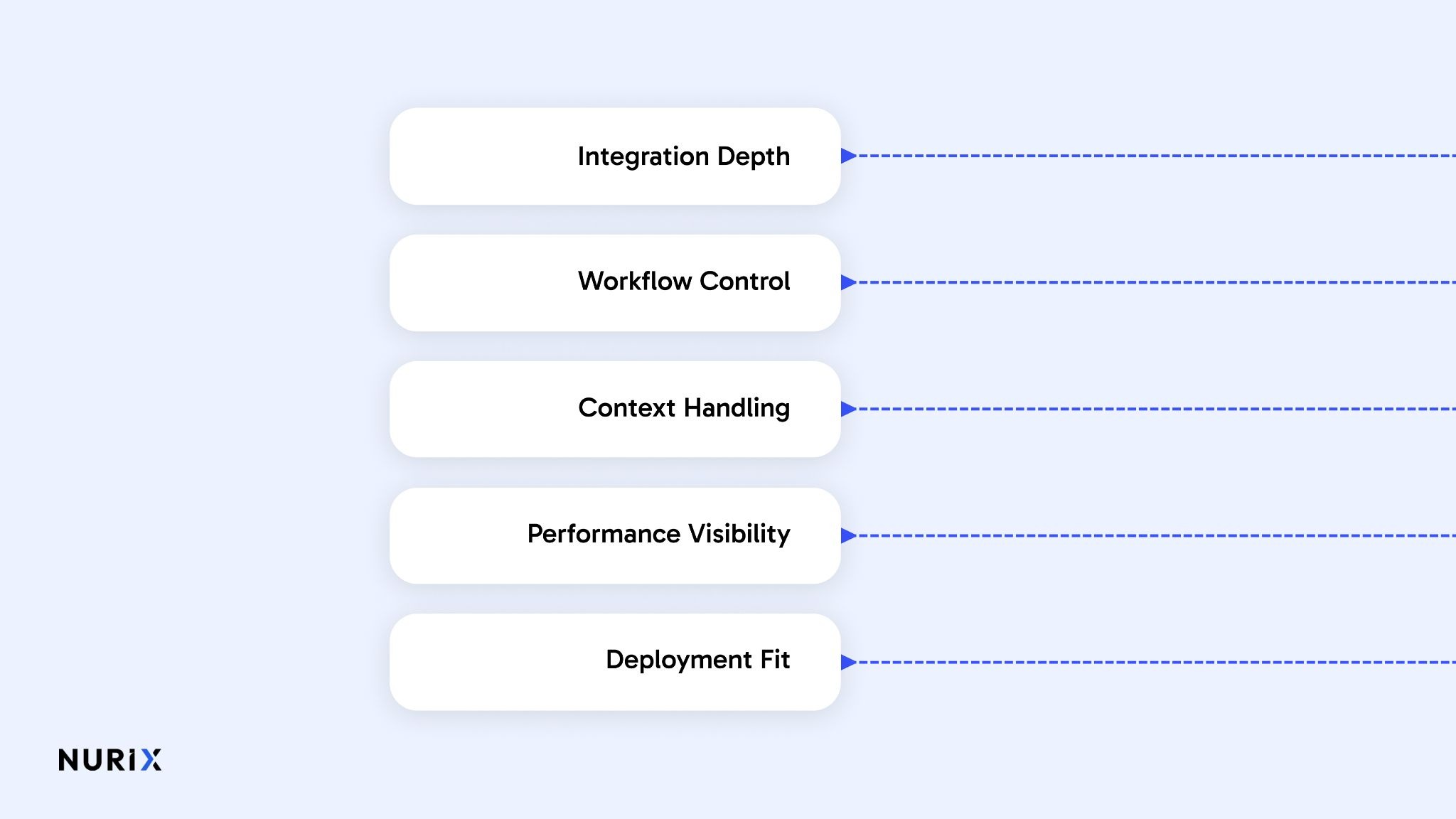
Retail teams should evaluate conversational AI platforms based on operational fit, not demo quality. The right platform should connect with retail systems, handle real customer and service workflows, preserve context, and give teams enough visibility and control to improve performance after launch.
The strongest evaluation points are the ones that affect rollout, execution, and scale.
- Integration Depth: Check whether it connects with catalog, order, payment, inventory, and support systems.
- Workflow Control: Review how well it supports escalation rules, approvals, and task completion across retail workflows.
- Context Handling: Test whether it retains shopper history, cart state, and prior interactions across channels.
- Performance Visibility: Look for analytics on containment, resolution, handoffs, and drop-off points.
- Deployment Fit: Confirm it supports your security, compliance, and channel requirements.
Retail teams should choose platforms that fit existing workflows, connect cleanly with core systems, and support measurable improvement after deployment.
If you are evaluating platforms, focus on what you can verify in practice: live workflow handling, response accuracy, handoff quality, latency, and system fit. NuPlay gives enterprise teams a low-latency AI voice and chat platform with a 400+ integration ecosystem. Schedule a demo to test it against real retail workflows.
Common Challenges and How to Avoid Them
Retail conversational AI usually fails for operational reasons, not because the use case is wrong. The most common problems are weak rollout scope, unreliable retail data, poor escalation design, and low customer trust. Most of them show up after launch, when the assistant starts facing real purchase, service, and returns scenarios.
The main risks usually appear in scope, data, trust, and live workflow control.
Retail teams avoid most rollout problems when they keep scope narrow, clean up core data, define escalation early, and review live interactions continuously.
Many of the rollout issues in retail show up first in service workflows, which is why the next video adds useful context: How AI is transforming customer support
How NuPlay by Nurix AI Supports Enterprise Retail Workflows
NuPlay by Nurix AI supports enterprise retail workflows by combining voice and chat agents, multi-agent orchestration, live monitoring, and enterprise controls in one platform. For retail teams, that matters because the platform is built to automate routine interactions, execute workflows across systems, and keep performance visible after launch.
Its value is easier to understand through the outcomes and controls that the platform is built to support.
- Workflow Automation: NuPlay is positioned to automate up to 80% of inquiries, which matters for high-volume retail support and service workflows.
- Cost Efficiency: The platform is described as delivering up to 65% cost savings by reducing manual handling across repetitive interactions.
- Operational Visibility: NuPulse gives teams live visibility into response time, containment, and resolution, so performance can be improved continuously.
- Execution Depth: Multi-agent orchestration and system integrations help the platform move beyond answers into actions across retail workflows.
- Enterprise Control: NuPlay includes Personally Identifiable Information redaction, audit trails, retention controls, and role-based access control for production deployment.
NuPlay by Nurix AI supported conversational product discovery, live stock checks, offer guidance, and cart assistance, leading to a 30% increase in product page-to-checkout conversions and a 40% reduction in support load during peak seasons.
NuPlay by Nurix AI fits retail teams that need measurable automation, live performance visibility, and enterprise control, not just a conversational layer on top of existing systems.
Final Thoughts!
What matters now is execution. Retail teams are under pressure to improve shopping journeys, reduce service friction, and support customers without adding more operational drag. This blog showed where conversational AI delivers the strongest retail impact, how it improves real customer journeys, where it fits across existing systems, what can go wrong during rollout, and how to evaluate platforms with more confidence.
For enterprise teams that need more than a basic chatbot layer, NuPlay by Nurix AI offers a stronger path forward with voice and chat AI, workflow orchestration, live monitoring, brand control, and enterprise-grade security built for real retail operations.
Get in touch with us to see how NuPlay can support your retail workflows.
Author: Sakshi Batavia, Marketing Manager
Sakshi Batavia is a marketing manager focused on AI and automation. She writes about conversational AI, voice agents, and enterprise technologies that help businesses improve customer engagement and operational efficiency.