Enterprise phone operations are quickly shifting toward AI voice agents that can qualify leads, resolve support requests, schedule appointments, and trigger backend workflows automatically. As adoption accelerates, the Voice AI agents market is projected to grow by USD 10.96 billion (Technavio, 2025) at a 37.2% CAGR between 2024 and 2029.
As deployment complexity increases, organizations evaluating Ringg AI begin assessing platforms that provide stronger workflow orchestration, deeper system integrations, and enterprise-grade scalability.
In this guide, we compare the best Ringg AI alternatives, examining their capabilities, architecture, and deployment models to help you choose the right Voice AI platform.
Executive Summary: What is Ringg AI? Ringg AI enables businesses to automate phone conversations using AI voice assistants. As automation needs grow, enterprises evaluate alternatives such as NuPlay, Retell AI, Synthflow, Vapi, PolyAI, Cognigy, and ElevenLabs for stronger orchestration, integrations, and scalability.
The best choice depends on whether you prioritize no-code deployment, developer flexibility, or enterprise-grade automation.
Key Takeaways
- Voice AI is Becoming Enterprise Infrastructure: Organizations are deploying production-grade voice agents to automate sales, support, scheduling, and operational workflows.
- Ringg AI Allows Fast No-Code Automation: Businesses use it to launch AI calling campaigns for lead qualification, support, and outbound engagement.
- Enterprises Compare Platforms As Automation Scales: Evaluation typically focuses on architecture, CRM, and ERP integrations, and scalability for high call volumes.
- Voice AI Platforms Differ In Technical Depth: Solutions like NuPlay, Retell, Synthflow, Vapi, PolyAI, Cognigy, and ElevenLabs vary in orchestration, developer control, and deployment models.
- Platform Selection Depends On Operational Fit: Teams assess technical flexibility, compliance support, supported channels, and pricing before choosing a voice automation platform.
What Is Ringg AI?
Ringg AI is a no-code AI voice automation platform that allows businesses to automate phone conversations using AI voice assistants. Organizations use it to run high-volume outbound and inbound calling workflows for sales, support, and lead qualification.
Built by Stoic AI Pvt Ltd in Bengaluru, India, Ringg AI focuses on fast deployment and scalable voice automation for businesses that want to launch AI calling campaigns without building complex infrastructure.
Key Capabilities of Ringg AI Include:
- High-Velocity Auto Dialer: Place up to 1,000 calls per minute with retry logic to improve contact rates.
- Low-Latency Voice Interactions: Supports 20+ languages with sub-330 millisecond latency for natural conversations.
- Custom AI Voice Assistants: Train voice agents using FAQs, knowledge bases, and Standard Operating Procedures (SOPs).
- Business System Integrations: Connect with Customer Relationship Management (CRM) platforms like Salesforce and scheduling tools like Calendly.
- Human Agent Handoff: Transfer calls to live agents while preserving conversation context.
- Security Controls: Uses end-to-end encryption to protect call data and communications.
Overall, Ringg AI provides businesses with a fast way to launch AI-powered calling workflows without complex development.
Why Companies Look for Ringg AI Alternatives
Many businesses evaluate Ringg AI alternatives as their automation needs grow or change. While Ringg AI supports high-volume AI calling, organizations often compare multiple platforms to identify tools that best match their workflows, integrations, and long-term technology strategy.
Common factors companies consider when exploring alternatives include:
- Expanded AI Capabilities: Some teams seek deeper Large Language Model (LLM) features, such as automated call summaries, conversation insights, and workflow automation.
- Omnichannel Engagement: Certain platforms support automation across voice, chat, email, and social messaging, allowing businesses to manage customer interactions from a single system.
- Technical Flexibility: Engineering teams may prefer platforms that allow control over Automatic Speech Recognition (ASR), Text-to-Speech (TTS) models, or custom conversational workflows.
- Voice Quality and Language Coverage: Some businesses prioritize expressive voice synthesis or broader multilingual capabilities for global customer engagement.
Comparing platforms helps teams evaluate orchestration models, integration depth, and scalability before deploying voice automation at scale.
Learn how modern enterprises automate conversations, qualify leads faster, and scale customer engagement with AI Voice Interaction for Business: What You Need to Know
7 Best Ringg AI Alternatives for Voice Automation
Enterprise buyers evaluating Ringg AI alternatives typically compare platforms across three dimensions: automation architecture, deployment model, and operational scale.
Ringg AI Alternatives 2026: Comparison Table
The table below compares leading platforms across automation architecture, deployment model, and operational scale.
Decision insight: Enterprises prioritizing workflow orchestration and governance often evaluate NuPlay or Cognigy, while developer teams lean toward API-driven platforms such as Vapi or Retell.
1. NuPlay
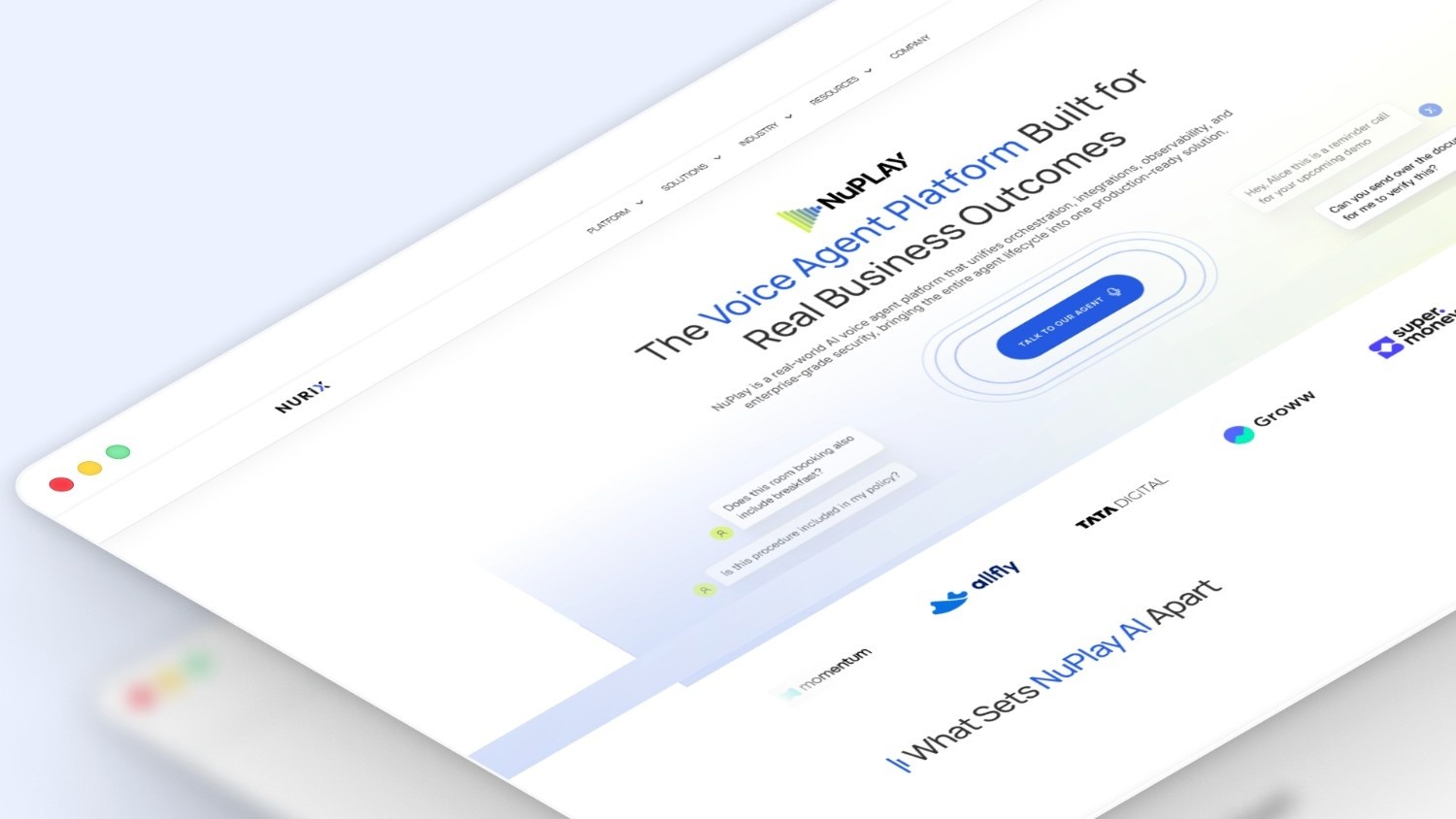
NuPlay is an enterprise AI voice agent platform built for operational voice workflows. The platform combines voice agent orchestration, enterprise integrations, observability, and governance in a single production-ready system.
Key Features
- Multi-Agent Orchestration: Design voice agents that manage multi-turn conversations, branching logic, and agent-to-agent workflows for complex customer interactions.
- Model-Agnostic Architecture: Choose the best AI model based on latency, accuracy, or cost without being locked into a single provider.
- 400+ Enterprise Integrations: Connect NuPlay voice agents with CRM, Enterprise Resource Planning (ERP) systems, and other business tools.
- Real-Time Insights With NuPulse: Track metrics such as Customer Satisfaction Score (CSAT), conversion rates, and drop-off points to continuously improve voice agent performance.
- Knowledge-Driven Conversations: Use Retrieval-Augmented Generation (RAG) to synthesize company knowledge and deliver accurate responses during live calls.
- Enterprise Governance And Compliance: Built-in monitoring, security controls, and audit capabilities support regulated industries and large-scale deployments.
Best for: Mid-to-large enterprises in retail, financial services, insurance, education, and home services that need scalable AI voice automation for high-volume customer conversations. Unlike most Ringg AI alternatives, NuPlay focuses on multi-agent orchestration, deep enterprise integrations, and governance at scale.
Price: NuPlay uses custom enterprise pricing, typically based on conversation volume, integrations, and deployment complexity. Businesses can request a demo to receive a customized quote.
Looking to automate high-volume customer conversations? See how NuPlay, the enterprise AI voice agent platform, powers nearly 800,000 AI conversations each month.
2. Retell AI

AI Voice Agent Platform for Phone Call Automation - Retell AI
Retell AI is a voice-first conversational AI platform that uses LLMs to automate inbound and outbound calls with human-like conversations and real-time task execution.
Key Features
- Low-Latency Voice Conversations: Delivers ~600 millisecond latency, allowing natural, real-time conversations during live phone calls.
- Agentic Voice Automation Framework: Build conversational workflows using drag-and-drop tools, real-time function calling, and automated task execution such as booking appointments or processing payments.
- Enterprise-Scale Call Infrastructure: Infrastructure designed to support millions of calls, with integrations for telephony systems like Twilio, Vonage, and SIP trunking.
Cons
- Pricing Complexity: Costs can vary depending on usage, integrations, and telephony providers.
- Technical Setup Requirements: Advanced customization may require developer involvement.
- Workflow Configuration Learning Curve: Teams may need time to configure complex conversational flows and integrations.
Best for: Mid-to-large businesses building AI-powered call centers, appointment scheduling systems, customer support automation, or outbound sales workflows.
Price: Retell AI offers usage-based pricing, starting with $10 in free credits for new users. Final costs depend on call volume, integrations, and infrastructure requirements.
3. Synthflow AI
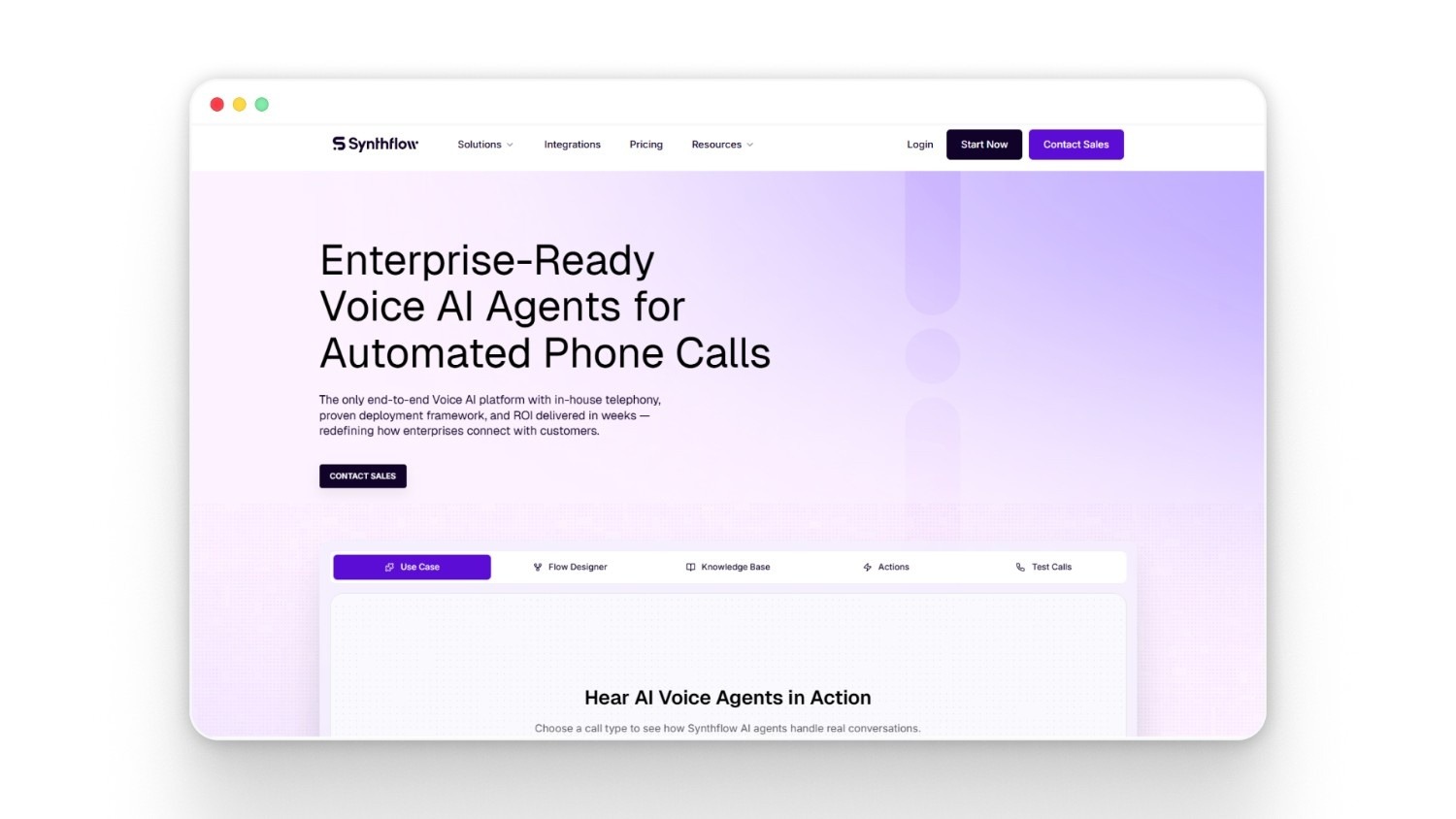
AI Voice Agent Platform to Automate Your Phone Calls
Synthflow AI is a no-code voice automation platform that deploys AI voice agents to manage inbound and outbound calls, allowing enterprises to automate customer conversations at scale.
Key Features
- High-Volume Voice Automation: Proven performance across 65 million+ automated customer calls with infrastructure designed for enterprise-scale phone operations.
- Low-Latency Enterprise Telephony: In-house telephony infrastructure maintains sub-100 millisecond latency and 99.99% uptime for reliable voice interactions.
- No-Code Agent Builder With Integrations: Visual workflow designer allows teams to deploy voice agents and connect with 200+ integrations, including CRM and contact center systems.
Cons
- Enterprise-Focused Platform: Infrastructure and deployment model may be more complex than required for very small teams.
- Pricing Visibility: Detailed pricing tiers are not publicly listed and typically require consultation with the sales team.
- Workflow Configuration Effort: Designing advanced conversational flows may require testing and optimization before full deployment.
Best for: Enterprises and contact centers looking to automate high-volume customer calls, appointment scheduling, lead qualification, and support workflows using AI voice agents.
Price: Synthflow uses pay-as-you-go pricing, allowing businesses to start building agents for free and pay based on actual call usage when deployed in production.
4. Vapi AI

Vapi is a developer-first voice AI platform that provides configurable APIs to build and scale AI voice agents for inbound and outbound phone automation.
Key Features
- Developer-First Api Platform: API-native architecture allows engineering teams to build customizable voice agents with thousands of configuration options and integrations across AI models and telephony systems.
- Large-Scale Voice Infrastructure: Handles 300M+ calls, supports sub-500 millisecond latency, and maintains 99.99% uptime for enterprise-scale voice deployments.
- Flexible AI Model Integration: Supports bring-your-own models for speech-to-text, Large Language Models (LLMs), and text-to-speech providers such as OpenAI, Anthropic, and ElevenLabs.
Cons
- Developer-Oriented Platform: The API-first architecture may require engineering expertise for setup and customization.
- Multiple Cost Components: Pricing includes hosting, telephony, and AI model providers, which can make cost forecasting more complex.
- Limited No-Code Capabilities: Businesses seeking simple drag-and-drop builders may prefer more no-code-focused platforms.
Best for: Developer teams and technology companies building custom AI voice applications, AI call centers, or large-scale phone automation systems.
Price: Vapi uses usage-based pricing, with hosting starting at $0.05 per call minute, plus additional costs for telephony providers and AI models. A $10 free credit is available for new users.
5. PolyAI
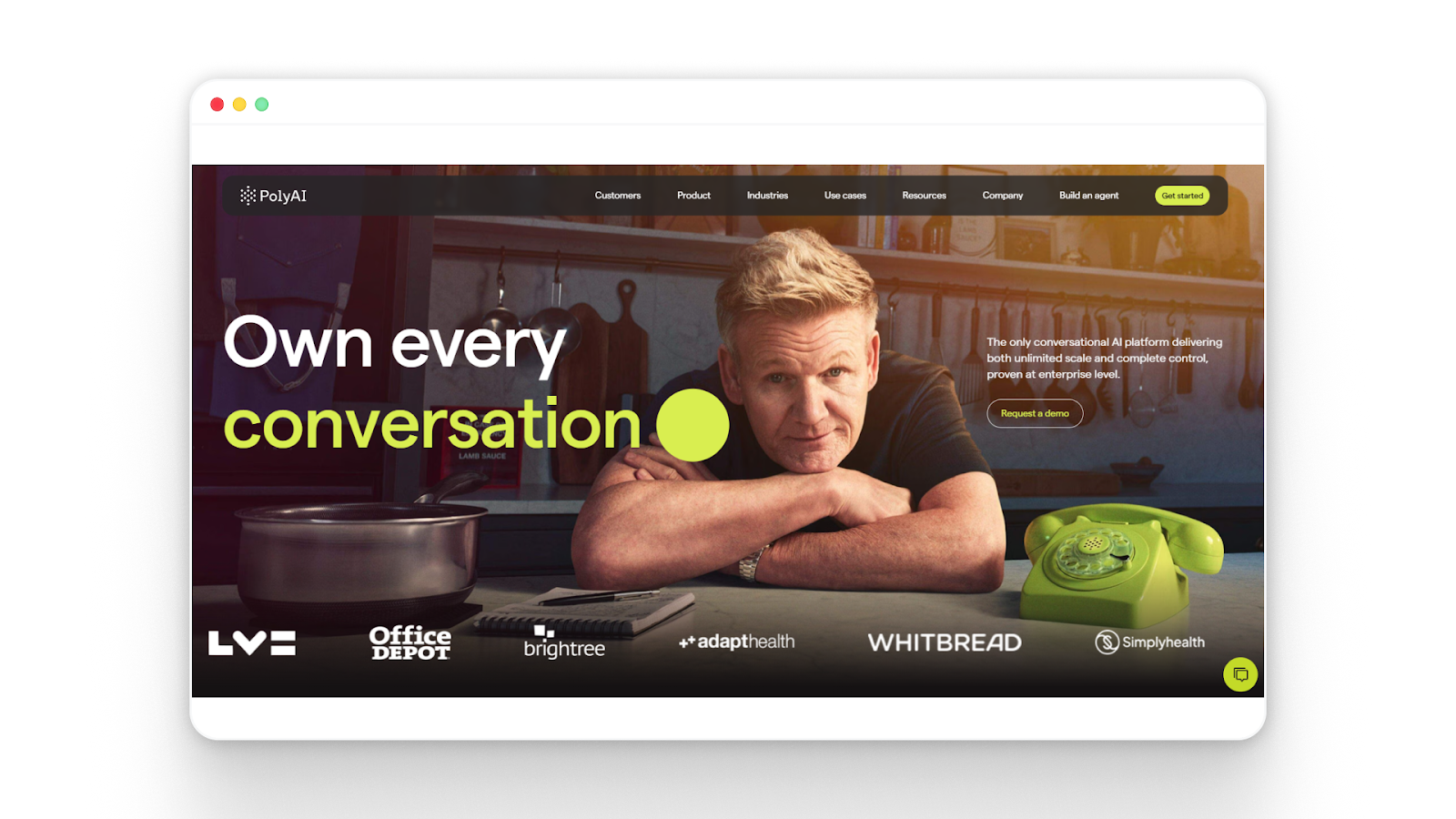
PolyAI is an enterprise conversational AI platform that deploys voice assistants to automate customer service calls while maintaining natural conversations across contact centers and support operations.
Key Features
- Enterprise-Scale Voice Automation: AI voice agents handle large customer call volumes and resolve a high percentage of requests without human intervention.
- Omnichannel Conversational Deployment: Build an AI agent once and deploy it across voice, chat, and SMS channels without rebuilding workflows.
- Customer Experience Impact: Enterprises report measurable outcomes, including millions in new revenue and significant reductions in seasonal hiring costs.
Cons
- Enterprise-Focused Deployments: Implementation and customization may require collaboration with PolyAI specialists.
- Limited Public Pricing Transparency: Pricing details are typically shared through enterprise consultations.
- Customization Time: Deployments may take longer compared with lightweight no-code voice automation tools.
Best for: Large enterprises and contact centers in financial services, healthcare, retail, hospitality, and telecom that want AI voice assistants to automate customer service calls at scale.
Price: PolyAI offers custom enterprise pricing, typically determined by call volume, integrations, and deployment scope. Organizations usually request a demo to receive a customized quote.
6. Cognigy AI
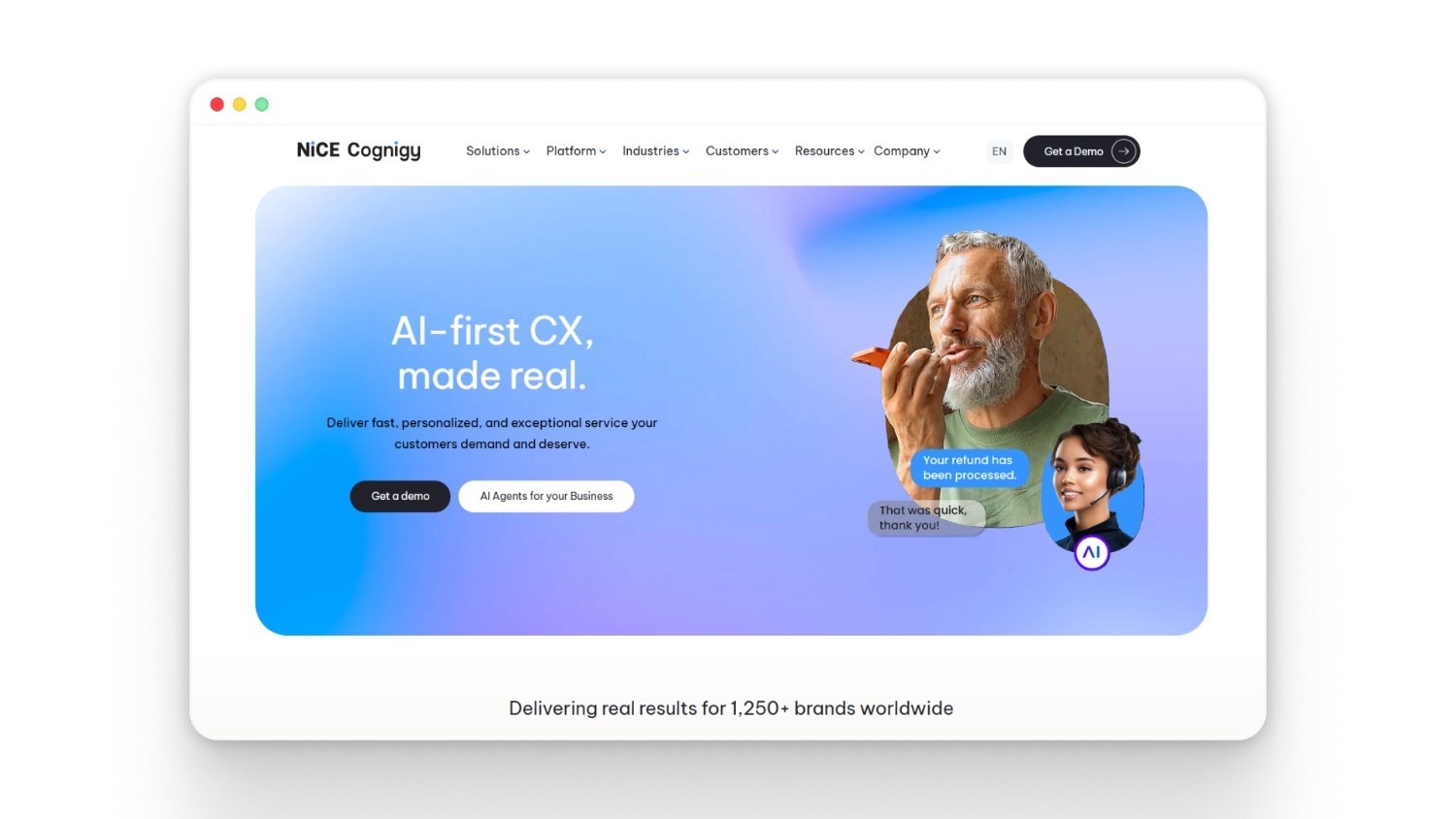
Cognigy AI is an enterprise conversational AI platform that deploys voice and chat agents to automate customer service across contact centers and digital channels.
Key Features
- Enterprise-Scale Conversational AI: Handles 1 billion+ customer interactions annually with automation designed for large global contact center operations.
- Omnichannel AI Agents: Deploy AI agents across voice, chat, messaging, and social channels while maintaining a consistent customer experience.
- Advanced AI Language Understanding: Uses LLMs and NLP to improve intent detection and automate complex conversations.
Cons
- Enterprise-Focused Implementation: Deployment typically requires enterprise integration and configuration.
- Higher Platform Complexity: The platform includes many advanced features that may require specialized teams to manage.
- Pricing Transparency: Pricing details are usually provided through enterprise consultations.
Best for: Large enterprises and global contact centers that want to automate customer service, support operations, and omnichannel customer interactions using conversational AI.
Price: Cognigy AI offers custom enterprise pricing based on interaction volume, integrations, and deployment scope. Organizations generally request a demo to receive a customized quote.
7. ElevenLabs
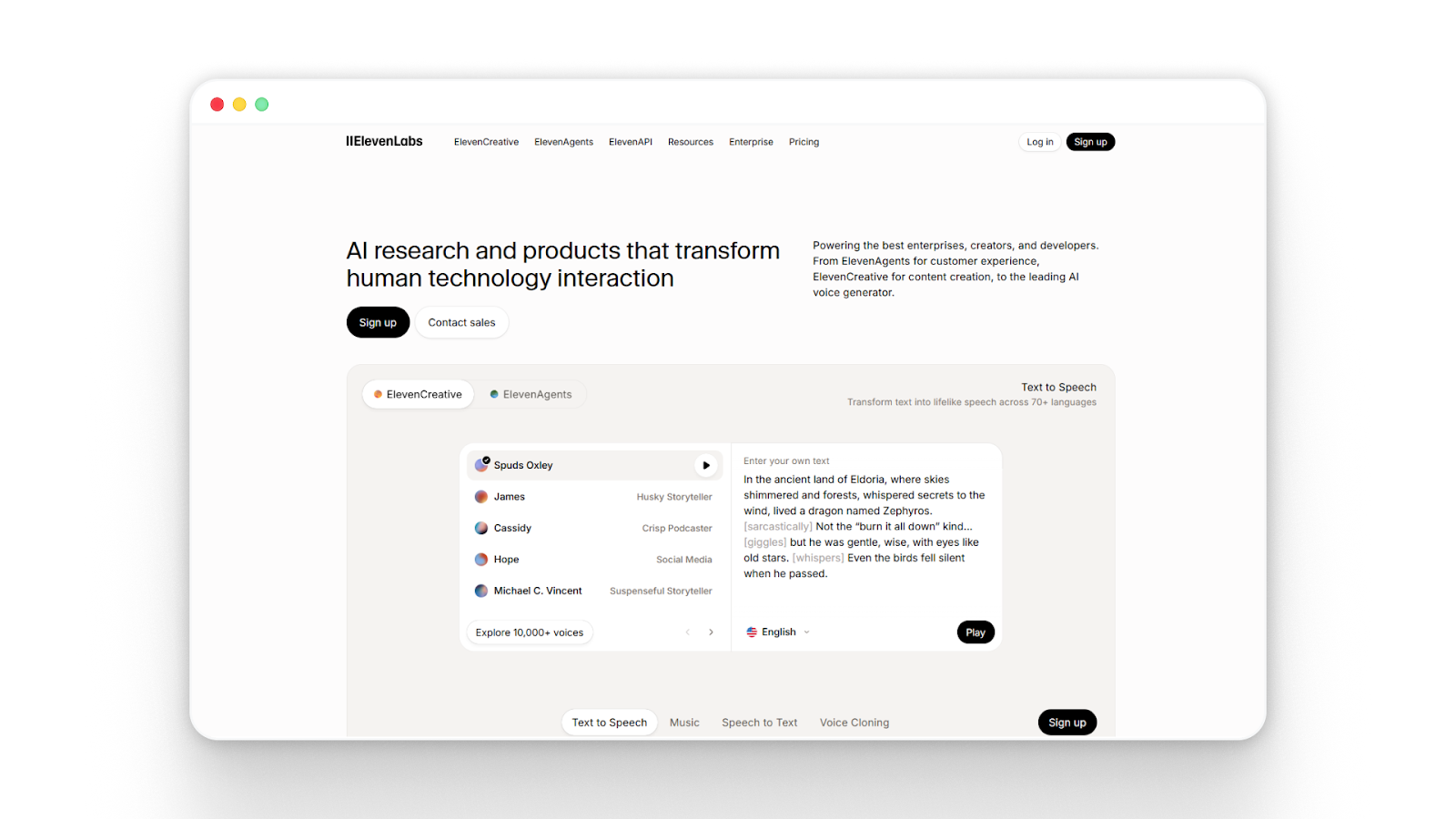
Free AI Voice Generator & Voice Agents Platform | ElevenLabs
ElevenLabs is an AI audio platform that generates lifelike speech and voice agents, allowing businesses to build conversational experiences using advanced text-to-speech and voice cloning technology.
Key Features
- Ultra-Realistic Speech Generation: Converts text into natural speech across 70+ languages with expressive voice control and emotion-aware delivery.
- Advanced Voice AI Models: Offers multiple speech models, including low-latency voice generation with ~75 millisecond latency for conversational use cases.
- Extensive Voice Library and Cloning: Access 10,000+ voices or create custom voices using voice cloning and AI voice design tools.
Cons
- Primarily an Audio Platform: Focuses on speech generation rather than full conversational automation platforms.
- Workflow Configuration Required: Building complex voice automation flows may require additional integrations.
- Pricing Varies by Usage: Costs depend on usage volume and API consumption.
Best for: Developers, media teams, and businesses that need high-quality AI voice generation, voice cloning, and speech synthesis for conversational AI, content creation, and voice applications.
Price: ElevenLabs offers tiered subscription plans and API usage pricing, with enterprise options available for large-scale deployments and advanced integrations.
The comparison highlights how leading Ringg AI alternatives differ in orchestration depth, developer infrastructure, and deployment architecture, helping enterprises shortlist platforms for large-scale voice automation.
Before deploying voice automation, understand the key technologies, infrastructure, and challenges in What You Need to Know Before Building an AI Voice Call Platform
How to Choose the Right Ringg AI Alternative
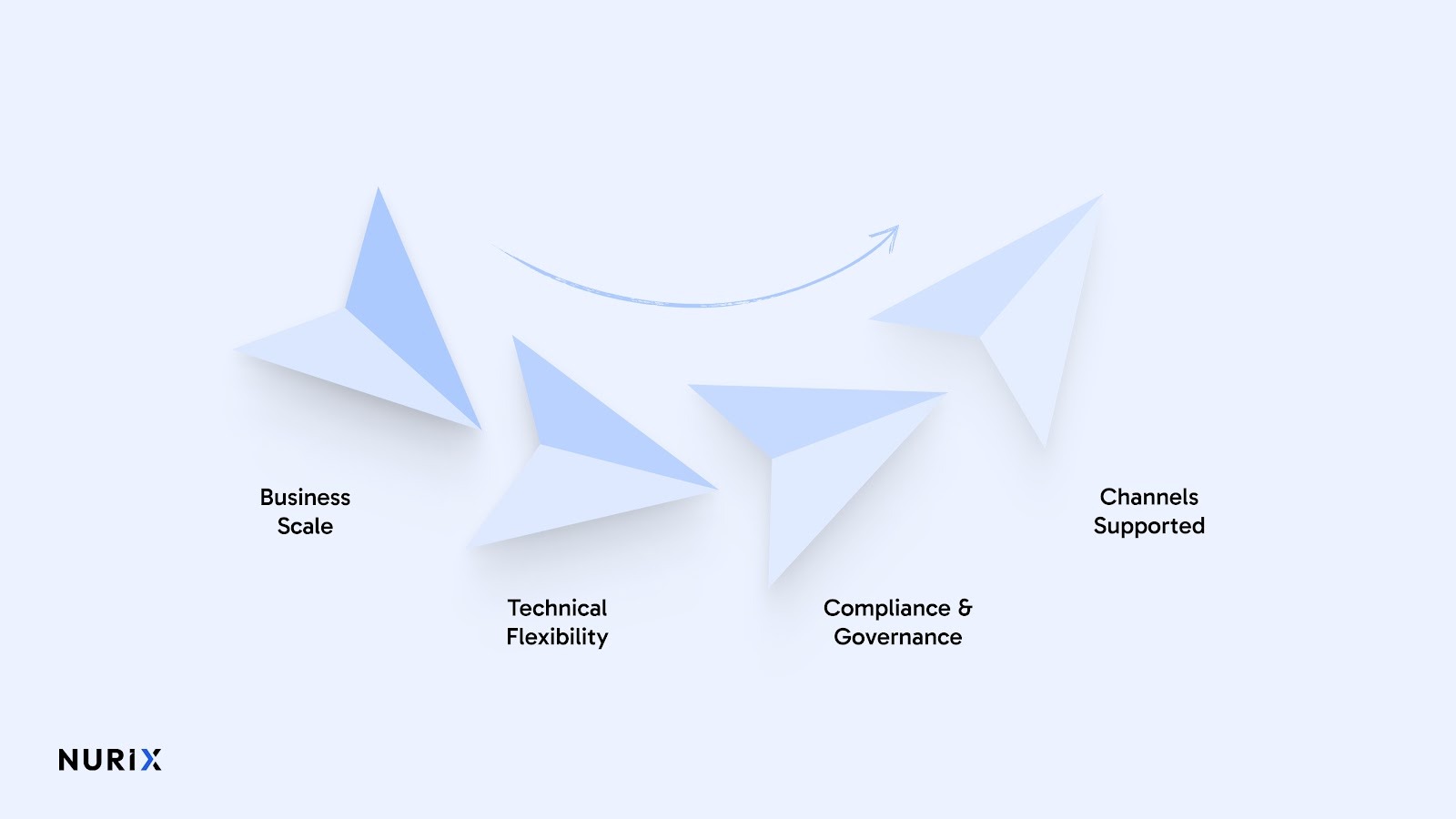
Choosing the right Ringg AI alternative depends on your business size, technical resources, and the level of automation you need. Some platforms focus on fast no-code deployment, while others provide enterprise orchestration and deeper system integrations.
- Business Scale: Smaller teams may prefer platforms with quick setup and simple workflows. Enterprises often need solutions designed for high call volumes and complex automation.
- Technical Flexibility: Developer-focused platforms allow control over ASR, LLMs, and TTS models. No-code platforms offer a simpler setup with prebuilt workflows.
- Compliance and Governance: Regulated industries may require compliance with HIPAA, SOC 2, or GDPR. Enterprise platforms such as NuPlay provide governance and monitoring features designed for large-scale deployments.
- Channels Supported: Some platforms focus on voice automation only. Others support voice, chat, and messaging in one system.
Reviewing these factors helps businesses choose a voice automation platform that fits their technical stack, operational scale, and customer communication strategy.
Understand which performance indicators truly matter for automation success in 6 Ways to Measure AI Voice Agent Metrics That Impact Cost and Resolution
Enterprise Trends Driving Voice AI Adoption
Enterprise adoption of Voice AI has moved from experimentation to core operational infrastructure. Organizations now deploy voice agents to automate complex workflows, improve service efficiency, and manage large-scale customer interactions in real time.
Key technology and operational shifts are accelerating enterprise Voice AI adoption.
- Agentic Workflow Automation: Modern systems use Agentic AI to orchestrate multi-step workflows such as loan collections, logistics coordination, and automated recruitment screening.
- Assistive Intelligence For Human Teams: Voice AI agents assist professionals by handling documentation and operational updates.
- RAG Accuracy: RAG grounds responses in enterprise knowledge bases, allowing agents to retrieve policy details, transaction data, and compliance rules during conversations.
- Multilingual And Multimodal Interfaces: Advanced platforms support real-time multilingual conversations and integrate voice interactions with screens, allowing users to confirm requests through visual interfaces.
- Voice Biometrics And Emotional Intelligence: AI systems analyze speech patterns for voice biometrics authentication and detect sentiment signals like frustration or urgency during live conversations.
Voice AI adoption is accelerating as enterprises deploy autonomous agents that automate complex workflows, improve accuracy, and scale customer operations while maintaining compliance and operational visibility.
Conclusion
Choosing the right Ringg AI alternatives comes down to scalability, integrations, and workflow orchestration. As voice automation expands across sales, support, and operations, evaluating Ringg AI alternatives with enterprise deployment in mind becomes critical.
NuPlay, the enterprise AI voice agent platform, powers nearly 800,000 AI conversations each month, helping organizations achieve 65% cost savings, 80% automation coverage, and a 50% efficiency boost.
3–4× increase in lead qualification after replacing traditional IVR with AI voice agents. 10% uplift in lending funnel conversions through real-time intent detection and contextual routing. 24/7 automated lead qualification and cross-sell discovery without increasing contact center headcount.
Schedule a demo to see how NuPlay can power enterprise voice automation.
Author: Sakshi Batavia — Marketing Manager
Sakshi Batavia is a marketing manager focused on AI and automation. She writes about conversational AI, voice agents, and enterprise technologies that help businesses improve customer engagement and operational efficiency.