Generative AI in Sales and Marketing (2026): Use Cases & ROI

Don’t miss what’s next in AI.
Subscribe for product updates, experiments, & success stories from the Nurix team.
Sales and marketing teams often struggle with high volumes of repetitive tasks and slow response times, preventing them from capitalizing on key opportunities. Manual workflows create inefficiencies, leading to missed leads and delayed actions.
Generative AI in sales and marketing is emerging as a practical solution to these challenges.
According to McKinsey & Company, generative AI could unlock $0.8 trillion to $1.2 trillion in productivity across sales and marketing, highlighting its growing role in enterprise operations. The focus is no longer on experimentation, but on applying AI to real workflows.
So, how can generative AI improve sales and marketing in a way that drives measurable outcomes? This article outlines how generative AI is transforming business strategies, with real use cases, workflows, and implementation steps.
Executive Summary (2026)
Generative AI is helping enterprise sales and marketing teams automate lead qualification, improve outreach, and optimize workflows. Instead of isolated tools, AI is now embedded into CRM systems and go-to-market processes. This article explains key use cases, workflow integration, and implementation strategies to help teams reduce manual effort, improve conversion rates, and scale operations effectively.
Quick look
- Generative AI helps sales teams prioritize high-intent leads, automate CRM updates, and improve outreach timing using real-time customer signals.
- Marketing teams use generative AI to generate content, personalize journeys, and optimize campaigns based on live performance data.
- Embedding AI into workflows (CRM, campaigns, communication tools) reduces manual effort and improves execution speed across teams.
- Successful adoption depends on integrating AI with existing systems, starting with pilot use cases, and ensuring governance for accuracy and compliance.
- NuPlay by Nurix AI helps reduce manual effort and improve conversion outcomes by automating end-to-end sales and marketing workflows across systems.
What Is Generative AI in Sales and Marketing?
Generative AI refers to systems that can create content, analyze data, and generate insights using advanced models like Large Language Models (LLMs). In sales and marketing, this means automating tasks such as drafting emails, summarizing calls, and generating campaign content.
Unlike traditional automation, generative AI works with context. It uses customer data, past interactions, and real-time signals to produce outputs that are relevant and actionable. This makes it suitable for workflows where decisions depend on timing, personalization, and accuracy.
For enterprise teams, the shift is not just about content generation. It is about embedding AI into systems that handle customer interactions, pipeline management, and campaign execution at scale.
Understanding the definition is useful, but the real value comes from why teams are adopting it in the first place.
Why Are Sales and Marketing Teams Using Generative AI?
Most sales and marketing teams face the same structural issues:
- High volume of repetitive tasks across outreach, reporting, and follow-ups
- Delayed response times that reduce lead engagement and conversion
- Fragmented tools and data silos across CRM, marketing platforms, and communication channels
These problems directly impact revenue. Leads are not engaged at the right time, campaigns lose relevance due to delayed insights, and teams spend more time updating systems than moving deals forward.
Generative AI addresses this by:
- Automating repetitive workflows such as follow-ups, data entry, and lead qualification
- Providing real-time insights based on customer behavior and engagement signals
- Enabling personalization across emails, campaigns, and interactions without increasing manual effort
For example, AI can analyze signals from CRM data, emails, and customer interactions to recommend next-best actions during the sales cycle. This reduces reliance on manual judgment and improves consistency in how teams engage prospects.
The result is not just improved productivity, but stronger alignment between sales and marketing teams through shared data, faster execution, and more coordinated workflows.
To understand this impact clearly, it helps to look at how generative AI is used in real sales workflows.
How Is Generative AI Used in Sales? (Top Use Cases)
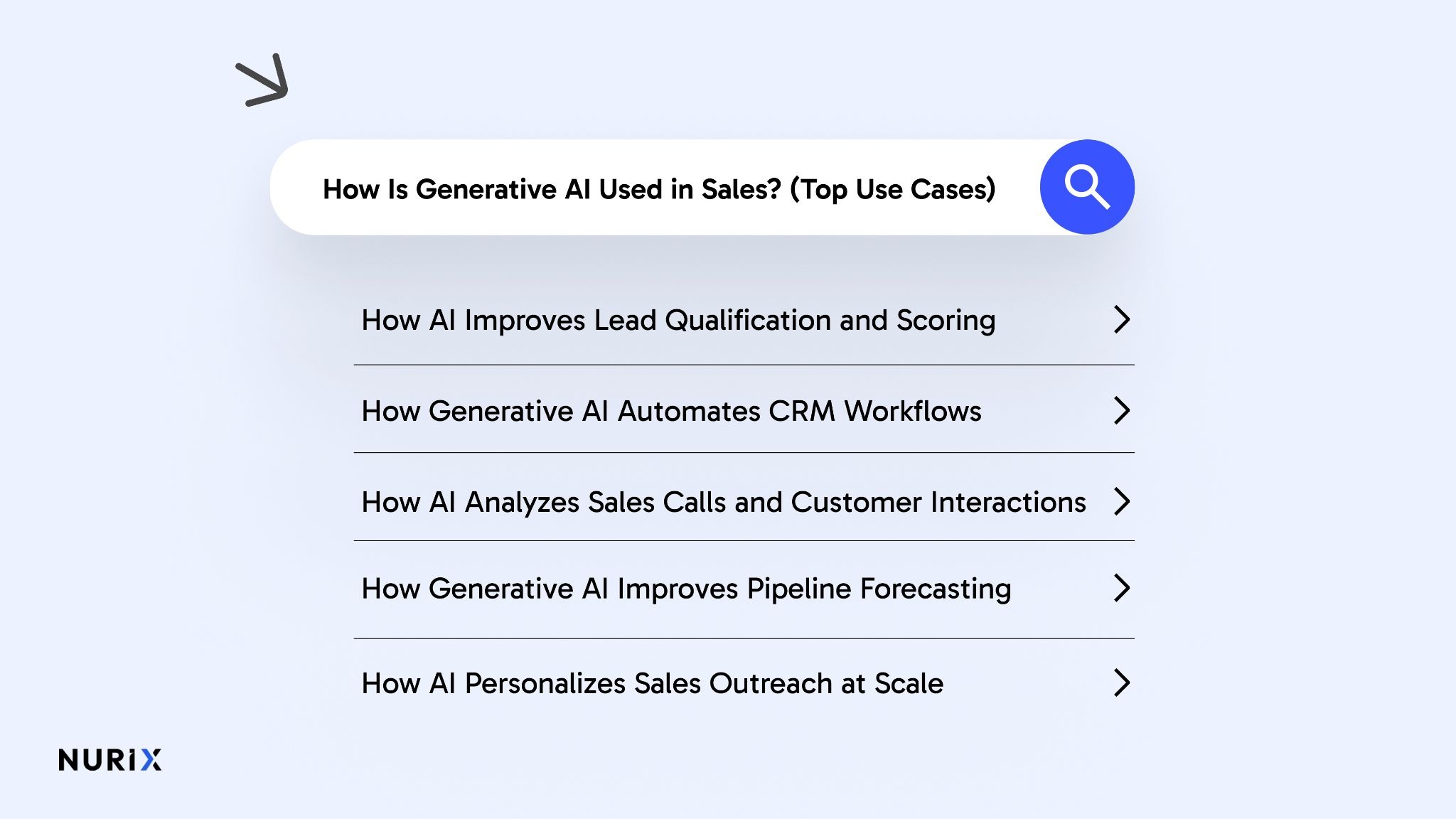
Generative AI is being applied across core sales workflows where speed, accuracy, and timing directly impact revenue outcomes. Instead of isolated automation, it is embedded into CRM systems and sales processes to improve decision-making and execution at scale.
These use cases show how AI supports sales teams across the entire pipeline, from identifying the right leads to closing deals more efficiently.
1. How AI Improves Lead Qualification and Scoring
Sales teams often struggle to identify which leads are worth pursuing. Manual scoring methods rely on limited data, delayed updates, and static criteria that fail to reflect real-time buyer intent.
Generative AI analyzes:
- behavioral signals such as website activity and email engagement
- CRM data including past interactions and deal history
- engagement patterns across multiple touchpoints
According to Gartner, by 2027, 95% of seller research workflows will begin with AI, highlighting how critical AI-driven research and qualification are becoming in modern sales processes.
This shift enables sales teams to move faster, reduce manual research time, and engage prospects with better context from the first interaction.
2. How Generative AI Automates CRM Workflows
CRM systems are central to sales operations, but they often become bottlenecks due to manual updates and inconsistent data entry.
Generative AI automates:
- data entry and enrichment from emails, calls, and forms
- meeting summaries with key insights and action items
- follow-up reminders triggered by deal stage or inactivity
This ensures that CRM data remains accurate, up-to-date, and usable for decision-making without increasing workload for sales teams. It also reduces data gaps that impact forecasting and reporting.
3. How AI Analyzes Sales Calls and Customer Interactions
Sales calls contain critical signals about customer intent, objections, and readiness to buy. However, most of this information is lost or underutilized.
Generative AI can:
- transcribe and summarize calls in real time
- identify objections, competitor mentions, and sentiment
- highlight key decision signals and next steps
This enables managers to coach teams more effectively and helps sales reps respond with better context. It also improves deal progression by ensuring no critical insight is missed during interactions.
4.How Generative AI Improves Pipeline Forecasting
Forecasting often depends on incomplete or outdated CRM data, leading to inaccurate revenue projections.
Generative AI improves accuracy by:
- analyzing historical deal patterns and win/loss trends
- identifying pipeline risks such as stalled deals
- predicting deal outcomes based on engagement signals
This allows leaders to make more informed decisions and adjust strategies proactively.
5. How AI Personalizes Sales Outreach at Scale
Personalization is critical for engagement but difficult to execute consistently across large prospect lists.
Generative AI generates:
- personalized emails based on customer context and past interactions
- customized proposals aligned with buyer needs and industry
- context-aware messaging that adapts to deal stage
This ensures that every interaction is relevant without requiring manual effort. It also improves response rates by aligning communication with customer intent.
While sales sees the most immediate impact, marketing teams are also using generative AI to improve execution across campaigns.
You may find this useful: What Is Voice AI for Sales? Use Cases + Tools [2026]
How Is Generative AI Used in Marketing? (Key Applications)
Generative AI is helping marketing teams move from static campaign execution to real-time, data-driven engagement. Instead of working with delayed insights and manual processes, teams can now adapt messaging, content, and campaigns based on live customer signals.
These applications show how generative AI improves marketing execution across content, personalization, and performance optimization.
1. How AI Generates Marketing Content at Scale
Marketing teams produce large volumes of content across channels, often under tight timelines and resource constraints.
Generative AI helps by:
- drafting blogs, emails, landing pages, and ad copy based on campaign goals
- adapting content for different audience segments, industries, and funnel stages
- maintaining brand consistency by aligning outputs with predefined guidelines
This reduces production cycles and ensures content can be generated and deployed faster without compromising quality.
2. How Generative AI Personalizes Customer Journeys
Customer journeys are no longer linear, with users interacting across multiple touchpoints before making decisions.
Generative AI enables:
- dynamic recommendations based on user behavior and preferences
- behavior-based messaging across email, web, and paid channels
- real-time engagement triggers based on actions like clicks or inactivity
This ensures that messaging stays relevant throughout the customer journey, improving engagement and conversion rates.
3. How AI Optimizes Campaign Performance in Real Time
Traditional campaign optimization relies on delayed reporting, which limits the ability to respond quickly.
Generative AI continuously:
- tests variations in headlines, creatives, and CTAs
- analyzes performance across channels and audience segments
- adjusts campaigns automatically based on engagement signals
This leads to improved ROI without requiring constant manual intervention.
4. How AI Improves Marketing Analytics and Insights
Data analysis in marketing is often fragmented across tools, making it difficult to extract actionable insights.
Generative AI:
- synthesizes data from multiple sources such as CRM, analytics tools, and campaign platforms
- identifies trends, patterns, and performance gaps
- generates insights in natural language for faster decision-making
This allows teams to move from reactive reporting to proactive strategy adjustments based on real-time insights.
These use cases become more effective when generative AI is embedded into end-to-end workflows rather than used as standalone tools.
How Does Generative AI Work in Sales and Marketing Workflows?
In enterprise environments, generative AI is embedded into workflows rather than used in isolation.
A typical workflow might look like:
- Lead enters system through website or campaign
- AI qualifies and scores the lead
- CRM is updated automatically
- Personalized outreach is triggered
- Meeting is scheduled based on availability
This creates a continuous loop where data flows across systems without manual intervention.
The key enabler here is orchestration. AI agents coordinate tasks across tools like CRM, marketing platforms, and communication systems to ensure seamless execution.
Once workflows are clear, the next step is understanding how to implement generative AI effectively.
How to Implement Generative AI in Sales and Marketing (Step-by-Step)
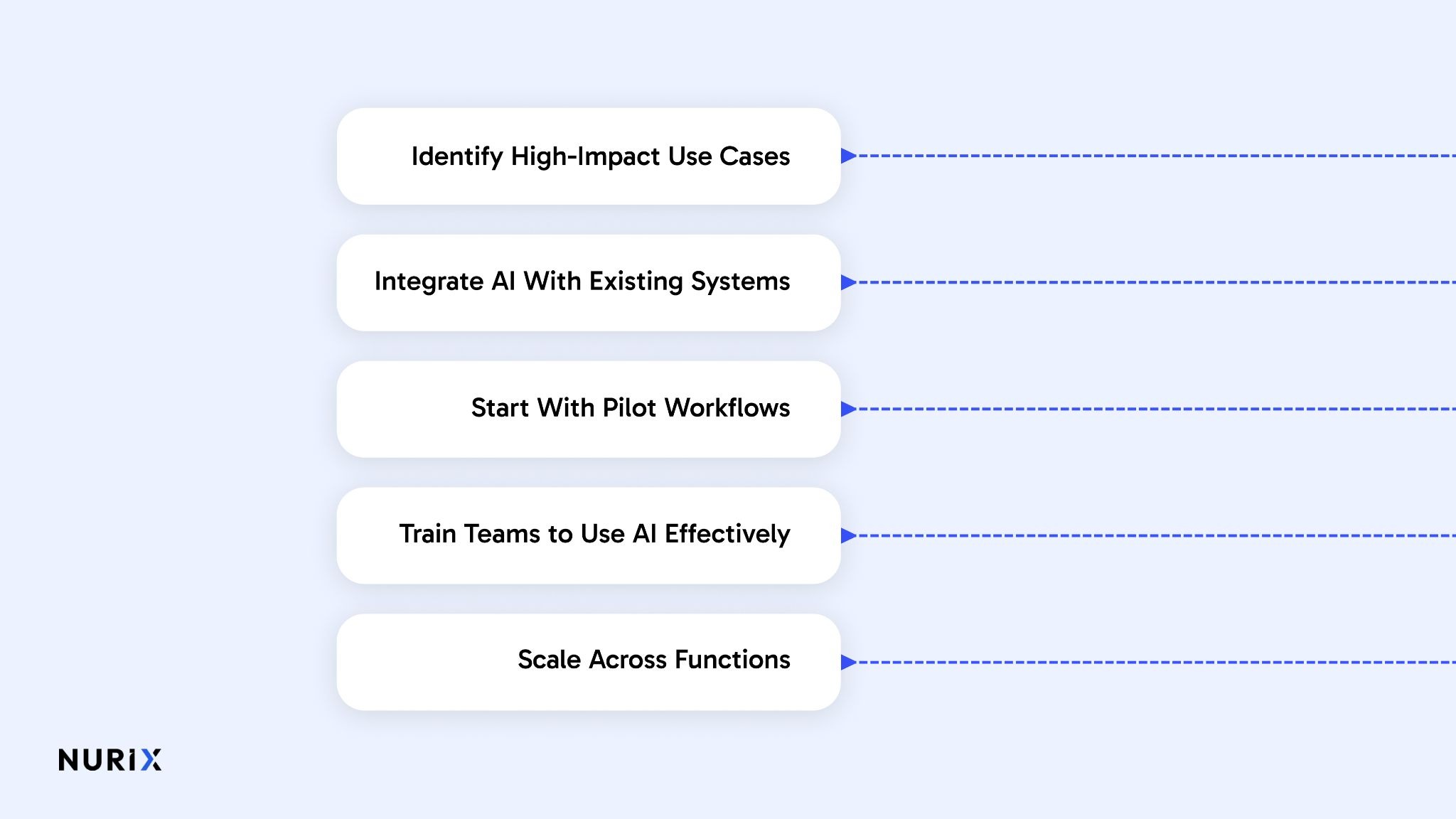
Implementing generative AI requires more than tool adoption. It involves identifying the right workflows, integrating with existing systems, and scaling based on measurable outcomes.
Step 1: Identify High-Impact Use Cases
Start with workflows that directly affect revenue or efficiency.
Focus on areas such as:
- lead qualification and scoring
- outbound and follow-up workflows
- content generation for campaigns
- RFP or proposal drafting
These use cases typically have high volume and clear inefficiencies, making them easier to automate and measure impact.
Step 2: Integrate AI With Existing Systems
Generative AI must work within your current stack to deliver value.
Ensure integration with:
- CRM systems (for customer data and pipeline visibility)
- marketing platforms (for campaigns and engagement data)
- communication tools (email, chat, call systems)
This prevents data silos and allows AI to operate on real-time, unified data.
Platforms like NuPlay by Nurix AI, an enterprise-grade voice and chat AI platform that automates sales, support, and workflow execution, help unify these integrations across systems.
This allows AI agents to execute tasks across CRM, communication tools, and workflows without manual handoffs.
Step 3: Start With Pilot Workflows
Avoid scaling too early. Begin with controlled implementations.
- test one or two workflows (e.g., lead qualification or email automation)
- measure performance improvements (response time, conversion rates)
- identify gaps in data quality or process alignment
This helps validate effectiveness before expanding across teams.
Step 4: Train Teams to Use AI Effectively
Adoption depends on how well teams understand and trust AI outputs.
- define where AI assists vs where human judgment is required
- train teams on interpreting AI-generated insights and recommendations
- establish clear usage guidelines to ensure consistency
This ensures AI supports decision-making rather than creating confusion.
Step 5: Scale Across Functions
Once pilot workflows deliver results, expand gradually.
- extend AI use cases across sales, marketing, and operations
- standardize workflows to maintain consistency
- monitor performance continuously and refine based on data
Scaling should be driven by proven impact, not assumptions.
While implementation delivers clear efficiency gains, it is equally important to address risks such as data privacy, accuracy, and adoption challenges.
Looking for AI workflow automation options? Start here: 7 Best Turing Alternatives for AI Workflow Automation and Managed Delivery
What Are the Challenges of Using Generative AI in Sales and Marketing?
Enterprise adoption of generative AI introduces operational and governance challenges that can impact accuracy, compliance, and scalability if not addressed early.
Common challenges include:
- Data privacy and compliance risks: Handling customer data across systems raises concerns around Personally Identifiable Information (PII), regulatory compliance (GDPR, CCPA), and secure data access.
- Accuracy and reliability of outputs: AI-generated responses can be incomplete or misleading if not grounded in verified data sources, especially in customer-facing interactions.
- Integration with existing systems: Connecting AI with CRM, marketing platforms, and internal tools often requires alignment of data structures, APIs, and workflows.
- Inconsistent adoption across teams: Sales and marketing teams may hesitate to rely on AI due to lack of trust, unclear usage guidelines, or disruption to existing processes.
To mitigate these risks, organizations need:
- Defined governance frameworks: Establish clear policies for data usage, model behavior, and access control.
- Human oversight in critical workflows: Ensure AI outputs are reviewed in high-impact areas such as customer communication and deal decisions.
- Continuous monitoring and performance tracking: Track accuracy, response quality, and workflow outcomes to identify gaps and improve reliability over time.
These controls ensure that generative AI operates within defined boundaries while delivering consistent and measurable outcomes.
This is where enterprise platforms play a key role in enabling secure, integrated, and scalable AI adoption.
How NuPlay by Nurix AI Automates Sales and Marketing Workflows With AI Agents?

NuPlay by Nurix AI is an enterprise-grade voice and chat AI platform that helps organizations automate sales, support, and internal workflows at scale. It enables businesses to deploy AI agents that can understand context, interact with customers, and complete multi-step tasks across systems.
The platform is built to integrate with existing enterprise tools while maintaining security, compliance, and control.
NuPlay by Nurix AI helps organizations by:
- Automating lead qualification and routing: AI agents capture intent, qualify prospects, and push high-value leads directly into CRM systems for faster follow-up.
- Streamlining customer interactions across channels: Voice and chat agents handle inquiries, follow-ups, and support requests, reducing response times and improving engagement.
- Orchestrating workflows across systems: Connects CRM, marketing tools, and internal systems so tasks like outreach, scheduling, and updates happen without manual intervention.
- Maintaining brand voice consistency (NuRep): Ensures all AI-generated interactions align with company messaging and tone across sales and marketing channels.
- Providing real-time insights and monitoring (NuPulse): Tracks performance metrics such as response time, resolution rates, and engagement quality to improve workflows continuously.
- Supporting secure and compliant AI adoption: Includes features like PII redaction, access controls, and audit logs to meet enterprise security and regulatory requirements.
NuPlay by Nurix AI enables teams to move from disconnected tools to unified, automated workflows that execute tasks end-to-end. This helps improve response times, operational efficiency, and consistency across customer interactions.
Wrapping Up
Generative AI helps sales and marketing teams automate lead qualification, personalize outreach, and optimize campaigns. By embedding AI into workflows, teams can reduce manual effort and respond faster. This improves conversion rates, shortens sales cycles, and strengthens execution.
NuPlay by Nurix AI is an enterprise-grade voice and chat AI platform that deploys AI agents across sales, support, and workflows. It connects CRM, communication tools, and systems to automate execution end-to-end. With orchestration and real-time insights, it enables scalable and secure AI adoption.
Contact us to reduce manual effort and improve conversion outcomes across your sales and marketing workflows with NuPlay by Nurix AI.
Start by identifying high-impact workflows such as lead qualification or campaign execution. Then assess data readiness and integration with existing systems like CRM. A structured rollout with pilot use cases ensures measurable outcomes before scaling.
ROI is measured through metrics like conversion rates, response time, campaign performance, and cost per acquisition. Teams also track efficiency gains from reduced manual work. The focus is on operational impact rather than just output volume.
Generative AI depends on structured and unstructured data such as CRM records, customer interactions, and campaign performance data. High-quality, well-integrated data improves personalization and accuracy. Poor data quality can limit results significantly.
Generative AI creates a shared layer of insights across both teams, improving alignment on lead quality and customer intent. It enables coordinated workflows instead of siloed execution. This reduces friction and improves overall pipeline efficiency.
Organizations should assess data security, integration capabilities, and whether the solution can execute workflows end-to-end. It is also important to understand how the AI handles accuracy and compliance. Strong governance and flexibility are key selection criteria.
Don’t miss what’s next in AI.
Subscribe for product updates, experiments, & success stories from the Nurix team.